· retrotech · 7 min read
The Great Search Engine Wars: Comparing Lycos with Google and Bing
Lycos was once a dot‑com superstar - this essay compares its early strategies with Google and Bing and argues what Lycos should have done to survive and thrive.
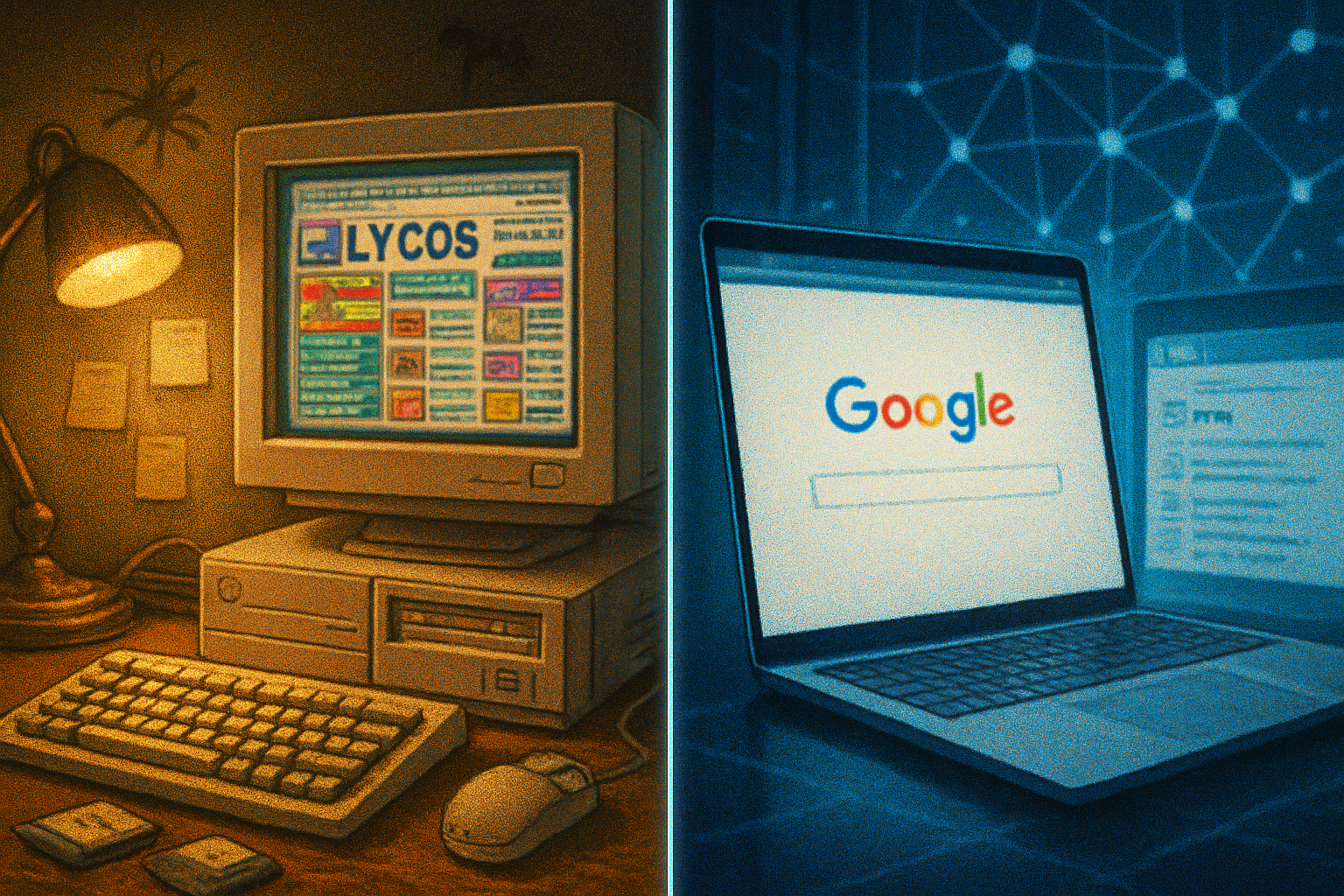
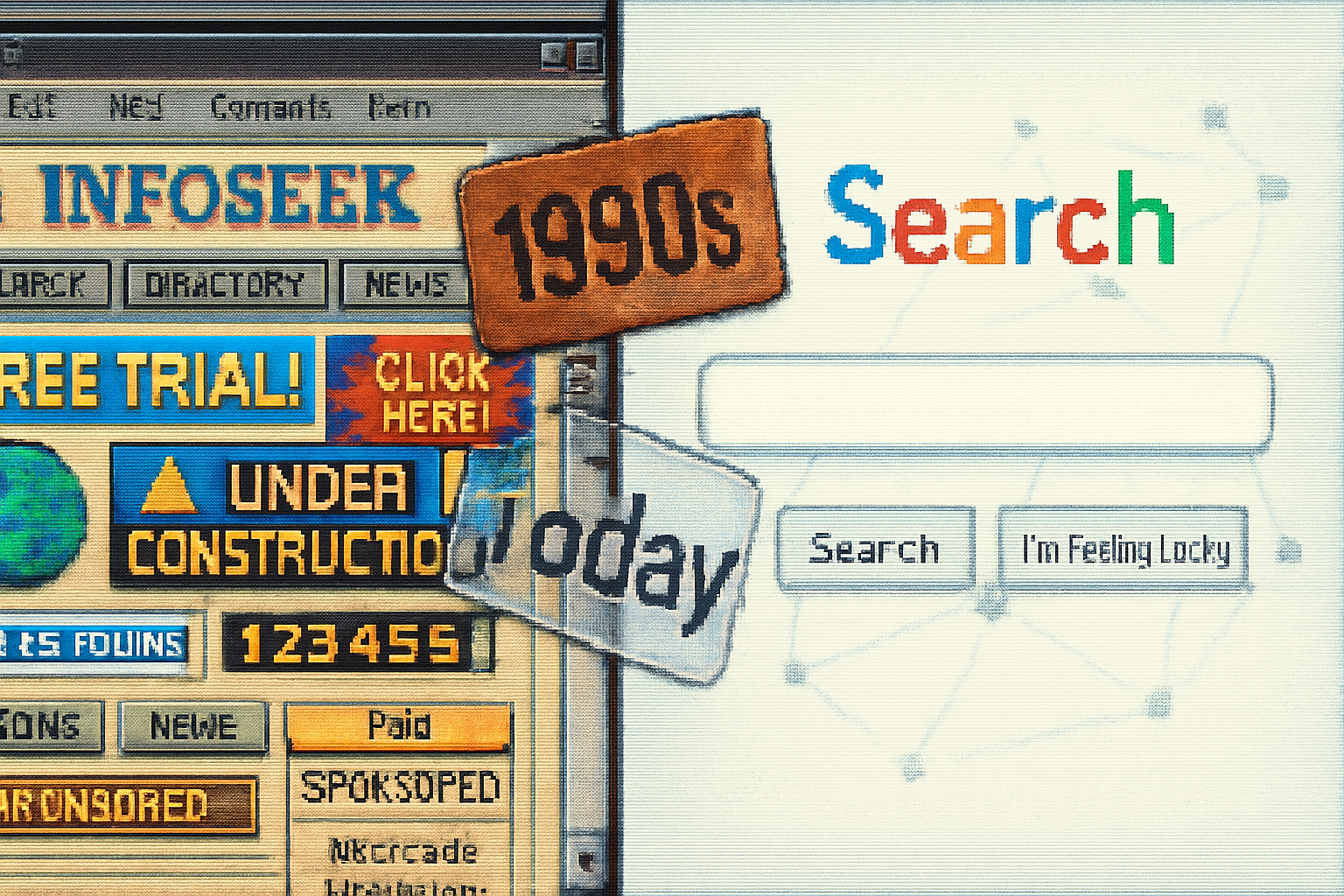
It is 1999. You sit down in front of a beige CRT, the modem hums, and Lycos loads with the confidence of a company that owns the internet-at least in spirit. The page is a noisy carnival: directories, email, GIFs, growing content channels, and a portal that promises to be everything to everyone.
That carnival didn’t collapse because the web suddenly became boring. It collapsed because the web learned to be useful in a way Lycos didn’t prioritize. The lesson is blunt: in the battle for attention, breadth without depth becomes an attractive nuisance.
The setup: Lycos as dot‑com wunderkind
Lycos began at Carnegie Mellon in 1994 as a research project by Michael Mauldin and quickly morphed into one of the earliest commercial search engines source: Lycos - Wikipedia. By the late 1990s Lycos was everywhere: branded portals, hosting, email, avatars, and glowing stock charts. In 2000, during the intoxicating bubble, Lycos was bought by Terra Networks for a headline number - a sign that the company had become an asset to be traded rather than a technology to be nurtured.
Lycos’s public persona was not wrong for 1998. In an era when the web was a fragmented tangle of pages, being the hub - a human-friendly front door with lots of services - felt like being indispensable.
What Lycos did well
- Rapid product diversification - Lycos built services users could stick with - email, chat, entertainment portals. That felt sticky.
- Brand and marketing - Lycos was a household name for a brief, shining season. It put itself in front of consumers.
- Global ambition - The Terra acquisition was an attempt to assemble international scale quickly.
These were sensible bets for a company playing the attention game in the late 90s. But sensible isn’t the same as strategic.
The mistake: playing portal, not search
Lycos’s fatal tilt was its decision to be everything - a portal king rather than a search engine scientist. The company invested in surface-level user engagement and content, but it did not systematically invest in the core engineering problem that ultimately defines search: relevance.
Compare that to Google’s origin story: Sergey Brin and Larry Page focused obsessively on ranking quality, inventing PageRank and publishing rigorous results source: “The Anatomy of a Large‑Scale Hypertextual Web Search Engine”. The outcome was a product that did one thing extraordinarily well: return the pages you actually wanted.
Bing, later, was Google’s foil - built by Microsoft with a different calculus: integrate search into an existing ecosystem (Windows, Office, enterprise deals), invest in vertical search experiences, and lean into advertising and partnerships source: Bing - Wikipedia.
Lycos chased breadth at the expense of depth. That looks clever when pageviews grow. It looks foolish when advertisers and users pay a premium for intent and quality.
The technological and business gaps (short list)
- Algorithmic rigor - Google made ranking a research problem and iterated with A/B experiments. Lycos did not develop an equivalent, defensible ranking moat.
- Scalable infrastructure - Google’s investments in data centers and indexing pipelines created latency advantages. Lycos lacked comparable scale.
- Monetization model - Google’s AdWords tied relevance to advertising revenue (auction + relevance). Portals relied more on display ads and partnerships, which are volatile.
- Ecosystem lock‑in - Microsoft and Google built platforms (search + OS + apps). Lycos remained a web property.
How Google and Bing exploited different competitive dimensions
- Google - Single‑minded product focus, empirical engineering, and a revolutionary ad model (text auctions tied to quality). The homepage’s minimalist UX was almost a manifesto: get out of the way of the search.
- Bing (Microsoft) - Leverage corporate distribution and deep pockets. Focus on curated verticals (travel, shopping) and integrate with Windows & Office to capture queries where enterprise and consumer intent overlap.
Both played to their strengths. Google took the research route and commoditized relevance. Microsoft played systems and distribution.
What Lycos could have done differently - a playbook
Lycos’s decline is not a morality play about bad people; it’s a strategic cautionary tale about choices. Here’s a concrete list of moves they could have taken - not magic, just sensible priority shifts.
- Double down on the search stack
- Commit to research - fund and publish search research. Turn the engineering team into a center of excellence for ranking and indexing.
- Build a better index - invest in crawling, freshness, and link‑analysis. This is slow and expensive, but it creates durable advantages.
Why it matters: the long tail of search queries rewards technical superiority. Google won that war because of superior relevance and scale.
- Make simplicity a product mission
- Abandon the portal homepage for a simple search-first UX. Make every product funnel back to search as the primary surface.
Why it matters: when you compete with a product that is ruthlessly useful, superficial engagement features look like candy wrappers.
- Reimagine monetization around intent
- Build an auction-based ad platform tied to relevance and click‑through quality (think AdWords). Focus on advertiser ROI, not gross impressions.
- Use the portal assets to seed inventory, but monetize programmatically.
Why it matters: display dollars evaporate in downturns. An intent-based ad model converts search relevance into predictable revenue.
- Keep independence or execute disciplined M&A
- If you sell, pick a buyer that will preserve R&D autonomy and commit capital to infrastructure.
- If you stay independent, pursue targeted acquisitions for algorithmic talent and infrastructure, not vanity content.
Why it matters: Terra’s acquisition prioritized scale and content synergy, not a long-term technical roadmap.
- Build distribution partnerships - but own the user experience
- Integrate search into email, browser toolbars, ISPs, and device manufacturers the way Google and Microsoft did, but ensure the user experience and result quality remain the brand’s responsibility.
Why it matters: distribution buys user growth cheaply. But if distribution dilutes product quality, it’s wasted.
- Invest early in mobile and personalization
- Anticipate search becoming mobile and contextual. Build lightweight SDKs, local indexing, and user-personalization that respects privacy.
Why it matters: the center of gravity moved off the desktop. Companies that delayed mobile lost the interface war.
- Culture - make engineering the heartbeat
- Reward empirical validation. Run experiments. Publish performance metrics internally. Hire PhDs if needed.
Why it matters: culture shapes priorities. A marketing-led culture will optimize for surface metrics; an engineering-led culture will optimize for user value.
Concrete counterfactuals - what if Lycos had done X?
- If Lycos had built a PageRank competitor and rolled out an auction-based ad product in 1999, it could have preserved its brand while creating a sustainable revenue stream. That requires patient capital and engineering discipline.
- If Lycos had kept autonomy and invested the Terra proceeds into R&D and data centers instead of forked content initiatives, it might not have become a trading asset.
- If Lycos had partnered with Microsoft for distribution while maintaining its own search stack, it could have gained scale without sacrificing control.
These aren’t fairy-tale scenarios. They are strategic tradeoffs that require conviction.
The human element: attention, incentives, and vanity
The dot‑com era rewarded visibility and narrative. Boards loved scale and brand. Executives loved the idea of being a portal king. But incentives matter: when executive bonuses are tied to short‑term metrics (pageviews, eyeballs), companies emulate carnival barkers, not scientists.
Lycos’s story is not just a corporate failure - it’s a story about incentives misaligned with the technical realities of search. That is why the giants who won paid attention to the hard stuff: relevance, latency, and monetization aligned to user intent.
Closing: the right war to fight
If there is a moral, it is simple and slightly cruel: in platform markets, being liked is not the same as being useful. Lycos was liked. Google was useful. Bing learned the art of integration.
There’s still room for contrarian bets in search - privacy-first engines, vertical specialists, and regional champions - but the lesson remains. If you want to own the door to the internet, you must be obsessive about the hinge.
References
- Lycos - Wikipedia: https://en.wikipedia.org/wiki/Lycos
- Bing (search engine) - Wikipedia: https://en.wikipedia.org/wiki/Bing_(search_engine)
- Brin, S., & Page, L. “The Anatomy of a Large-Scale Hypertextual Web Search Engine”: https://infolab.stanford.edu/~backrub/google.html