· retrogaming · 7 min read
Sega Saturn: The Forgotten War Against the PlayStation - A Retrospective
A look back at the brutal, bungled duel between Sega's Saturn and Sony's PlayStation - the marketing misfires, hardware choices, killer games, and the stubborn fandom that turned a lost war into a lasting legend.
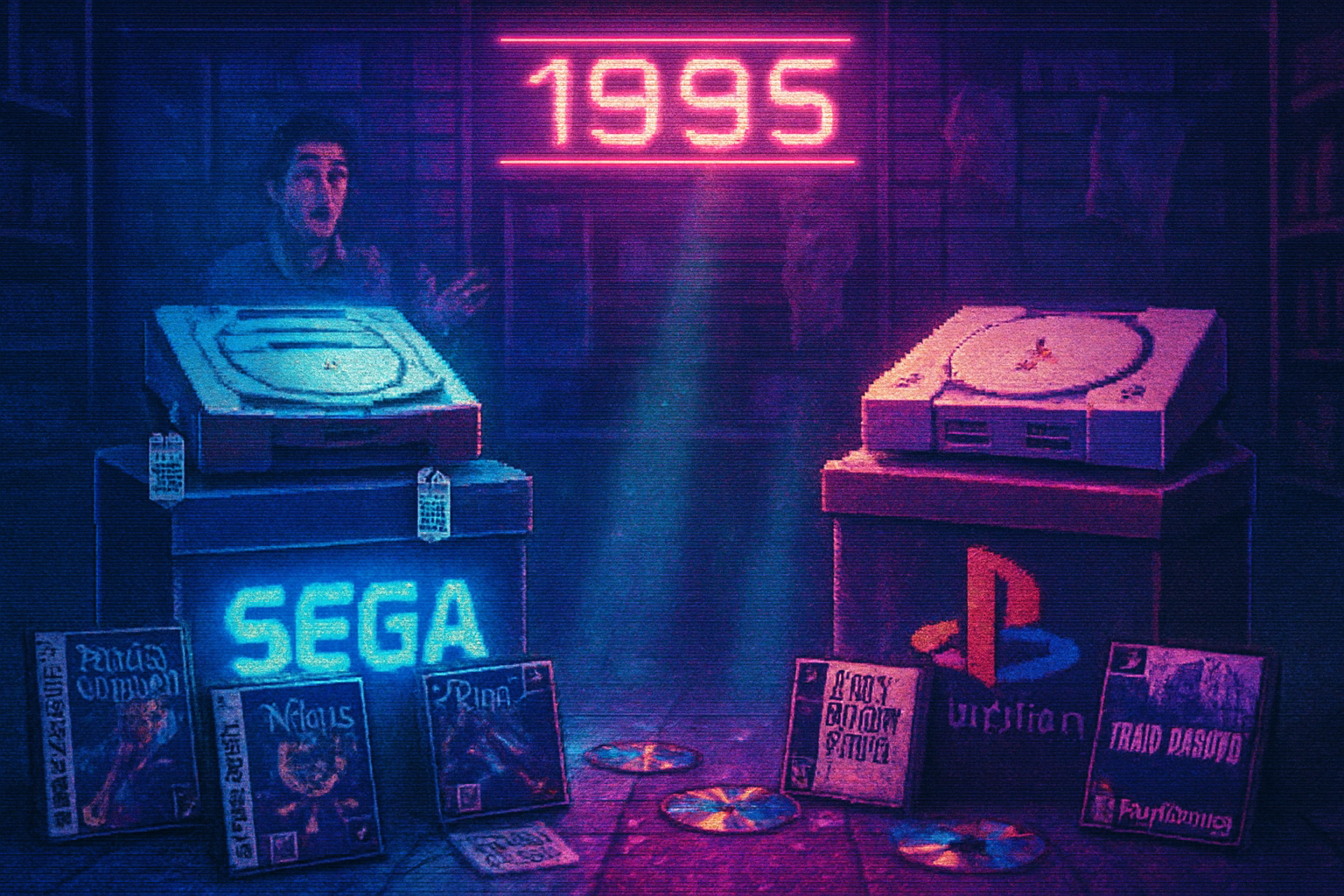
The morning the Saturn jumped the gun
May 11, 1995: a small, furious edict from Sega of America rippled through the industry. Without warning, the Sega Saturn was in stores across the U.S. The message was gloriously simple: we’re live. The execution was not.
That surprise launch - announced at the Consumer Electronics Show with the subtlety of a hand grenade - perfectly captures the Saturn story: bold, aggressive, and spectacularly self-sabotaging. It is also the best way to understand why the PlayStation, a latecomer to household gaming, ended up as the 90s’ dominant force.
Two claims to the 90s throne
The mid-90s were a civil war fought with plastics, polygons, and pop-culture hype. On one flank was Sega - bruised but hungry after the Genesis/Sega Genesis (Mega Drive) successes and convinced that a rapid strike could keep momentum. On the other: Sony, a newcomer with impeccable timing, impeccable budget, and a message that never dulled: 3D games for a new generation.
Sega pitched the Saturn as the logical next step for arcade-quality experiences at home. The company leaned on its arcade pedigree and a hardware architecture designed to accelerate certain forms of polygon and sprite rendering. Sony pitched an accessible platform friendly to developers and consumers, with a single-minded focus on making 3D games feel cinematic.
The hardware: designed like a Swiss watch, built like an enigma
If a console is an instrument, the Saturn was a Stradivarius in a dumpster.
Technically, the Saturn packed some very capable components: dual Hitachi SH-2 CPUs, multiple video processors, and a CD-ROM drive. The problem was the choreography - it was hard to make every part play nicely. Two CPUs meant parallelism, but parallel programming is fiendishly difficult, especially for external developers who had spent years coding for single-CPU platforms.
Contrast that with the PlayStation. Sony’s architecture was not the fastest raw silicon in every synthetic benchmark, but it was coherent and predictable. Developers could learn it quickly, optimize for it, and most importantly, port arcade and PC code into PlayStation games without a circus of workarounds.
For analysis of the hardware differences and their impact on development, see the Sega Saturn and PlayStation pages on Wikipedia: Sega Saturn, PlayStation (console).
The launch: triumph turned Trojan horse
A surprise release might sound like audacity, and for marketing theater it was. But it was a strategic gift to nobody but short-term sales figures. Why?
- Third-party publishers were not ready. Many had the Saturn dev kits but not finished games. Suddenly asking retailers to stock a console with no broad launch lineup alienated the very partners Sega needed.
- Retailers were blindsided and burned. Some major chains refused to reorder. Relationships in retail matters as much as margin math.
- The message confused consumers - if a console appears overnight, what does that say about planning, software libraries, or longevity?
Sony, meanwhile, paced itself. They timed the PlayStation rollout and used strong third-party relationships, courting developers and ensuring a steady-and growing-library.
Polygon and IGN have retrospectives that touch on these launch-day dynamics and their longer-term consequences (for example, see Polygon’s look at Sega’s hardware history and IGN’s Saturn retrospective).
Games: where the war was really fought
Hardware matters. Software decides history.
Sega’s first-party output on Saturn is uneven but remarkable. In Japan, the Saturn was a fine console: it had treasures like Virtua Fighter, Panzer Dragoon, Sonic R (Japan-only), NiGHTS into Dreams, and excellent 2D ports like Radiant Silvergun and arcade conversions that demonstrated exquisite sprite handling.
But in the West, it wasn’t enough. The PlayStation amassed blockbusters - Final Fantasy VII, Resident Evil, Tomb Raider, Metal Gear Solid - each a cultural pivot that drew players toward Sony’s ecosystem. Final Fantasy VII in particular deserves scrutiny: when a major westernizing shift of a flagship franchise lands on a competitor’s machine, it signals more than a hit game. It transfers fans.
A few points:
- Saturn’s strength in 2D and certain arcade-style experiences didn’t map to the 3D console zeitgeist. Many Western players wanted sprawling 3D worlds.
- Third-party support favored PlayStation. If your console can say “we have X, Y, Z big-release RPGs/third-person action,” it becomes a snowball.
- Exclusive gems like Panzer Dragoon earned critical love but lacked the mass-market gravitational pull of Sony’s lineup.
Read more on landmark releases and how they shifted momentum on game-industry retrospectives (IGN, Kotaku, Polygon).
Marketing and management: the slow-motion train wreck
Sega’s problem was not a single misstep; it was a chain of them, linked by poor global coordination and leadership that often seemed to sabotage its own prospects.
- Regional fragmentation - Sega of Japan, Sega of America, and Sega Europe often fought each other. Different visions, different priorities.
- Messaging was muddled - Saturn was promoted as an arcade champion, then as a 2D powerhouse, then as a general 32-bit console - consumers got whiplash.
- Conflicted priorities - Sega was running multiple projects (32X, Sega CD, Saturn) in rapid succession. Consumers and developers tired of buying into temporary stopgaps.
A classic example of corporate myopia: the 32X and Sega CD were add-ons that diluted Sega’s brand and developer focus. By the time Saturn arrived, many partners were exhausted. For timelines and corporate decisions, see detailed histories such as Polygon’s Sega pieces and numerous industry interviews.
Fan loyalty: stubborn, passionate, and ultimately futile? Not quite.
Sega fans were not merely consumers - they were evangelists. For a time, that zeal kept Saturn communities alive. In Japan the console had life and love; in the West, a small but fierce hardcore remained.
Fan loyalty did three things:
- It preserved Sega’s cultural capital. Generations still celebrate Saturn exclusives, which shows the adhesive quality of good games.
- It created myths - ‘the Saturn would have won if only…’ These counterfactuals are comforting and sometimes instructive, but usually ignore structural realities.
- It shaped the afterlife - Saturn’s cult classics attracted retrospective praise and influenced developers long after the console’s commercial life ended.
In short: loyalty didn’t save the Saturn’s bottom line but it granted the console immortality among enthusiasts.
The aftermath: what Saturn’s loss taught the industry
The Saturn’s fall was not a tragic accident. It was a lesson. Here are the headline takeaways, phrased as bluntly as they are useful:
- Developer relations are king. Consoles die when the devs stop caring.
- Simplicity is underrated. A more developer-friendly architecture wins more software, which wins more players.
- Global coordination matters. A divided company cannot execute a global hardware strategy.
- Timing is tactical, not strategic. Surprise launches win headlines, not ecosystems.
- Flagship exclusives move markets. If a platform attracts the tentpole franchises, the rest follow.
Sony learned these lessons and executed accordingly. Sega learned them, too - but often too late. When Sega launched the Dreamcast, many of the mistakes were corrected, but the brand damage and financial toll were already severe.
What ifs, counterfactuals, and the useful fiction of history
People love alternate histories. Suppose Sega had delayed the US Saturn launch to coordinate games and retail, or if the Saturn had a simpler single-CPU design - would the result be different? Possibly. But consoles are ecosystems. Hardware, software, retail, marketing, and developer goodwill must align simultaneously. One fixed lever rarely rewrites the outcome.
The PlayStation’s victory was not inevitable. It was the product of better engineering choices for third-party developers, smarter alliances, disciplined marketing, and a steady supply of must-have games.
Final verdict: forgotten war, enduring lessons
The Saturn vs. PlayStation contest is one of those rare industry moments that reads like Shakespeare with a joystick: hubris, ambition, and a catalogue of avoidable errors. Sega’s Saturn was brilliant in parts, achingly flawed in strategy. It had genuine masterpieces and toxic mismanagement in the same package.
If there’s a moral here, it’s modest but harsh: audacity without discipline is just a noisy defeat. The PlayStation asked the industry for trust and repaid it with clarity and consistency. Sega asked for faith and returned it with surprises, splinters, and scattered brilliance.
That is why, three decades later, Saturn survives not as a commercial victor but as a beloved outsider - the console that could have been something else, and which taught everyone else how not to repeat its mistakes.
Quick reading and references
- Sega Saturn - Wikipedia: https://en.wikipedia.org/wiki/Sega_Saturn
- PlayStation (console) - Wikipedia: https://en.wikipedia.org/wiki/PlayStation_(console)
- Polygon - retrospective pieces on Sega hardware and history: https://www.polygon.com
- IGN - Saturn retrospectives and hardware analysis: https://www.ign.com
- Kotaku - essays on Saturn’s cult legacy: https://kotaku.com