· retrogaming · 7 min read
Legal Gray Areas: The Controversy Surrounding Sega Saturn Emulators
An in-depth look at the legal, ethical, and cultural stakes of emulating the Sega Saturn: what the law actually allows, why ROM sharing is legally risky, and where preservation and fandom collide with copyright holders.
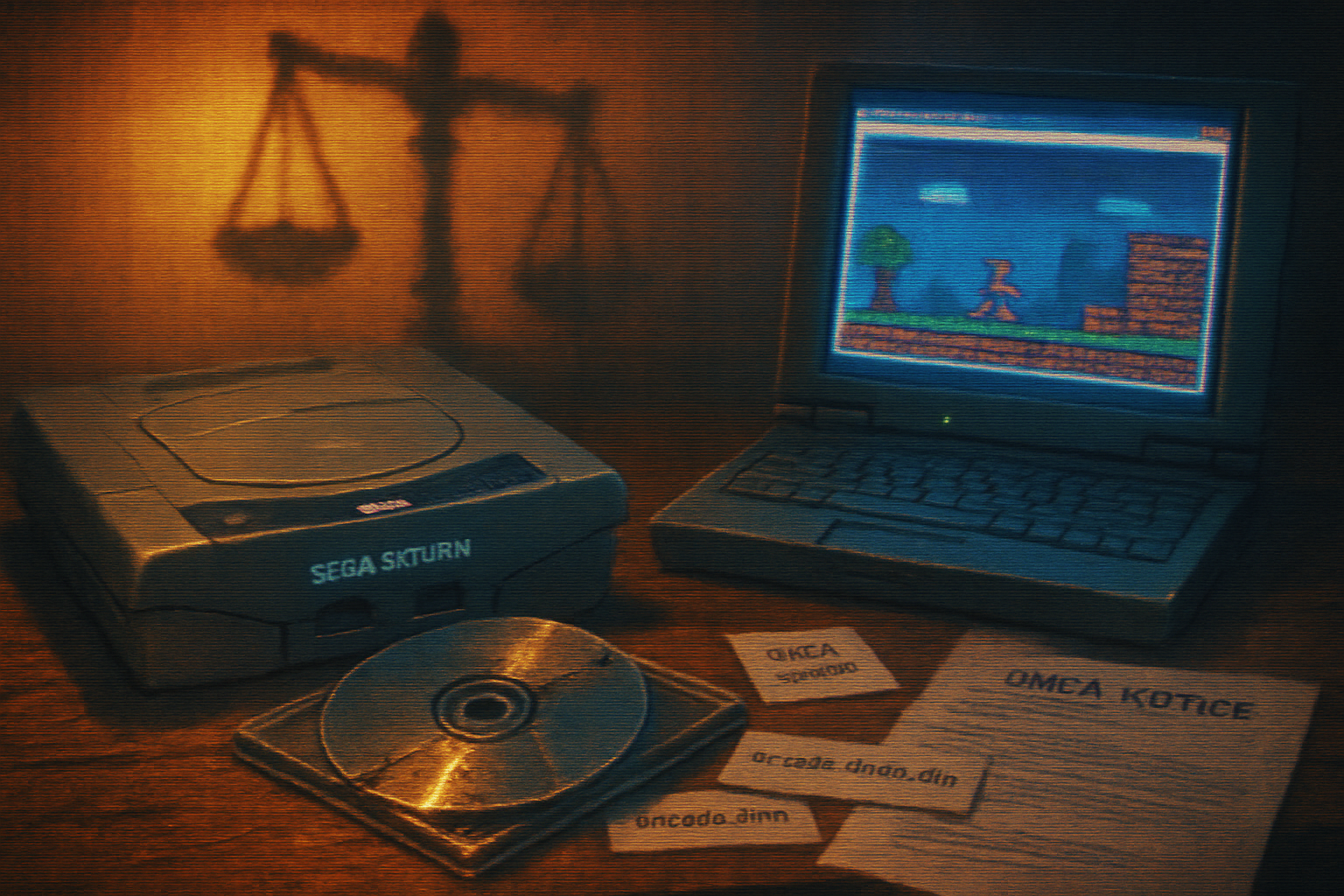
A decade ago I watched a friend in a dimly lit dorm room coax a battered Sega Saturn disc into life on a laptop. He had a grin like someone smuggling fireworks into a chapel. The game ran-imperfectly, but gloriously-and for a few minutes we both forgot why the machine had been abandoned: regional lockouts, obtuse hardware, and a market that moved on. The crackle of nostalgia is powerful. It is also legally combustible.
The argument around console emulation reads like an old family feud: equal parts technical wizardry, righteous preservation impulses, and petty thieving. The Sega Saturn sits at the center of this quarrel as a particularly eccentric relative-powerful, peculiar, and stubborn to emulate. That difficulty, oddly, is part of the legal and ethical mess.
Why the Saturn matters (and why emulation is awkward)
The Saturn is not just another 90s console. Its dual-CPU architecture and unusual chipset made it excellent at certain arcade-style 2D effects and maddening for console ports and developers. The same quirks that gave it a cult of fans made accurate emulation a technical headache for years.
The practical consequence: many Saturn games never made the jump to modern re-releases, leaving preservation hungry and enthusiasts to the only available option-emulation. But wanting to play something doesn’t grant legal immunity.
The legal fundamentals: emulators versus ROMs
Short answer: emulators themselves are generally legal; distributing copyrighted ROMs and proprietary BIOS files typically is not.
Why? Because an emulator is essentially software that mimics hardware behavior. If written by clean-room reverse engineering (i.e., recreating behavior without copying the original copyrighted code), an emulator is lawful. Several court cases have carved out room for reverse engineering when compatibility is the purpose:
Sega v. Accolade (9th Cir. 1992) allowed reverse engineering for compatibility under narrow circumstances (the courts found that copying certain code to discover functional requirements could be fair use). See the decision: https://casetext.com/case/sega-ent-v-accolade-2
Connectix v. Sony (9th Cir. 2000) involved a PlayStation emulator; the court found that intermediate copying to create a compatible product could be fair use. See the ruling: https://casetext.com/case/connectix-corp-v-sony-computer-entertainment-americ
These precedents mean that creating an emulator via independent engineering is not per se infringing. The law distinguishes between copying copyrighted code and re-implementing functionality.
But emulation frequently needs two other things to work in practice: BIOS firmware and game ROM images. Those are typically copyrighted works owned by publishers.
Distributing or downloading a console’s BIOS image (the vendor-supplied firmware) is normally illegal without permission. The BIOS is not a functional specification; it’s copyrighted code.
Distributing game ROMs-exact copies of game discs or cartridges-is copyright infringement absent consent from the rights holder. “Abandonware” is not a legal category; a game being old or out-of-print does not make copying lawful.
Finally, the Digital Millennium Copyright Act (DMCA) adds another layer: anti-circumvention rules. Circumventing technological protection measures to copy or play games can violate 17 U.S.C. §1201, even if your ultimate purpose is noncommercial preservation. The Library of Congress issues periodic exemptions to 1201 (e.g., certain preservation-related exemptions for libraries and archives), but those are narrow and specific. See the DMCA info and exemptions: https://www.copyright.gov/1201/
Landmark cases and their practical limits
Court victories for reverse engineering are often hailed as blanket permissions. They are not.
The Accolade and Connectix cases protected the act of reverse engineering for compatibility in certain circumstances, but neither license or lawful distribution of firmware/ROMs was endorsed.
Bleem and other emulator companies faced expensive litigation and harassment tactics from big publishers. Courts sometimes trimmed back overreaching claims-but litigation costs can shutter a project faster than a legal precedent can save it.
Legal wins are conditional, costly, and dependent on facts. They do not transform ROM sites into legal marketplaces.
The ethical terrain: preservation, access, and the rights-holder
Legality is one axis. Ethics is another.
Preservationists - Many historians, librarians, and archivists argue that emulation is essential to preserve video games as cultural artifacts. Some games only exist on fragile media or in formats incompatible with modern hardware. Preservation is a public good.
Consumers and fans - For many, emulation is about access-playing childhood favorites, exploring obscure titles, and keeping cultural memory alive. When publishers abandon back catalogs, fans feel morally justified in stepping in.
Rights-holders and creators - Companies and creators deserve compensation and control. A legal market for re-releases funds creators and can finance proper preservation.
Clashing moral claims create a classic tension: cultural heritage versus property rights. Both positions have merit. But noble ends do not legally justify means that violate copyright. And moral clarity is required: sharing pirated ROMs often harms small developers and makes publishers less likely to release official collections.
Practical realities: what people actually do
Many Saturn enthusiasts use emulators like Yabause or Mednafen. Some emulators emulate the BIOS (HLE – high-level emulation) to avoid redistributing firmware; others require you to dump your own BIOS from legally owned hardware.
- Yabause: https://yabause.org/
- Mednafen (multi-system emulator with Saturn support): https://mednafen.github.io/
ROM sites proliferate, supplying BIOS files and game images. These sites operate outside the law. They may disappear under takedown pressure or persist in semi-dark corners of the web.
Museums and archives sometimes rely on legal exemptions to preserve games, but their powers are limited and procedural. See the Library of Congress DMCA exemptions overview: https://www.copyright.gov/1201/
Risks and consequences
Downloading or sharing copyrighted ROMs can expose you to civil suits and, in rare cases, criminal charges. While individual users are seldom targeted, the legal risk exists.
Hosting or organizing ROM distribution invites swift takedowns and legal action. Many ROM sites have been shut down after publisher enforcement.
Even well-intentioned preservation efforts can be stymied by rights-clearance nightmares. Some companies own tangled IP rights across regions and decades.
Ethical, low-risk ways forward
If you care about playing or preserving Saturn games without wilfully stealing, consider these paths:
Buy official re-releases when available. They’re how creators get paid.
Dump and use copies of games and BIOS firmware you legally own. (Dumping may still raise DMCA issues depending on circumvention, so be cautious.)
Support and donate to archives, museums, and libraries that pursue lawful preservation and licensing.
Advocate for clearer legal frameworks for preservation - broader exemptions in the DMCA or targeted rights that allow libraries and museums to preserve software.
Engage creators and publishers. Sometimes a respectful campaign for a re-release succeeds where piracy only alienates.
Use and contribute to open-source documentation, test suites, and clean-room specifications that help emulator authors avoid copying copyrighted code.
The future: compromise or clampdown?
Publishers hold the legal cards. But public pressure, nostalgia markets, and preservation arguments have pushed many companies to release retro collections and re-releases on modern platforms. The booming retro market is proof that reconciliation is possible: games can be both preserved and monetized.
Yet rights fragmentation, complex licensing (who owns what after decades of studio changes), and the inherent fragility of digital media mean many titles-especially obscure Saturn exclusives-remain in limbo.
The sensible compromise recognizes three things:
- Emulators built by independent engineers are not inherently criminal.
- Exact copies of copyrighted firmware and games remain protected works; distributing them without permission is typically infringement.
- Preservation and access are legitimate public goods that deserve legal recognition and funding.
If you want to play a Saturn gem tonight, understand the law and the ethics: emulation isn’t a get-out-of-jail-free card. If you care about the medium as a cultural artifact, lobby, donate, and buy where possible. If you’re an emulator developer, document your methods and stay on the right side of clean-room practices. If you run a museum or archive-use the DMCA exemption process and partner with rights-holders when feasible.
Final thought
Video games are strange children of code and culture. They rot if ignored and ossify if owned and hoarded. Emulation is a scalpel: it can preserve, dissect, and resurrect. But like any tool, its moral worth depends on the hand that wields it.
References
- Sega Enterprises Ltd. v. Accolade, Inc. (9th Cir. 1992): https://casetext.com/case/sega-ent-v-accolade-2
- Connectix Corp. v. Sony Computer Entertainment America, Inc. (9th Cir. 2000): https://casetext.com/case/connectix-corp-v-sony-computer-entertainment-americ
- U.S. Copyright Office - DMCA and 1201 exemptions: https://www.copyright.gov/1201/
- Electronic Frontier Foundation - Emulation: https://www.eff.org/issues/emulation
- Yabause emulator: https://yabause.org/
- Mednafen emulator: https://mednafen.github.io/