· retrotech · 6 min read
Old School Amazon: A Celebration of Forgotten Features and Services
Amazon today is a tech behemoth. But there was a time when it felt experimental, scrappy and oddly human. This piece celebrates the forgotten, quaint, and sometimes brilliant features Amazon launched-and quietly retired-during its formative years.
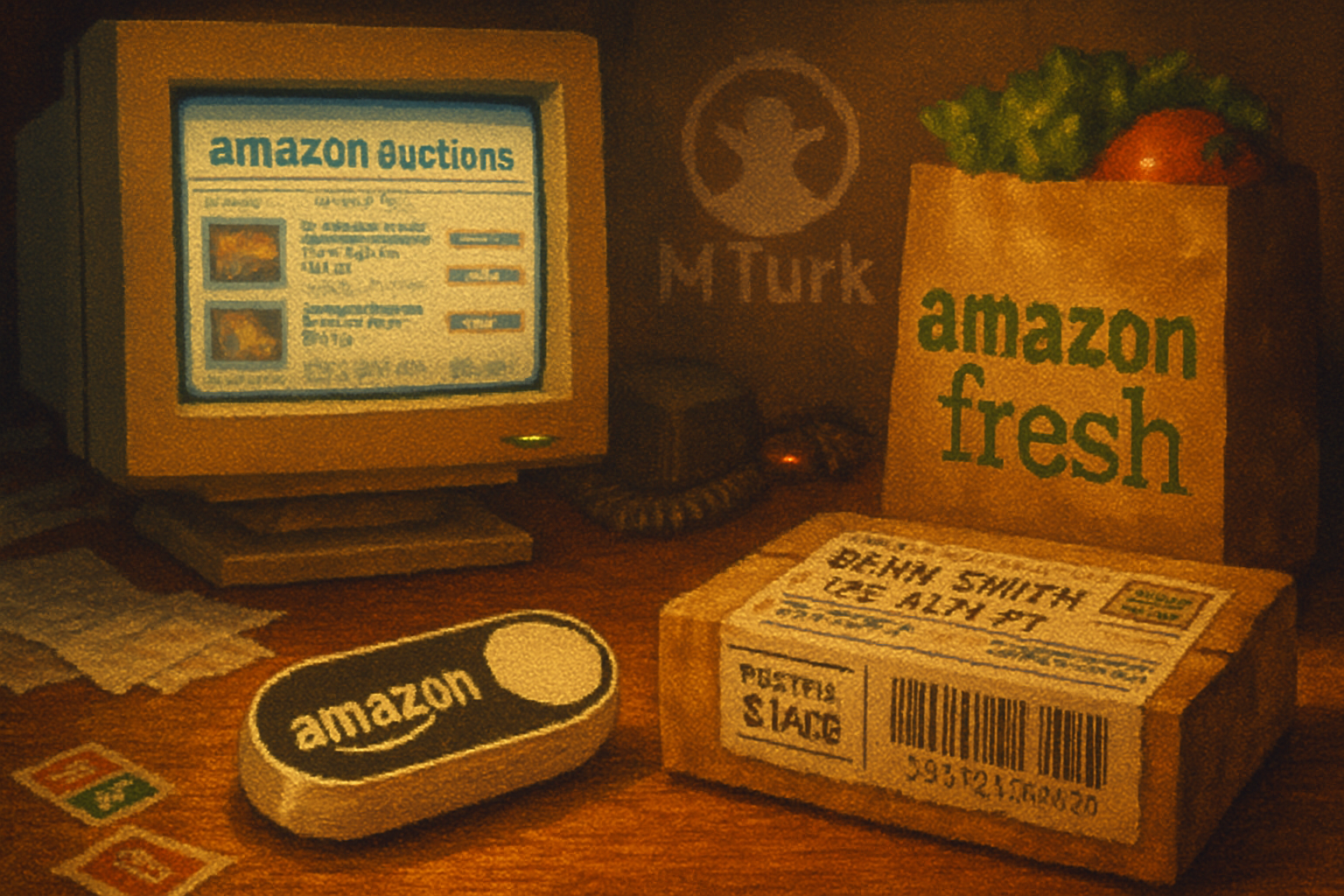
I remember the thrill of typing a bid into a tiny auction box on Amazon and feeling like I was participating in something civic rather than algorithmic. It was 1999, my dial‑up croaked in the background, and for a moment Amazon felt like a flea market with better search. That little adrenaline rush has been deliberately engineered out of the modern shopping experience, but the echoes remain in a scattering of forgotten products and services.
These are not just relics. They are cultural fossils. Each one tells you how Amazon experimented with community, commerce, and trust-sometimes brilliantly, sometimes disastrously. The company’s present might be inexorable, its supply chains opaque, but its past is messy, human, and oddly consoling.
The early experiments that smelled faintly of possibility
Below are the pieces people forget first: micro‑products that captured a moment when Amazon was still learning what to be.
Amazon Auctions - the bazaar phase
For a few chaotic years Amazon hosted auctions alongside its fixed‑price listings. It was a public experiment in peer‑to‑peer commerce in the shadow of eBay. The auctions weren’t pretty; they were mercantile and unpredictable. But they felt alive.
- Why it mattered - Brought buyer‑to‑seller dynamics to Amazon’s largely retail architecture and let passionate communities trade rare items.
- Why it faded - eBay won the auction niche, and Amazon folded these lessons into its more controlled third‑party marketplace model.
(See the historical record: https://en.wikipedia.org/wiki/Amazon_Auctions)
zShops and the proto‑Marketplace hustle
Before Marketplace became the dominant back‑channel merchants used to run entire zShops-mini storefronts under Amazon’s roof. The experience was clunkier than today’s dashboards, but you could feel a small seller’s personality through handwritten descriptions and odd product bundles.
- Why it mattered - It was an early proof that Amazon could be a platform for other sellers rather than only a retailer.
- Why it faded - Marketplace’s more integrated approach made separate storefronts redundant.
(Background: https://en.wikipedia.org/wiki/Amazon_Marketplace)
A9 and the search that almost saved journalism
A9 was Amazon’s research garage: search experiments, maps, and product discovery tools. At times it felt like an earnest attempt to fix the web’s discoverability problem rather than just optimize for conversion.
- Why it mattered - Showed Amazon’s early interest in owning search and the data that lets you recommend things.
- Why it faded - Search can be boring to fund and brutal to monetize-so A9’s more fantastical projects were whittled down.
(Company page: https://en.wikipedia.org/wiki/A9.com)
Amazon Mechanical Turk - the invisible workforce
Launched in the mid‑2000s, Mechanical Turk (MTurk) let humans perform micro‑tasks that computers couldn’t-label an image, transcribe audio. It introduced many to the strange intimacy of remote piecework.
- Why it mattered - Early, mainstream visibility for microtasking and human‑in‑the‑loop AI work.
- Why it faded from public conversation - It never became consumer‑facing; it was infrastructure for researchers and startups.
(Details: https://en.wikipedia.org/wiki/Amazon_Mechanical_Turk)
Amazon Fresh - the grocery bet that was both humble and terrifying
Amazon Fresh began as a grocery delivery pilot in its hometown of Seattle and later ballooned into a national strategy that would reshape food retail.
- Why it mattered - It flagged Amazon’s willingness to enter the low‑margin, logistics‑heavy worlds most retailers feared.
- Why it feels forgotten - Today Fresh is folded into a thousand initiatives (Prime Now, Whole Foods integration) so the original service feels like a prototype that grew legs.
(Read more: https://en.wikipedia.org/wiki/Amazon_Fresh)
Dash buttons - the gadget with a single, undignified purpose
Press a physical button, and a specific product is ordered. Brilliant in its simplicity. Absurd in its existence.
- Why it mattered - A study in reducing friction to the point of farce; it showed how convenience can be productized.
- Why it faded - Security concerns, redundancy with voice and apps, and a general social realization that humans pressing buttons to reorder detergent is slightly dystopian.
(Historical note: https://en.wikipedia.org/wiki/Amazon_Dash)
Amazon Local and the daily‑deal hangover
Amazon tried its hand at local deals during the flash‑sales craze. The initiative rode the Groupon wave and then sank when the market matured.
- Why it mattered - Amazon had to test local commerce in earnest-coupons and local inventory presented different challenges than shipping boxes.
- Why it faded - Local deals are messy; consumers learned to distrust them, and logistics made national scale much more attractive.
(Archive: https://en.wikipedia.org/wiki/Amazon_Local)
Amazon Studios’ open submission experiment
For a few years Amazon let anyone submit scripts and pilot ideas. It was a genuinely radical democratization of TV development-part Kickstarter, part studio.
- Why it mattered - Gave creators a platform outside Hollywood’s closed rooms and legitimized data‑driven creative decisions.
- Why it faded - Creative gatekeeping returned; open submissions were closed as Amazon matured its studio business.
(Overview: https://en.wikipedia.org/wiki/Amazon_Studios)
Amazon Mom (and the motherhood of marketing)
Amazon Mom offered curated discounts-diaper coupons, subscription conveniences-targeting parents in a way that felt oddly domestic and intimate.
- Why it mattered - It showed Amazon tailoring loyalty programs to life stages.
- Why it faded - Brands repackage and rename. Amazon Mom’s ethos lives on in targeted promotions but the original program quietly retreated.
(Reference: https://en.wikipedia.org/wiki/Amazon_Mom)
What connects these vanished features?
There are recurring patterns. A few worth noting:
- Experimentation beats arrogance in early stages. Amazon tried weird things without insisting they all be permanent.
- Community and unpredictability were casualties of scale. The auctioneer‑type thrill doesn’t convert as well as a one‑click checkout.
- Vertical expansion is messy. Groceries, local services, media-Amazon played them all, and the experiments that didn’t fit the logistics model were repurposed or absorbed.
In short: Amazon learned by doing, and then it learned to monetize the winners ruthlessly. That’s an effective strategy. It’s not always warm.
Why this nostalgia matters (beyond “I miss my dash button”)
Nostalgia here is a moral sensor. It tells us what we lost when efficiency and control became priorities:
- Randomness. Auctions and open submissions let serendipity happen. Algorithms tend to make things predictable.
- Personality. Small sellers and zShops carried tone and voice; marketplaces optimize for neutral reliability.
- Visibility. Some services foregrounded the humans behind tasks-MTurk, small storefronts-while modern systems hide them behind labels and fulfillment centers.
We should care because the values embedded in product design shape culture. Convenience is political. Ease is persuasive. The choices a company makes about what to keep say something about the society it wants to build.
A practical guide for recreating the old‑school feel today
If you miss the Amazon of odd corners and human sellers, try these small antidotes:
- Seek out independent sellers on niche marketplaces (Discogs for records, Etsy for craft, eBay for auctions).
- Buy used and read the seller notes. The personality is often in the condition description.
- Support local grocers or co‑ops for the grocery intimacy you can’t get from Fresh.
- Explore MTurk alternatives for microtasking or contribute to open data labeling projects if you want to get involved in human‑in‑the‑loop work.
Final thought: the archive as a lesson
Amazon’s forgotten features are not quaint curiosities. They’re evidence that big tech grows by pruning experimentation into product lines. Some experiments became global infrastructure; others were quietly euthanized.
If you’re nostalgic, that’s normal. But nostalgia can calcify into defeatism if it stops with longing. Use these memories as a map: find local markets, champion creators, and vote with your wallet for the messier, human parts of commerce. They’re small things, but they matter-because they keep the economy from feeling like a single, humming machine.
References
- Amazon Auctions: https://en.wikipedia.org/wiki/Amazon_Auctions
- Amazon Marketplace: https://en.wikipedia.org/wiki/Amazon_Marketplace
- A9.com: https://en.wikipedia.org/wiki/A9.com
- Amazon Mechanical Turk: https://en.wikipedia.org/wiki/Amazon_Mechanical_Turk
- Amazon Fresh: https://en.wikipedia.org/wiki/Amazon_Fresh
- Amazon Dash: https://en.wikipedia.org/wiki/Amazon_Dash
- Amazon Local: https://en.wikipedia.org/wiki/Amazon_Local
- Amazon Studios: https://en.wikipedia.org/wiki/Amazon_Studios
- Amazon Mom: https://en.wikipedia.org/wiki/Amazon_Mom
- BookSurge (on‑demand print service): https://en.wikipedia.org/wiki/BookSurge