· retrotech · 6 min read
Nostalgia or Greed? The Controversial Side of Collecting Retro Items on eBay
Late-night auctions, dusty cartridges, and suddenly your childhood becomes an investment vehicle. This piece looks at how genuine longing for the past and naked profit-seeking meet (and sometimes collide) on marketplaces like eBay - and what that means for collectors, communities, and culture.
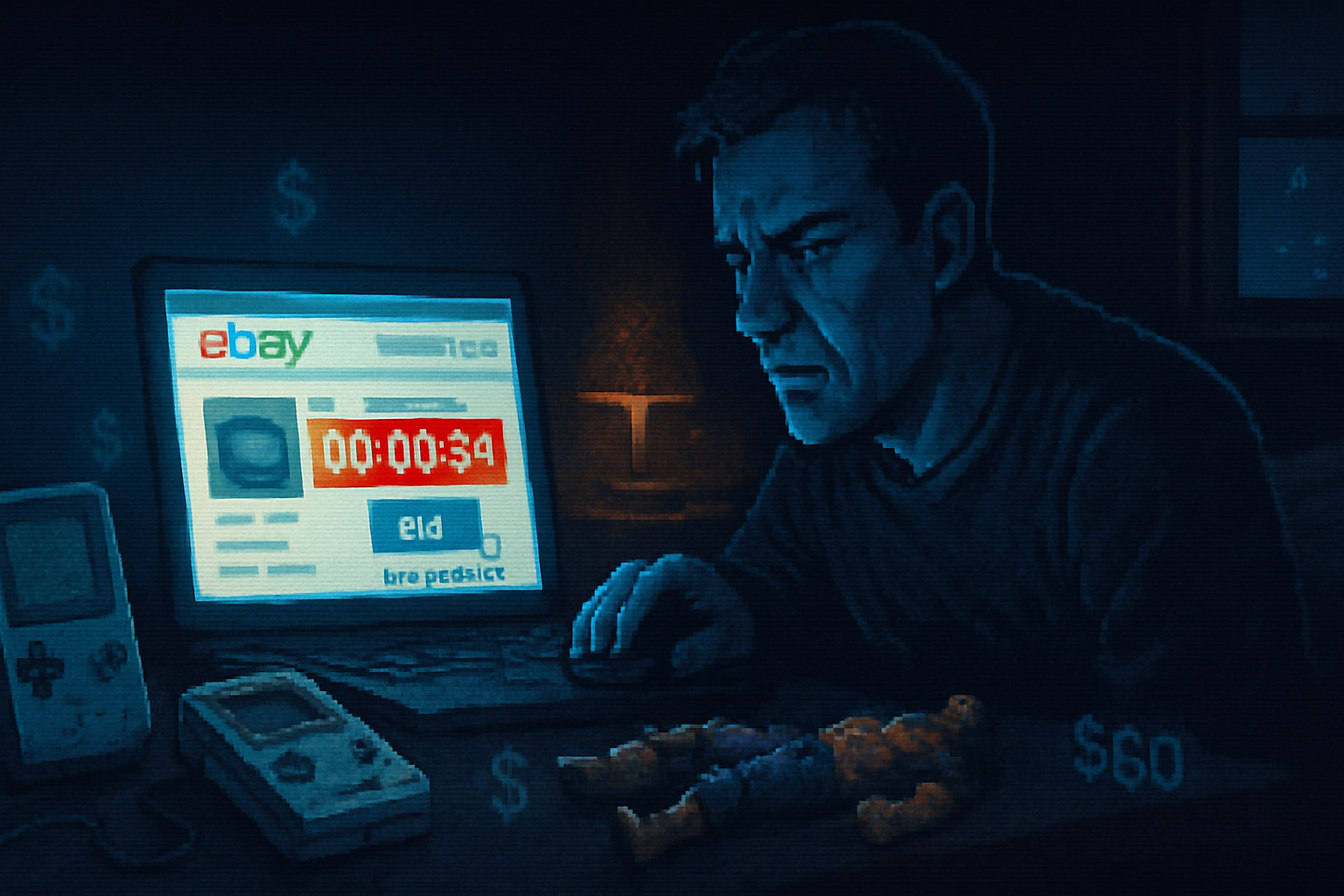
It was 2:17 a.m. and a single image habitually pasted to the corner of my laptop - a scuffed grey cartridge with a hand-scrawled sticky note - kept refreshing. The auction clock blinked. The price rose. By the time the timer hit zero, a stranger in a different time zone had spent more than they probably spent on their first car to win a sealed game from 1987.
That moment captures a strange modern ritual: nostalgia, rendered into an adrenaline sport. We don’t just remember childhood objects anymore. We bid on them, monetize them, vault them into glass cases, and sometimes, quietly, rip the heart out of the communities that loved them.
Nostalgia is not a soft feeling. It’s currency.
Nostalgia is a warm, twinged lens. It smooths over the rough edges of memory and makes certain past objects feel like anchors of identity. People talk about “comfort” or “heritage,” but an easier metaphor is oxygen: you don’t notice it until it’s missing; once it’s scarce, you fight for it.
Psychologically, this is plain math. The emotions that make us long for retro tech - smell, touch, the look of a pixelated logo - also make us poor appraisers. Behavioral science terms the biases: the endowment effect makes owned or formerly owned things feel more valuable; loss aversion makes us pay to avoid missing out; and auction dynamics themselves are a studied driver of irrational escalation (auction theory).
When auctions become gladiator pits
Auctions turn private yearning into public competition. Online marketplaces like eBay add timers, bid increments, and visible rivalry - all the things that stoke what journalists and psychologists call “auction fever.” The same friction that got us to fight for concert tickets or limited sneakers applies to sealed consoles and mint-condition action figures.
The mechanics nudge behavior:
- Visible bids signal social proof - if ten people want it, it must be worth wanting.
- Fixed, short countdowns increase emotional arousal and poor impulse control.
- Anonymous buyers lower the social cost of overbidding.
The result: items trade hands for prices untethered from their utility or historical significance and tethered instead to an intense, time-limited mood.
Where nostalgia ends and predation begins
There is nothing inherently evil about reselling. Sometimes a collector funds a new purchase by selling an old one. But the secondary market can quickly become an industrial system that converts memory into markup.
Common darker practices on marketplaces:
- Flipping - People buy limited runs or thrifted finds and list at huge markups, often hours after acquiring the item.
- Manufactured scarcity - Sellers withhold inventory, drip-feeding listings to sustain high prices.
- Bots and drops - Automated tools snatch items at release and push them to resale platforms.
- Shill bidding and fraud - Coordinated or fake bids that artificially inflate prices (
- Counterfeits and misrepresentation - Fake seals, doctored provenance, or overstated grading.
These tactics turn what could be an affectionate, communal practice into rent-seeking. The community - the kids who loved a console or the hobbyists who traded magazines in schoolyards - slowly lose access as scarcity is weaponized by speculators.
A few historical echoes (and lessons)
Collecting bubbles are not novel. The Beanie Babies rush of the 1990s provides a blunt parable: an ordinary plush toy became a speculative asset until the market collapsed and value evaporated. The emotional power that created the craze was the same force that made it fragile. See the Beanie Babies entry for background: Beanie Babies.
Modern parallels are everywhere: sealed video games that command headlines, early personal computers fetching collector sums at auction, and limited-edition sneakers whose resale indices look more like stock tickers than fan enthusiasm. The winners are rarely the original communities; they are the folks with the capital, the algorithms, and the nerve to flip.
The market’s invisible hands - and the platforms that enable them
Marketplaces are not neutral. Design choices matter. A listing page that highlights recent bids, a countdown clock that auto-extends by a few seconds, a lack of enforced provenance - all these let high-stakes auctions happen at the speed of dopamine.
Platforms also struggle with enforcement. Shill bidding and coordinated fraud appear with periodic reports, and seller feedback can be gamed or faked. See the broader problem of auction distortions in auction theory and the practice of shill bidding above.
When a marketplace makes speculative flipping easy, nostalgia becomes a resource to be extracted rather than shared.
Who pays the real price?
A few groups lose when nostalgia turns speculative:
- Casual fans who wanted one mint copy of a game for their shelf.
- Younger collectors without capital, priced out of cultural artifacts.
- Niche communities and small businesses that curated and preserved these objects for love, not profit.
The ethical question shouldn’t be sentimental. It should be practical: do we want heritage to be preserved and shared, or auctioned into gated display cabinets owned by speculators?
How to collect without becoming part of the problem
If you love retro tech and don’t want to feed the machine, try these guardrails:
- Research provenance. Ask for photos, serial numbers, receipts, and grading documentation.
- Buy from known, reputable sellers or local collector groups where possible.
- Set a hard budget and use automatic bidding tools to avoid emotional overbids.
- Wait. Mania collapses. The lowest-hanging speculative fruit is often overpriced at the peak.
- Support preservation projects and museums rather than feeding scalpers.
- Look beyond sealed scarcity. Functional items that are used and loved have cultural worth even if they’re not graded 10/10.
The moral Inevitable: nostalgia is beautiful and fragile
Nostalgia is a human good. It stitches identity, connects generations, and sometimes helps us find a small, real pleasure in a copy of a long-out-of-production device. It also, when commodified, becomes a lever for extraction. That’s the uncomfortable truth at the heart of every late-night eBay auction: something tender is being priced, and the market doesn’t care whether the bidder is a scholar of the object or a speculator with a spreadsheet.
We can have both sides of this world - healthy markets that reward curation and accessibility that preserves cultural memory. But that requires attention: platform design that curbs predatory tactics, stronger provenance standards, and collectors who remember that owning a relic is not the same thing as owning the culture that gave it meaning.
If you find yourself in a bidding war, ask a simple question before you click: am I buying a memory, or just fueling someone else’s profit margin?
References and further reading