· retrogaming · 6 min read
The Controversial Legacy of Neo Geo Pocket: A Birth of Gaming's Dark Era?
How did SNK's brash claims and premium-minded pricing around the Neo Geo Pocket era reshape handheld gaming? A sardonic retrospective that connects marketing theater, pricing hubris, and lasting industry lessons.
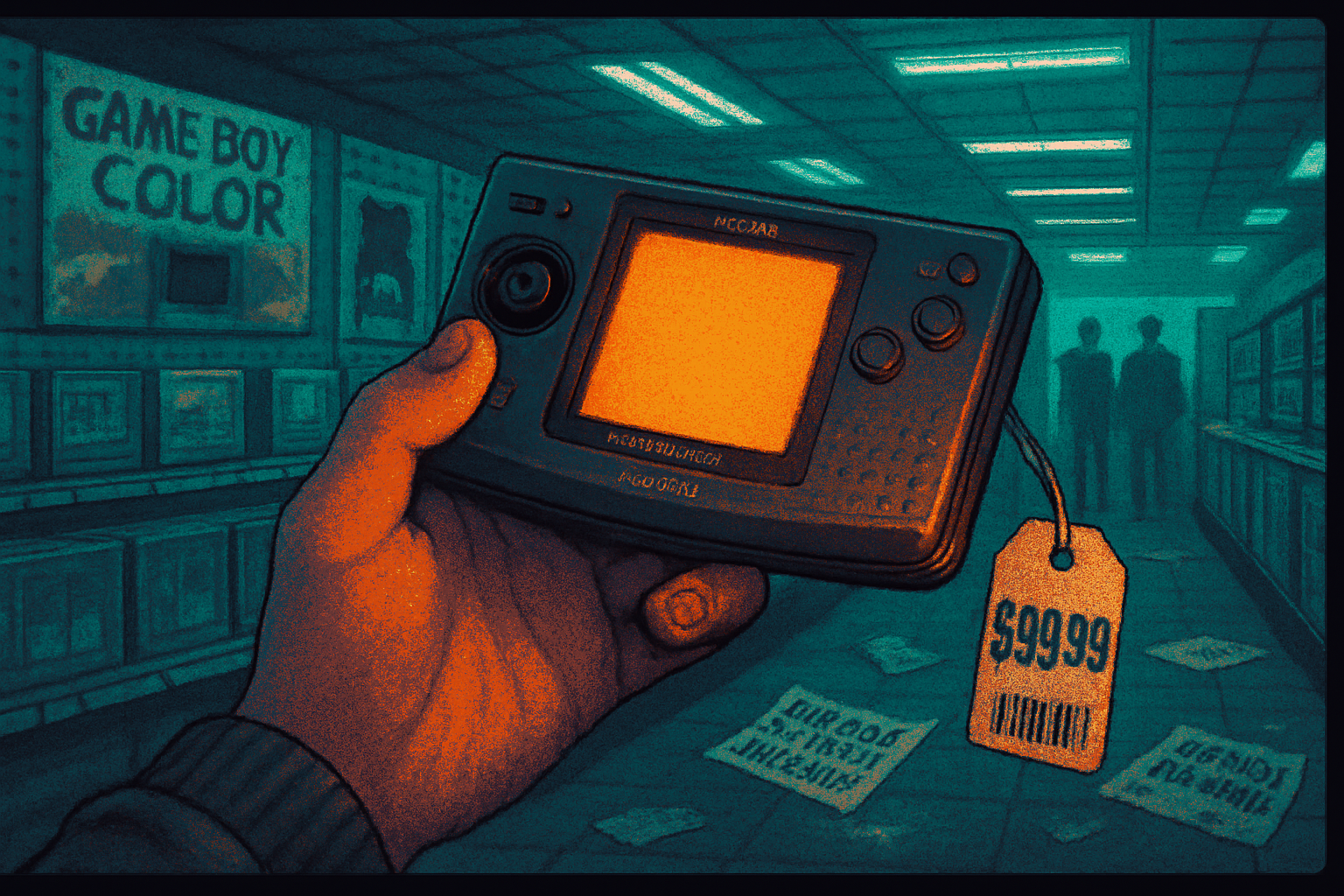
The kid in the corner of the electronics store had a comic-book stare: a new handheld in his hands, eyes wide, dreams already mapped to high scores. A salesperson leaned in, voice dripping with conviction: “This blows Nintendo away.” The device was the Neo Geo Pocket Color. The year was 1999. The claim was audacious. The price tag, if you squinted, felt audacious too.
A short, loud history
SNK-once the pride of arcade cabinets and the company that made the Neo Geo AES into a symbol of ostentatious cartridge wealth-decided to take that swagger handheld. The Neo Geo Pocket (1998) and its color successor (1999) arrived with legitimate virtues: strong fighting-game ports, crisp hardware engineering, and a handful of sharp exclusive titles like SNK vs. Capcom: The Match of the Millennium and Sonic Pocket Adventure.
But they also arrived at the exact wrong cultural moment: a marketplace where Nintendo’s Game Boy line had oxygen in abundance and where consumers cared less for “arcade-accurate” credentials than for battery life, game library, price, and the comforting inertia of a hundred million installed Game Boys.
(Quick context: SNK’s broader corporate identity was shaped by the luxury pricing of the Neo Geo AES home console-its cartridges routinely sold for hundreds of dollars, a precedent that made “premium” a reflex for the company. See the Neo Geo and SNK histories for details.)[https://en.wikipedia.org/wiki/Neo_Geo] [https://en.wikipedia.org/wiki/SNK]
The mendacious claims: marketing vs. reality
SNK’s messaging around the Neo Geo Pocket was proudly expansionist. The company didn’t tiptoe into the handheld market; it announced itself as a challenger. Advertising suggested parity-or superiority-with Nintendo and Sega. That rhetoric did two things at once:
- It raised expectations among gamers who equated SNK with arcade fidelity. People imagined arcade-perfect Street Fighter in their palms.
- It antagonized the incumbent - Nintendo did not need to be reminded that the Game Boy had scale, partnerships, and retail mindshare.
The result was a mismatch between promise and ecosystem. The NGPC could emulate an arcade feel for certain genres, especially fighters, but it could not conjure Nintendo’s third-party breadth, cheap bundling strategies, or the installed base that turns a console into a social object.
Pricing strategy: arrogance or tragic realism?
Here the legacy forks into two narratives.
SNK’s instinct toward premium pricing - The company came from an environment where consumers accepted-if begrudgingly-the idea that “authentic” Neo Geo cartridges had a luxury cost. That instinct colored how SNK approached distribution and the perceived value of its software. Cartridges were fewer and sometimes pricier relative to the Game Boy’s economy.
Market realities punished the premium posture - handhelds are volume devices. The psychology of portable gaming is different from the arcade hall; consumers want cheap, immediate fun. When price substitutions exist (cheaper consoles, cheaper cartridges, cheaper batteries), a high-end positioning requires either a mass of must-have exclusives or a fervent, niche collector base. The NGPC had neither in sufficient measure.
To put it brutally: money is like oxygen-you don’t miss it until it isn’t there. Consumers didn’t breathe premium for a system with a small library and limited retail presence.
For background on how SNK’s premium brand had precedent, see the Neo Geo AES pricing phenomenon.[https://en.wikipedia.org/wiki/Neo_Geo]
The short-term cultural fallout
Here are the immediate effects that felt ugly at the time:
- Consumer confusion - Shoppers uncertain whether to buy into a premium dream or stick with Nintendo’s safe, cheaper bet.
- Retail hesitance - With limited demand, big-box retailers underweighted NGPC shelf space. Less visibility meant fewer sales; fewer sales meant less reason for retailers to stock games.
- Financial strain on SNK - The handheld gambit didn’t stem deeper problems; SNK later faced severe financial distress and corporate upheaval in the early 2000s.[
Those were the visible bruises. But the deeper, slower wounds were cultural and strategic.
How the Neo Geo Pocket shifted industry playbooks
Did the NGPC birth a “dark era”? No-there wasn’t an apocalypse-but it did accelerate several trends and lessons that reshaped handheld strategy.
- The library matters more than horsepower
SNK leaned on arcade-quality gameplay; the market leaned the opposite way. After NGPC, the industry increasingly prioritized rich third-party ecosystems, licensing deals, and captive first-party titles over raw fidelity for portable devices. Nintendo doubled down on exclusives and soft price aggression. The era reaffirmed that consumer handheld adoption hinges on software diversity.
- Pricing hygiene became a priority
Retailers and platform holders learned to treat handheld pricing as a competitive battleground. Bundling, aggressive MSRPs, and tiered SKU strategies became commonplace. Manufacturers realized that premium pricing without a huge installed base is a self-defeating proposition.
- Platform trust and distribution networks matter
The NGPC suffered in part because it lacked Nintendo’s distribution muscle. Afterward, third parties were more cautious about platform bets. The result: consolidation and safer deals for developers-prefer native support for the platform with the audience.
- The rise of niche collectors and long-tail economics
One irony of the NGPC’s failure: it produced a fierce collector culture. Scarcity, exclusive cartridges, and the aura of arcade-accurate ports made the system a fetish object for enthusiasts. That collector economy foreshadowed later business models that tap nostalgia and scarcity-limited runs, collector editions, and expensive reissues.
Concrete examples worth noting
Sonic Pocket Adventure - A genuine surprise-an excellent Sonic game on a non-Sega handheld. It proved the NGPC could attract high-quality content, but one great title does not a platform save.
SNK vs. Capcom - The Match of the Millennium: A marquee fighter that embodied SNK’s arcade strength but could not scale the system’s audience alone.
SNK’s corporate failures - SNK’s broader financial woes around 2000–2001 (bankruptcy and restructuring) show how hardware missteps feed company-wide calamity.[
For more granular reading, the Hardcore Gaming 101 retrospective offers useful, detailed context on the NGPC and its library.[https://hg101.kontek.net/neogeopocket/neogeopocket.htm]
The long view: did the NGPC cause a dark era or teach a lesson?
If the phrase “dark era” conjures industry-wide malice-predatory pricing, crushing monopolies, creative stagnation-then the NGPC was not the founding monster. The true monopolies and dark tendencies of gaming arose from much larger economic and technological forces: platform lock-in, app-store oligopolies, and digital distribution that concentrates power.
What the Neo Geo Pocket did, more accurately, was reveal a brittle logic: you cannot win handheld markets by leaning on prestige alone. The industry learned, sometimes painfully, that:
- Price sensitivity is a structural reality in handhelds.
- A rich software library trumps technical one-upmanship for portable adoption.
- Marketing bravado without distribution muscle is a hollow victory.
Those lessons nudged platform holders toward different strategies: Nintendo’s renewed emphasis on exclusives and price-bundles, Sony’s later approach to handhelds that emphasized multimedia and cross-platform play, and eventually the mobile ecosystem’s relentless focus on low entry costs and mass reach.
Final, not sentimental thoughts
The Neo Geo Pocket’s story is both tragic and instructive. It was a brave, somewhat deluded entree by a company that had mastered a different market. It produced beautiful games, earned a devoted cult, and left a residue in how publishers and platform holders think about price, library, and branding.
It did not, in and of itself, inaugurate a dark era. It was, instead, a cautionary tale: a reminder that bold claims without the scaffolding of price-sensitivity, distribution, and software breadth have the atmosphere of theater but lack the gravity of markets. The NGPC remains a scarlet vignette in gaming history-arrogant, elegant, and quietly influential.