· retrogaming · 7 min read
The Legacy of the Philips CD-i: How a Failed Console Shaped Modern Gaming
The Philips CD-i was a commercial disaster - a confused multimedia appliance that produced some of gaming's most derided moments. Yet its technical ideas and missteps seeded several trends that define modern gaming: CD-based media, FMV/interactive movies, IP licensing lessons, and the convergence of games with multimedia.
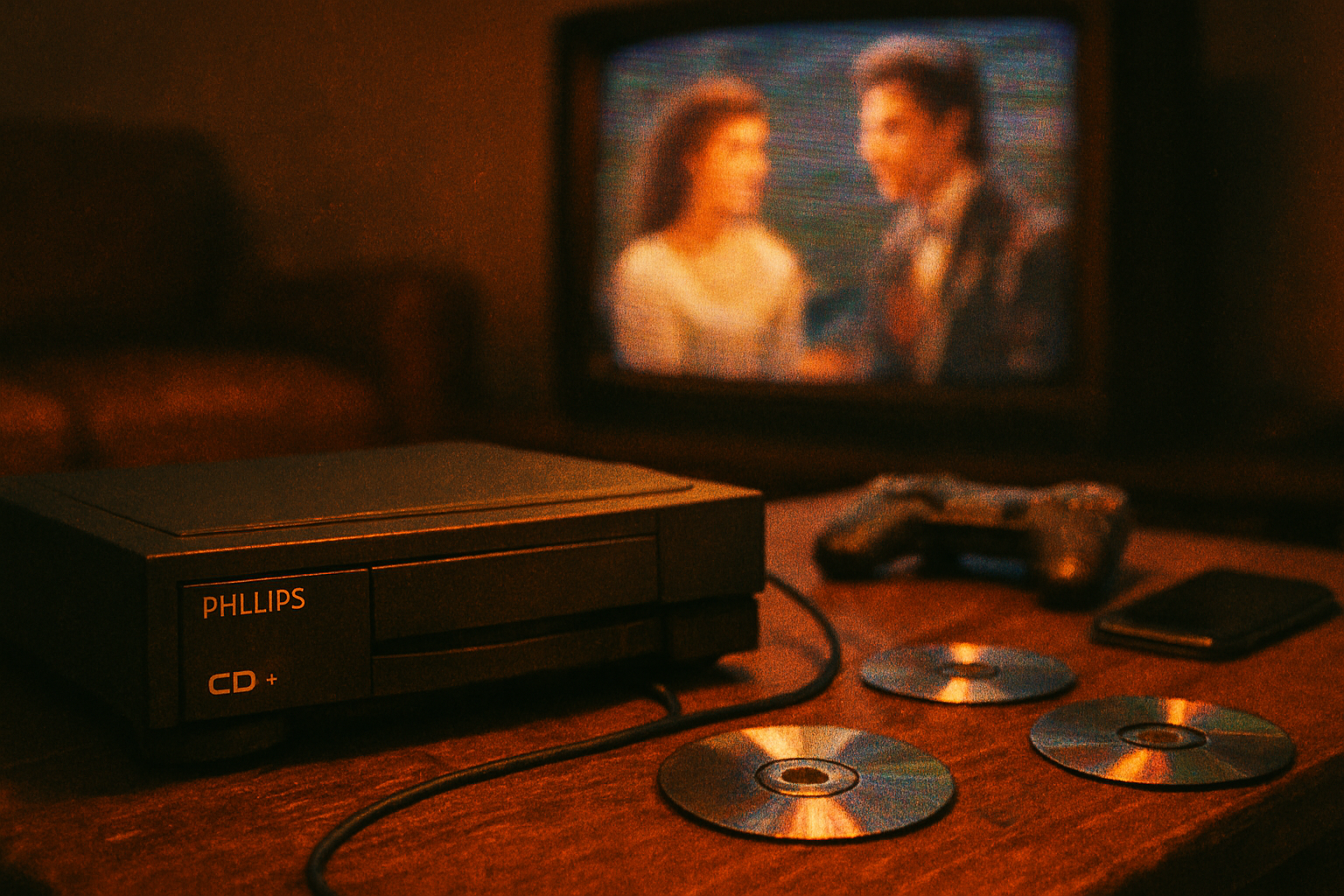
The night Hotel Mario taught the internet how to laugh began, as many humiliations do, with earnestness. Philips had licensed Nintendo characters, tossed low-budget animated cutscenes and awkward voice acting into a machine meant to be a living-room “multimedia” appliance, and the result was - well - history. The clips spread, people made fun, and a system that had been intended as a quiet revolution became a punchline.
But ridicule masks a subtler truth. Beneath the CD-i’s ugly diapers were ideas that would reappear, improved and refined, in the consoles and experiences we now take for granted. The CD-i didn’t so much fail as it fertilized the ground for things that came after it.
What the CD-i was trying to be
Philips’s CD-i (Compact Disc Interactive) arrived at the end of the 1980s and in the early 1990s as an attempt to turn the compact disc from a music carrier into a general-purpose multimedia format - a player that could show video, play audio, run educational software and, yes, host games [https://en.wikipedia.org/wiki/CD-i]. It was born out of a time when companies imagined the living room dominated not by cartridges but by discs and interactive manuals; an appliance, not a dedicated game machine.
That ambition explains both the CD-i’s strengths and its undoing. It could store minutes of voice and long video sequences. It encouraged developers to experiment with film-like storytelling and recorded actors. But it also arrived expensive, underpowered for real-time graphics, and burdened with corporate confusion about whether it wanted to be a toy, an educational tool, or a multimedia set-top box.
Why it failed (briefly, so we can move on to the interesting part)
The catalogue of mistakes reads like a primer in how not to launch a console:
- Price and positioning - Expensive hardware and a nebulous pitch - neither a pure game console nor a mainstream home appliance - made buyers confused.
- Hardware limitations - CD storage was huge, but CPU and graphics capabilities were weak for action gaming.
- Poor first-party software - Early games leaned heavily into FMV and educational content rather than tightly designed gameplay.
- Questionable licensing choices - Handing Nintendo IP to outside teams produced low-quality ports like some of the CD-i’s Mario and Zelda games [
Taken together, these are sufficient explanations for commercial failure. But they are not the whole story.
What the CD-i tried first - and why that mattered
The CD-i was, in an ugly and lucid way, an experiment with three technical and cultural currents that would reappear and eventually thrive.
- CD-based media as the default distribution medium
The compact disc offered orders-of-magnitude more storage than cartridges. That allowed:
- Long-form voice acting and music.
- Pre-recorded video and FMV sequences.
- Larger assets and richer audio design.
The CD-i wasn’t the only early adopter of this idea, but it helped normalize the assumption that games could be delivered on optical disc. When Sony launched the PlayStation as a CD-first console, it benefited from the exact capabilities the CD-i had been forced to demonstrate in public: bigger worlds, cinematic scores, and the possibility of merging filmic techniques with interactivity [https://en.wikipedia.org/wiki/PlayStation_(console)].
- Full-motion video (FMV) and interactive movies
CD-i pushed recorded video into games with gusto. The results were often clumsy - stilted acting, low-resolution video, and interfaces that treated recorded footage as a mechanical novelty rather than as an authored, interactive medium. Still, the machine helped normalize FMV as a genre. That awkward experimentation led directly to more polished uses of FMV in titles such as “Night Trap” and later to the FMV-driven commercial successes and controversies of the 1990s [https://en.wikipedia.org/wiki/Full-motion_video_in_video_games] - and, decades later, to critically acclaimed indie FMV games like “Her Story” that rethought what recorded actors could do inside a game [https://en.wikipedia.org/wiki/Her_Story].
- Multimedia as a promise - and the idea of convergence
Philips imagined the CD-i as more than a game console: a convergence device that would sit between education, entertainment, and television. That ambition presaged later experiments with hybrid devices and interactive TV, and it shaped how designers thought about cross-media experiences. The CD-i failed to make the idea commercially viable in the early ’90s, but it framed questions we still ask: How do games integrate live-action footage, voice, and non-linear narrative? How should interactive experiences sit alongside linear media?
Concrete legacies in modern gaming
The CD-i’s direct descendants are easier to spot than you might expect.
CD and disc-based distribution - The economics of optical media, proven (in part) by early disc machines, enabled Sony to build PlayStation’s massive catalogue of cinematic, voice-acted titles. The decision to use CD-ROMs changed the scale and sound of games forever [
FMV and cinematic experimentation - The clumsy FMV of CD-i is the ancestor of everything from the ’90s FMV boom to the modern resurgence of FMV-style interactive narratives (see “Her Story”). Where CD-i used video because it could, later developers learned to use it because it served design - a subtle but decisive shift [
Interactive storytelling and branching structures - CD-i titles often attempted branching video paths and hypermedia-style navigation. Those early attempts influenced designers who wanted games to feel like choose-your-own-adventure books with filmic trappings.
IP and licensing cautionary tales - The Nintendo-licensed titles on the CD-i illustrated the perils of handing beloved characters to teams without tight creative control. Modern publishers guard their IP more carefully; the CD-i era is a cautionary footnote in licensing strategy.
Cultural afterlife and memeification - The notorious cutscenes and awkward voices (Hotel Mario again) gave the CD-i a second life on the internet. Mockery turned into interest; archival footage and critical reappraisal have drawn scholars and players back to the system, highlighting how failure can create cult value.
Four lessons modern developers and companies still learn from the CD-i
Storage ≠ design. Bigger discs let you put more in a game. They don’t make it good. The CD-i had space for speech and video but not the gameplay that would justify them.
New media require new practices. Recorded video changes pacing, scripting, and player agency. CD-i teams treated FMV as a simple addition; smarter design treats it as a medium with its own grammar.
IP is a delicate instrument. Slapping famous characters into unfamiliar formats can backfire spectacularly.
Failure seeds experimentation. The CD-i’s mistakes mapped out the limits of what multimedia could do and forced later makers to iterate on those boundaries.
Examples that trace a line from CD-i to today
- From CD-i FMV to the 1990s FMV craze to boutique FMV games today like “Her Story” [https://en.wikipedia.org/wiki/Her_Story].
- From CD-i’s disc-first thinking to the PlayStation era, where CD media enabled blockbuster RPGs and FMV-enhanced storytelling [https://en.wikipedia.org/wiki/PlayStation_(console)].
- From clumsy corporate licensing on the CD-i to modern, cautious brand stewardship (and, in some cases, the opposite - careful but bold crossovers that respect source material).
The right way to remember the CD-i
The Philips CD-i is proof that technological history is not simply a parade of winners. It is a messy field of false starts, bad decisions, and odd brilliance. The CD-i gave us a catalogue of wrong turns - but in that wreckage were the parts that mattered: the idea that optical media could carry voice and video, the imperfect experiments with filmic interactivity, and the cultural lessons about handling IP and new formats.
Failure matters because it makes visible what success hides. The PlayStation made disc-based gaming look inevitable; the CD-i made the rough mechanics and bad scripts visible so others could avoid them. It was the awkward adolescent of multimedia: embarrassing in family photos, but responsible - in a perverse way - for some of the grown-up features we now enjoy.
The console failed at market fit. It succeeded at showing the future’s contours, roughly sketched and frequently misspelled. If modern gaming has a face for cinematic, disc-based, interactive storytelling, the Philips CD-i is a crooked, early sketch of it - ugly, instructive, and strangely proud of its mistakes.
References
- CD-i - Wikipedia: https://en.wikipedia.org/wiki/CD-i
- Hotel Mario - Wikipedia: https://en.wikipedia.org/wiki/Hotel_Mario
- Full-motion video in video games - Wikipedia: https://en.wikipedia.org/wiki/Full-motion_video_in_video_games
- Her Story - Wikipedia: https://en.wikipedia.org/wiki/Her_Story
- PlayStation (console) - Wikipedia: https://en.wikipedia.org/wiki/PlayStation_(console)
- Night Trap - Wikipedia: https://en.wikipedia.org/wiki/Night_Trap