· retrotech · 7 min read
From Ratings to Reviews: How IMDb Shaped Online Movie Criticism
IMDb transformed movie criticism by moving authority from a small circle of critics to millions of anonymous voters. That shift democratized taste, created new incentives (and pathologies), and rewired how audiences and filmmakers talk about films - for better and worse.
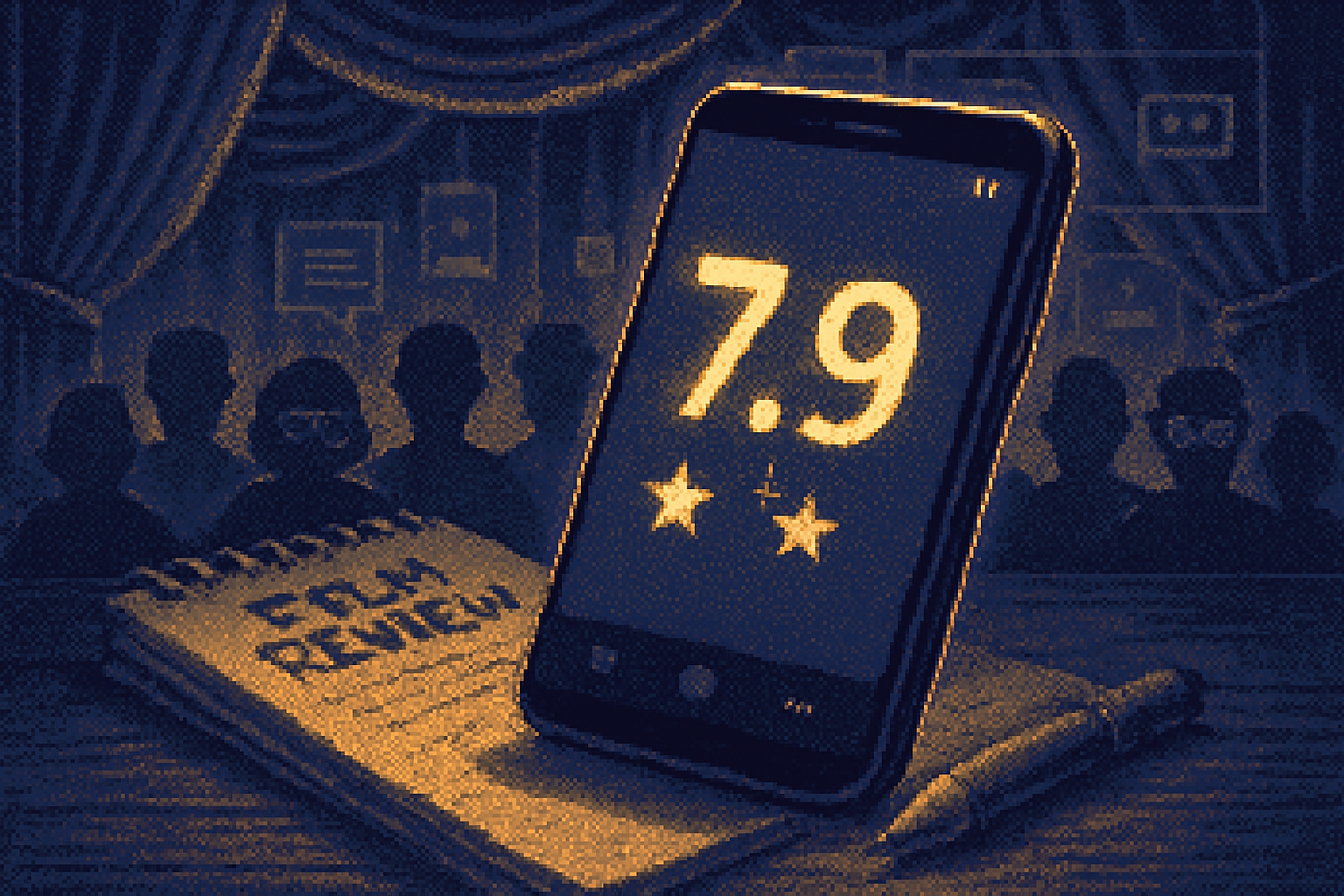
It began with a date-night ritual I know too well: twenty minutes of scrolling, five seconds of deliberation, and then a quick look at a glowing little number on my phone. 7.9 - good enough. I hadn’t read a review; I had read permission.
That tiny number is the product of a cultural revolution. What was once a conversation among a few professional critics became a metric-driven consensus generated by millions of users. IMDb - the Internet Movie Database - didn’t invent democracy, but it made taste measurable. And measurable taste changes behavior.
A short history: how IMDb went from hobby to cultural arbiter
IMDb started as a labor of love in the early 1990s, when film fans collected credits and notes on Usenet and then moved them to a fledgling website. Over the next decade it grew into the definitive online film reference and, in 1998, became part of Amazon’s empire, giving it reach and resources that turned volunteer lists into global influence (IMDb on Wikipedia; Amazon buys IMDb, NYT, 1998).
Two pieces of the site mattered most for criticism and culture:
- The star-rating system (a user-submitted 1–10 score that aggregates into an average), and
- The glut of free, user-written reviews and discussion boards that let anyone play critic.
Those features turned IMDb into more than a database: it became a public square for opinion, gossip, spoilers, and crusades.
Democratization: why that felt like progress
Before the web, film criticism lived in newspapers, magazines, and the occasional TV program. Critics were gatekeepers - largely educated, metropolitan, and cultural arbiters. IMDb’s user reviews opened the door to millions of voices. The immediate effects:
- Diverse perspectives. Viewers from outside critic demographics could champion films that mainstream reviewers dismissed.
- Long-tail discovery. Niche and international films found audiences when passionate users recommended them.
- Rapid feedback. Filmmakers learned, sometimes in real time, how audiences reacted to story beats, characters, and marketing.
From a democratic-ideal perspective, that sounds glorious. The most obvious empirical payoff is the link between user sentiment and commercial outcomes: multiple studies find that online word-of-mouth and user reviews correlate with box-office performance and sales, especially for smaller films where traditional marketing budgets are thin (Duan, Gu & Whinston, SSRN; see also the broader literature on online reviews and sales).
The tyranny of the score: how a number rewired attention
Here’s the rub: a ten-second glance at a number is easier than actually reading a review. Ratings are attractive because they compress complex judgment into a scalar that fits a phone screen. But compression discards nuance.
- Scores flatten disagreement. A film with a 6.9 average may include ecstatic 10s and venomous 1s - but the average looks tepid.
- Scores create incentives. Distributors and studios use high early ratings as marketing bullets; negative ratings can be PR disasters.
- Herding and anchoring. Early votes affect later voters; social influence and bandwagon effects drive convergence toward visible ratings.
The result is a culture that prizes consensus metrics over argument. A reductive signal replaces deliberation.
The dark arts: brigading, manipulation, and review-bombing
When counts matter, people game them. IMDb’s history has a few recurring pathologies:
- Vote brigading - organized campaigns to inflate or deflate a score - sometimes for fandom, sometimes politically.
- Review-bombing - mass negative reviews in response to a casting choice, an actor’s politics, or a perceived slight. The backlash against Star Wars: The Last Jedi is a textbook example of targeted negativity spilling into public metrics (
- Astroturfing - professional marketing firms soliciting positive user scores, or studios encouraging fans to vote en masse.
IMDb has tried technical fixes (weighting algorithms for Top 250, account verification steps) and policy moves (closing its message boards in 2017 after persistent abuse), but technical fixes never fully solve the underlying social incentives (The Verge on message boards closure). The platform is a mirror of whatever its users are doing, for better or worse.
Critics, meet the crowd: competition, complementarity, and displacement
Did IMDb kill critics? Not exactly. The relationship between professionals and amateurs is messy and creative:
- Competition for attention. Aggregated audience scores and social validation sometimes outweigh professional reviews for mass audiences.
- Complementary roles. Critics often provide context, craft analysis, and interpretive frameworks. User reviews give immediacy, emotional reaction, and spoilers.
- Legitimacy battles. Critics complain that numerical averages encourage lazy reading; audiences argue critics are out of touch.
Aggregators like Rotten Tomatoes complicated the scene by offering both critic and audience scores side by side. IMDb’s strength remains breadth: millions of votes and an immense review archive. That breadth means it can reflect cultural shifts more quickly than a handful of journalists, but it also amplifies the noise.
Filmmakers and industry behavior: attention as currency
Studios and filmmakers watch IMDb the way traders watch an index. Why?
- Marketing. Early positive audience reactions (high IMDb scores) can be used in trailers and posters.
- Greenlighting. Persistent strong audience sentiment for a niche title can influence the decision to make sequels or spin-offs.
- Reputation management. Actors and directors monitor audience scores as part of personal brand management; sometimes they respond publicly.
But this attention also creates harmful incentives. Aiming for a safe crowd-pleaser that plays well to broad user tastes may favor formula over risk-taking. And when social-media outrage can tank a score, publicity teams spend money suppressing negative surges rather than improving the product.
The epistemology of a vote: why most scores are unrepresentative
A few statistical realities weaken IMDb scores as a stand-in for quality:
- Self-selection. People who felt strongly - positively or negatively - are more likely to vote. Most viewers are silent.
- Unknown sample bias. The demographics of IMDb users are not representative of all movie-goers; global films may be rated by niche anglophone users.
- Temporal bias. Early voters (often fans or critics’ followers) can lock in perceptions.
This doesn’t render scores useless. It means you should read them as signals with error bars, not gospel.
The good that came with the bad
Before getting too dour, it’s worth listing real benefits IMDb created for film culture:
- Archive and attribution. IMDb democratized access to credits and film histories, preserving information that used to be scattered.
- Discovery. Long-forgotten films gain new life through user recommendations and lists.
- Community - even with messiness, IMDb and its successors gave millions a place to write, think, and argue about movies.
And many filmmakers have learned to treat user feedback as a source of truth - sometimes correctly. Indie directors celebrate when real audiences champion their projects; distributors discover sleeper hits because of user buzz.
How to use IMDb sensibly (a short user guide)
- Read the distribution, not just the mean. Look at the spread of 1s and 10s.
- Skim a handful of recent reviews to see whether complaints are about story, politics, spoilers, or trolls.
- Cross-reference - check critic scores (Rotten Tomatoes, Metacritic) and a trusted critic or two.
- Watch a clip. If the filmmaking and tone match your taste, roll the dice.
In short: treat IMDb as one instrument in your toolkit, not the arbiter of taste.
A nuanced legacy
IMDb didn’t so much invent online criticism as industrialize it. It translated taste into data and made that data actionable. The consequences are ambivalent: more voices and more discovery, but also new forms of manipulation, herd-think, and a flattening of argument into arithmetic.
If professional critics once worried about losing power, their role shifted rather than vanished. Their value now is context and interpretation - the slow, argumentative work that a number cannot replace. Meanwhile, audiences gained a voice that can lift a forgotten gem or mob a disliked sequel.
What remains uncanny is how little we notice this tectonic shift in daily life. We let a decimal decide whether to spend two hours on a film. That surrender is practical; it’s also a cultural choice about what authority looks like in the internet age.
In the end, IMDb is neither saint nor villain. It’s a tool that externalizes our taste into a public ledger. And like any ledger, what it records depends on who holds the pen.
References
- IMDb - history and general info: https://en.wikipedia.org/wiki/IMDb
- Amazon buys IMDb (NYT, 1998): https://www.nytimes.com/1998/05/05/business/amazon.com-buys-imdb.html
- On message boards closure and community changes: https://www.theverge.com/2017/2/20/14671940/imdb-message-boards-shut-down
- Review-bombing case study (Star Wars - The Last Jedi):
- Academic work on online reviews and sales (example literature) - Duan, Gu & Whinston - The impact of online user reviews on movie box office (SSRN):