· culture · 6 min read
From PalmPilot to Smartphone: The Evolution of Digital Organizers
The story of digital organizers is a story about focus vs. abundance. From the PalmPilot's singular mission - organize your life - to today's always-on smartphones that do everything and demand everything, here's what we lost, what we gained, and what designers should remember.
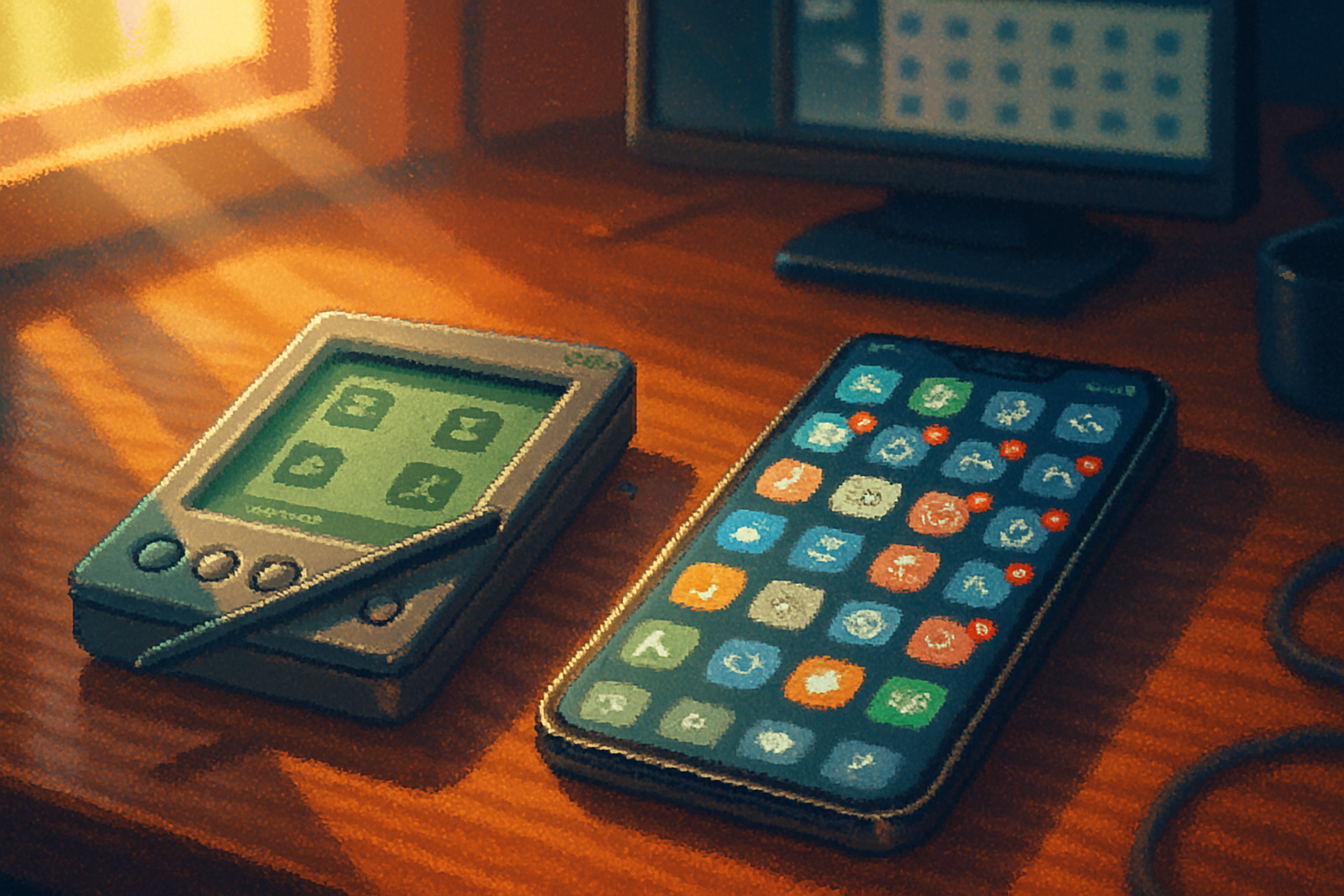
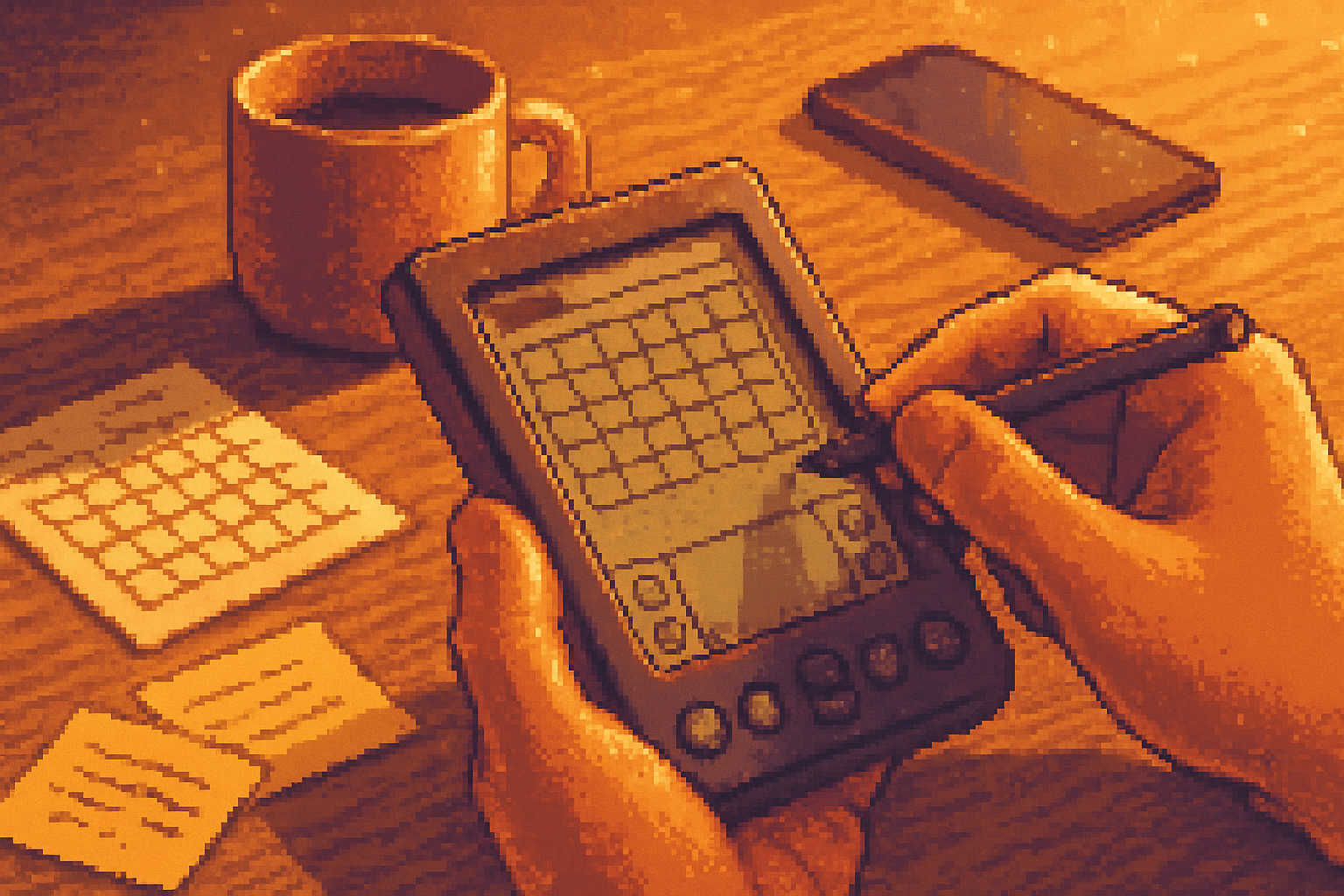
A man in a rumpled suit taps a small gray rectangle with a plastic stylus. He writes a note in blocky, confident strokes; the device translates it into tidy text. He docks the gadget at his desk and, with a soft click, everything on the handheld quietly syncs with his desktop computer - calendar, addresses, the to-do list. No cloud. No notifications. No ads. Just a single-purpose machine that did one job and did it well.
That was the PalmPilot era. It felt like salvation. It felt intimate. It felt finite.
Fast forward twenty years and there’s a rectangle again, only this one rings, photographs, navigates, plays, streams, tweets, and argues with your calendar about which flight you actually meant to book. It also manages to interrupt you about it every seven minutes.
This is a short history and a sharp look at what the evolution of digital organizers - from PalmPilot and its peers to today’s smartphones - cost us and what it bought in return.
A brisk timeline - milestones worth remembering
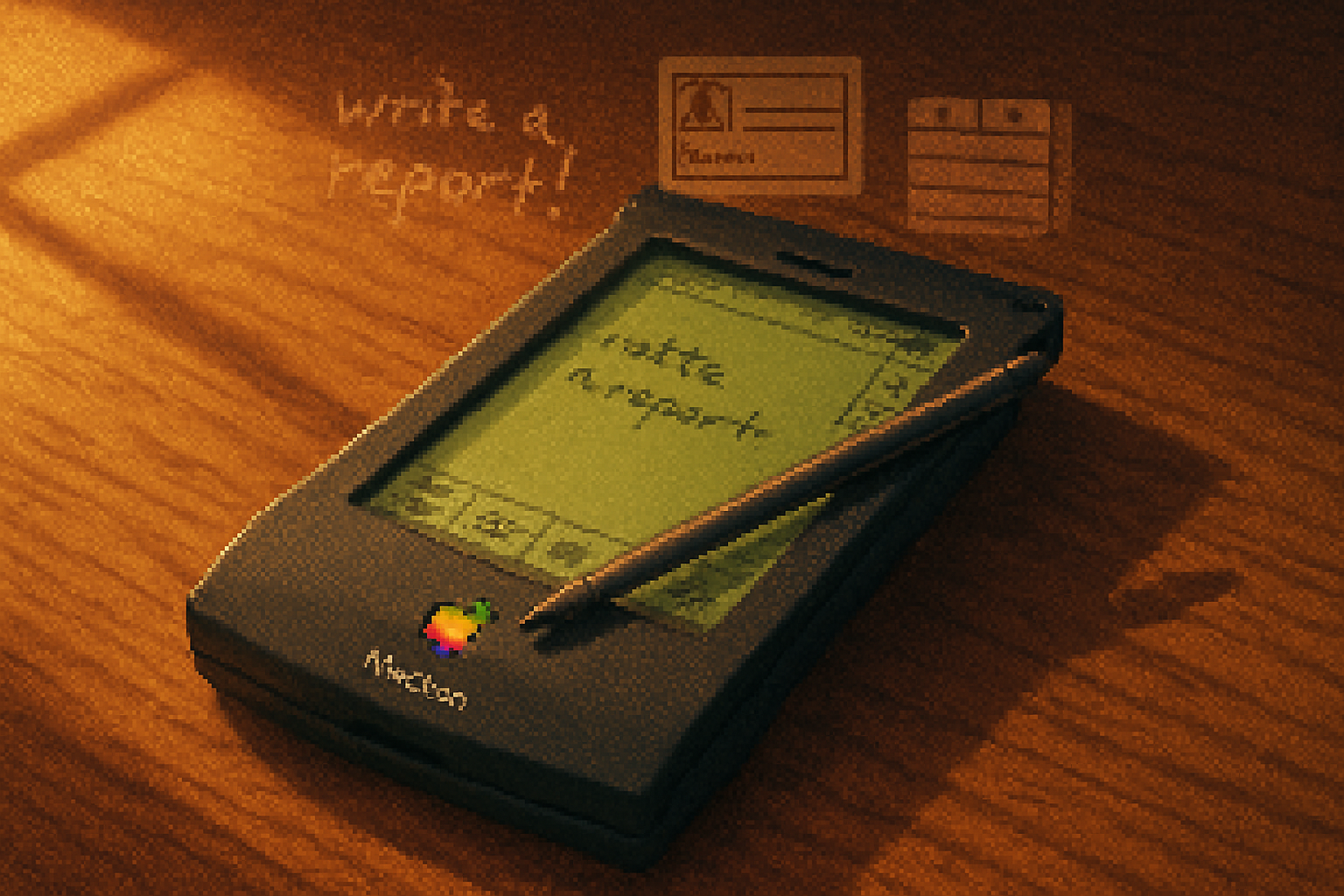
- Early 1990s - Apple’s Newton MessagePad introduces the idea of a handheld personal digital assistant (PDA) with handwriting recognition
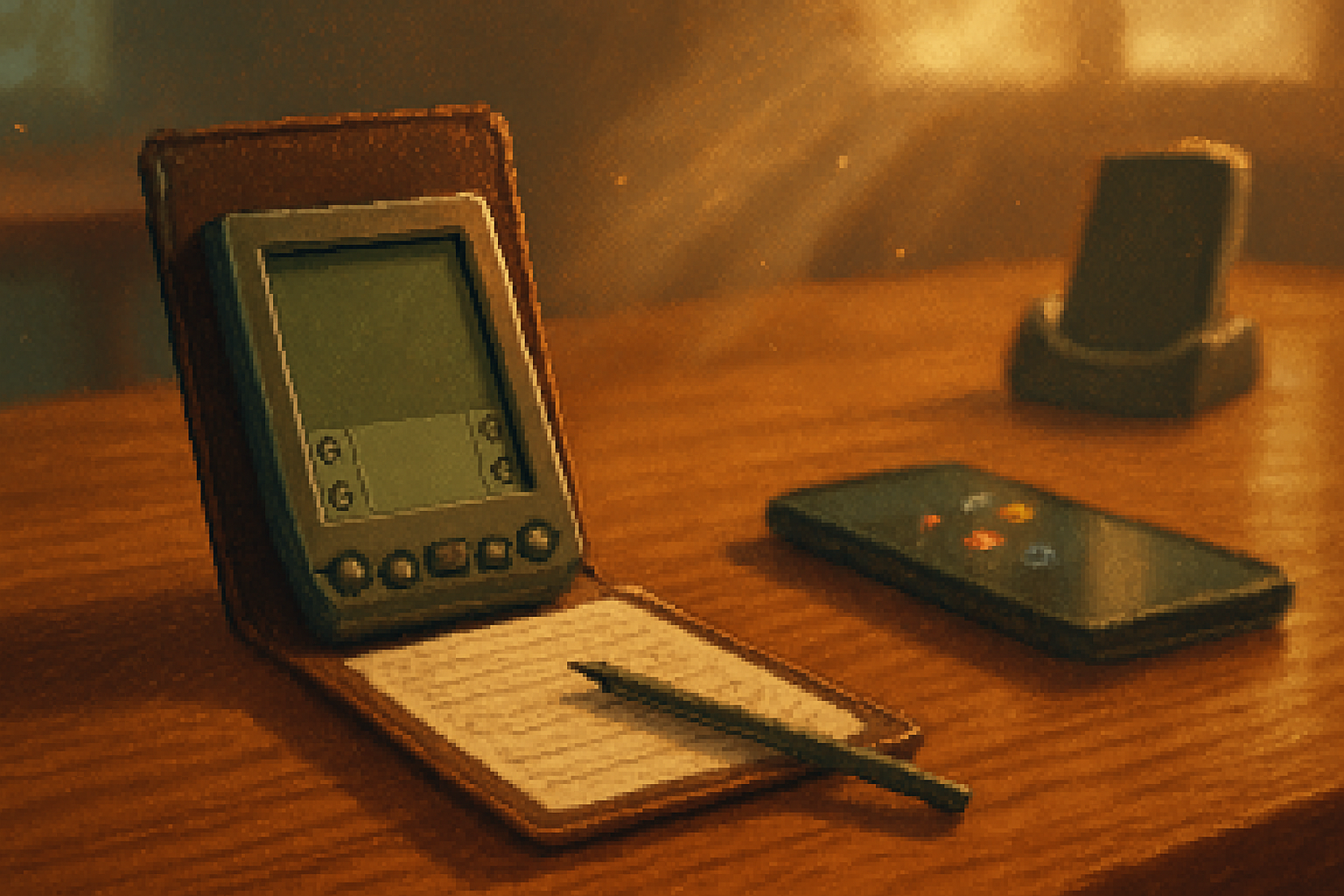
- 1996 - PalmPilot (Palm, Inc.) popularizes the modern PDA with a focused set of organizer tools and the Graffiti handwriting system
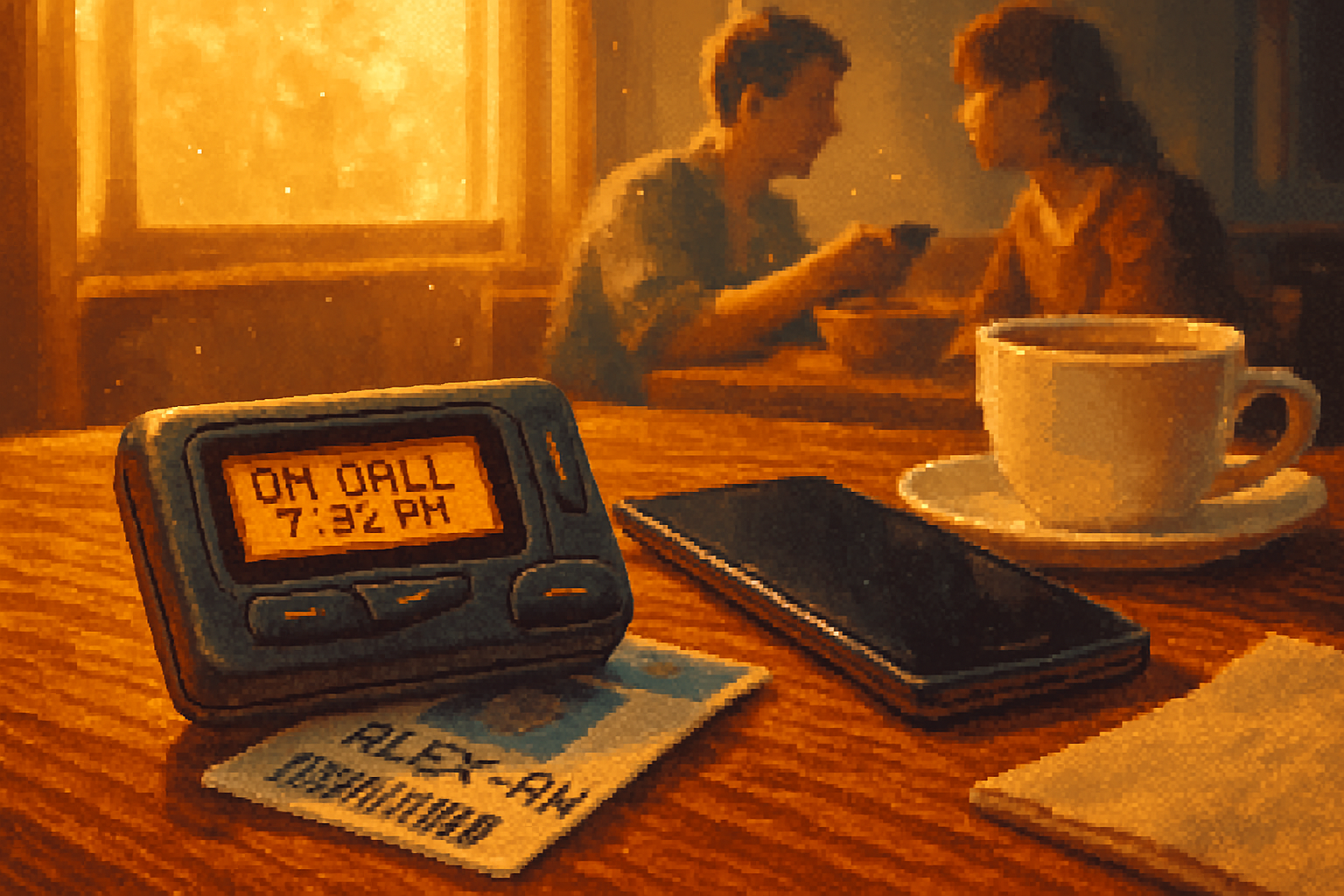
- Late 1990s–early 2000s - BlackBerry and Nokia extend the concept toward always-on messaging and mobile email (a.k.a. the first “smart” phones in enterprise)
- 2000s - Windows Mobile (Pocket PC) and Palm OS battle for PDA dominance; synchronization (HotSync, ActiveSync) becomes essential infrastructure
- 2007 - The iPhone consolidates many devices into one platform, and the App Store (2008) creates an ecosystem that explodes functionality and fragmentation at once
Each step was less a replacement than an accretion: organizers absorbed telephony, then messaging, then the internet, apps, and sensors until the category blurred into something else entirely: the smartphone.
What the PalmPilot - and other PDAs - got ruthlessly right
- Obsession with core tasks: calendar, address book, notes, and to‑dos. Not a hundred half-baked features, but a handful done simply and reliably.
- Predictable, low-attention UX - launching the calendar didn’t mean an avalanche of pop-ups. You focused and returned to work.
- Durable batteries and offline-first design - sync when you wanted. No constant thirst for power or data.
- Familiar metaphors - analog diary → digital calendar; paper address book → contacts.
- Effective syncing model - HotSync and companion desktop apps made the handheld part of a tidy workflow rather than an orphan
There’s elegance in constraints. The PalmPilot’s constraints were a feature, not a bug.
What we lost - and why it nags like a cheap cut
Some losses are nostalgia; others have real cognitive and social costs.
Simplicity and focus
- The PalmPilot was ruthlessly single-purpose. Your organizer wasn’t also a camera, a gaming device, a newsfeed, and a store. That lack of distraction had psychological value.
Predictable attention
- PDAs didn’t push notifications into the face of your day. The smartphone’s constant interruptions have reconfigured attention as a battleground.
Privacy by default
- Offline-first meant your calendar and contacts were on devices and desktops you controlled. Today’s calendar invites, location tags, and cloud backups are convenient - and visible.
Repairability and longevity
- Older PDAs were simpler and, at times, physically easier to fix or operate without vendor lock-in. Modern phones are sealed black boxes that age fast.
The tactility of the stylus and handwriting
- The stylus wasn’t just nostalgia. For many tasks (sketching, annotating), a pen beats a fingertip. Graffiti and pen input felt personal; typing is transactional Graffiti (Palm OS).
Battery humility
- PDAs often lasted days to weeks on a charge. Smartphones, for all their bigger batteries, demand charging daily (or more).
Each of these losses trades a quiet competence for shiny breadth.
What we gained - and why we keep accepting the costs
Networked intelligence
- Real‑time updates, auto‑sync, cloud backup. Lose the hard drive, lose the manual sync. Gain global coordination of calendars, shared docs, and instant logistics.
Multipurpose utility
- Camera, maps, payments, ride‑hailing, streaming - the smartphone turned the organizer into a platform for life’s mini‑transactions.
App ecosystems and specialization
- Need a Kanban to-do list integrated with work chat? There’s an app. Need a calendar that guesses travel times? There’s an app.
Sensors and context
- GPS, accelerometers, ambient light, biometrics - your phone knows the where, when and who in ways Palm’s calendar could not.
Ubiquitous connectivity and social coordination
- That “always on” presence is a feature for people who coordinate across time zones, families, and organizations. Calendars now share, invite, and negotiate seamlessly.
In short: utility and social scale. The smartphone democratized capabilities that once required multiple specialized devices.
The subtle trade-offs - attention, ownership, and design
There’s a moral economy here. The PalmPilot era assumed you owned your time and attention. The smartphone era treats attention as currency. Design shifted from helping you be organized to keeping you engaged.
- Attention economy - Notifications are optimized for engagement, not serenity.
- Platform lock-in - Cloud sync is convenient until you try to leave.
- Surveillance complexity - Location and metadata make private life legible to companies and, sometimes, governments.
Designers of digital organizers now have to be ethical economists: how do you maximize usefulness while minimizing extraction?
Concrete lessons for the next generation of organizers
- Defaults matter - Offline-first and local control should be options, not afterthoughts.
- Intentional interruptions - Let users define interruption budgets. Respect them.
- Modularity - Offer a minimal organizer “mode” that hides everything except the essentials.
- Pen and pencil - Stylus or handwriting support remains valuable for cognitive tasks like planning and sketching.
- Durable UX - Prioritize longevity over feature bloat. Allow exportable standards for data portability.
Think of these as design conservations - what we preserve determines what future users inherit.
A small prediction (and a hope)
The future won’t be a return to grey plastic PDAs. The future will be smarter about context: features that fade into the background until you need them; attention-aware systems that ask permission to be loud; and tools that privilege human time over engagement metrics.
We might see a renaissance of “focused mode” devices - stripped‑down smartphones or companions that resurrect the organizer’s dignity without turning the clock backward technologically. Imagine a pocket device that pairs to your phone for heavy tasks but otherwise behaves like a PalmPilot: offline, focused, and convictionally unsexy.
Final thought
The PalmPilot taught us something blunt and valuable: constraint can be elegance. The smartphone taught us something blunt and valuable, too: connectivity can be liberation - and tyranny.
Both lessons matter. If digital organizers are to serve human lives rather than harvest them, we must choose carefully which lessons we keep.
References
- PalmPilot - Wikipedia: https://en.wikipedia.org/wiki/PalmPilot
- Apple Newton MessagePad - Wikipedia: https://en.wikipedia.org/wiki/Apple_Newton
- HotSync - Wikipedia: https://en.wikipedia.org/wiki/HotSync
- Graffiti (Palm OS) - Wikipedia: https://en.wikipedia.org/wiki/Graffiti_(Palm_OS)
- iPhone - Wikipedia: https://en.wikipedia.org/wiki/IPhone
- BlackBerry - Wikipedia: https://en.wikipedia.org/wiki/BlackBerry