· retrotech · 7 min read
From Floppy Disks to Cloud Computing: The Evolution of Data Storage from the Original Macintosh to Today
A walk from the Macintosh's 400 KB floppy days to today's petabyte clouds: how technology, user experience, capacity and trust reshaped where we keep our digital lives.
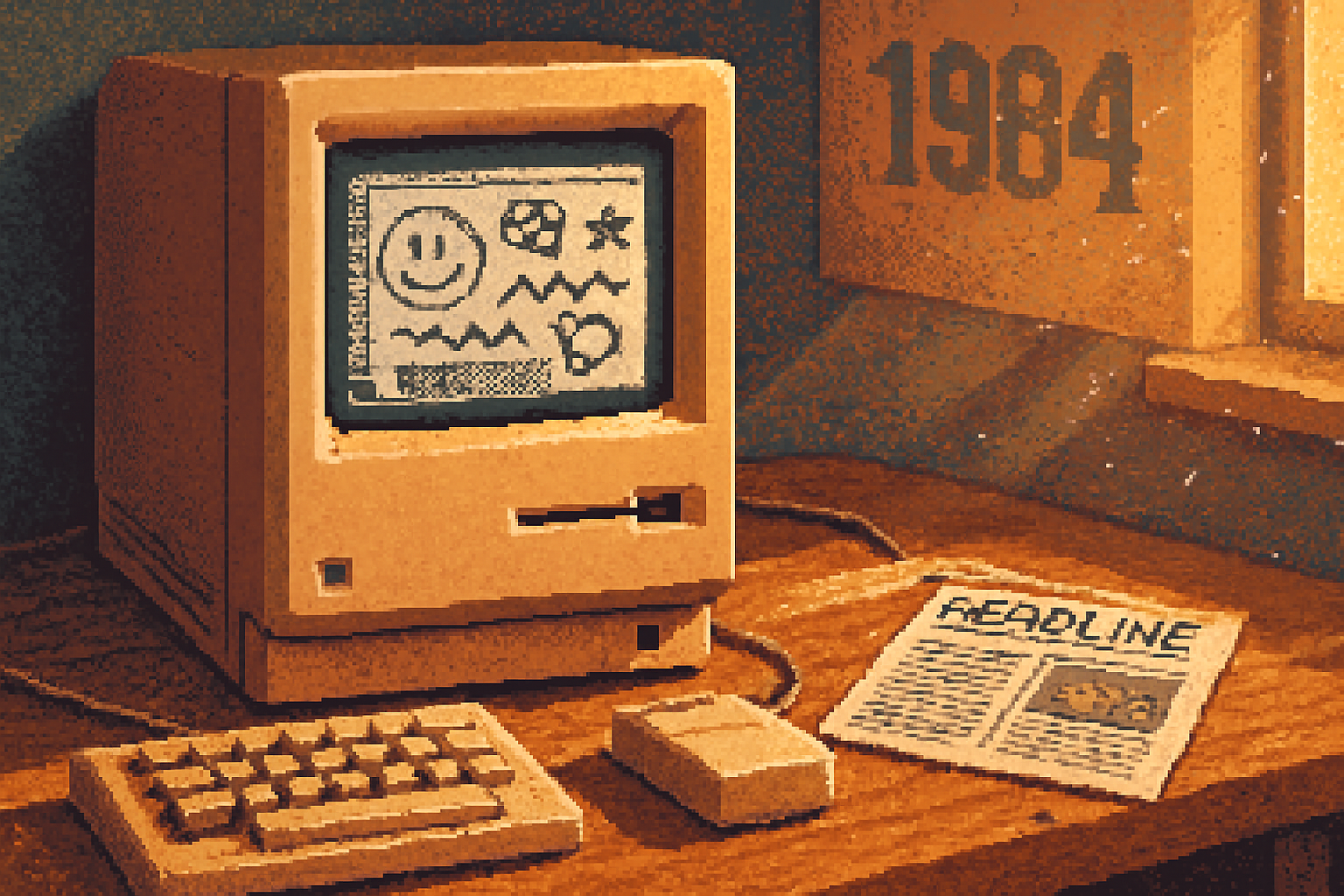
It is easy to forget how physical saving once felt. In 1984, saving a document on a Macintosh meant gently sliding a tiny, rigid sleeve of magnetic plastic into a slot and hoping the disk wasn’t magnetized by your alarm clock. We accepted flirtations with failure as normal. We called disks “floppies” with no irony.
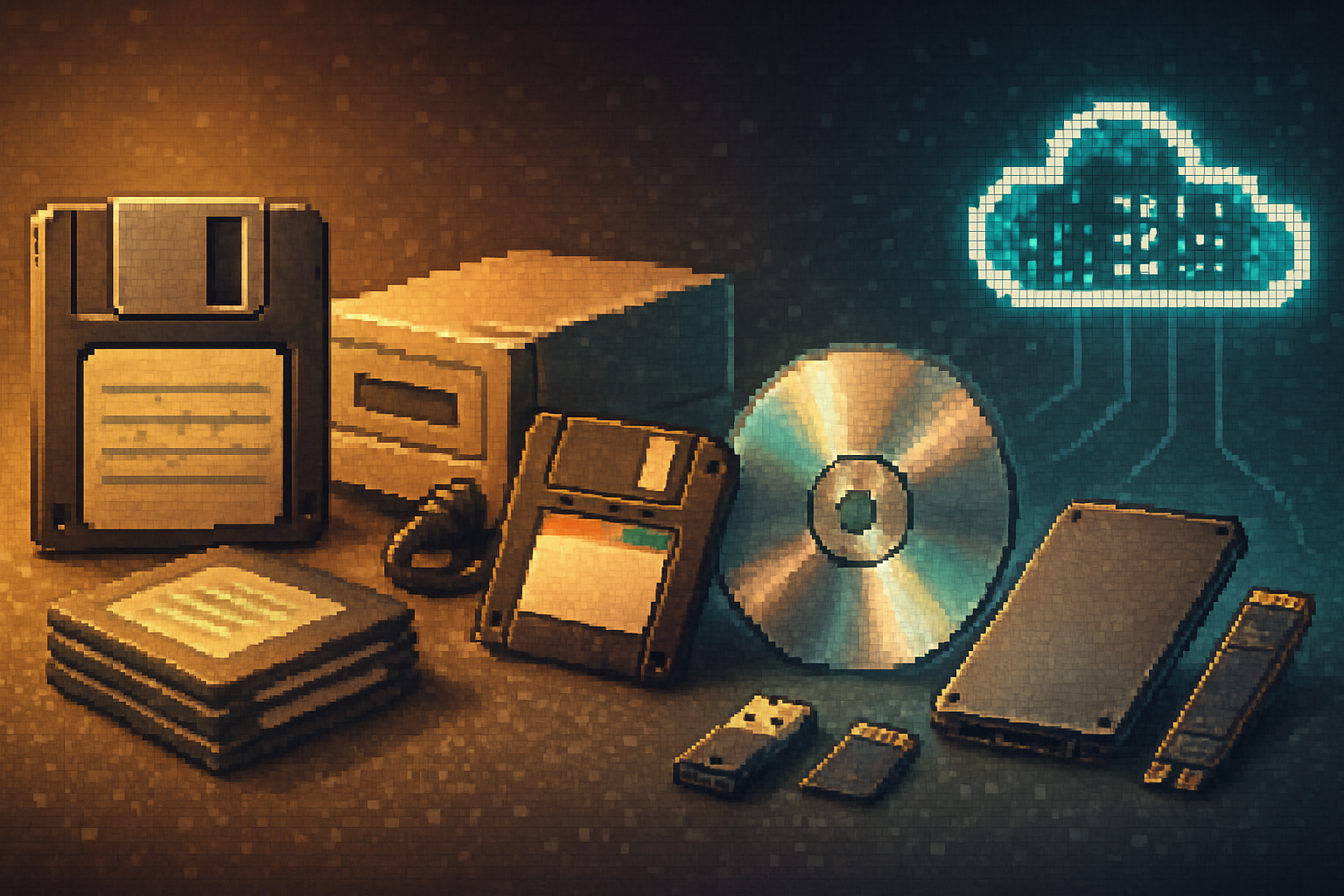
That intimate, tactile choreography tells a larger story. The journey from the Macintosh’s 400 KB floppy to petabyte cloud clusters is not merely a tale of bigger numbers. It’s a story of how expectations changed, how interfaces abstracted away failure, and how the social contract of privacy and control was quietly rewired.
The Macintosh and the floppy: storage you could hold (and lose)
The original Macintosh shipped in January 1984 with 128 KB of RAM and a built-in 3.5‑inch floppy drive that held roughly 400 KB of data. You could store a few pages of text and call it a day. Disks were physical, finite, and fragile; losing one was like losing a single photograph from an album.
- Capacity - ~400 KB (Macintosh 128K)
- Typical media - 3.5‑inch single‑sided floppy
Source: Apple’s early Macintosh specifications and historical summaries Macintosh 128K (Wikipedia).
The user experience then encouraged extreme economy. You saved, you swapped, you labeled. The computer expected you to be a librarian. Finder windows were metaphors for a physical desk with folders and paper; the file system insisted you think in containers because storage was scarce.
Magnetic spinning plates: hard drives make the inside get serious
Hard disk options came quickly to personal computing. Apple’s first internal hard drive for Macintosh, the Macintosh Hard Disk 20, offered 20 MB of storage in 1985 - fifty times the capacity of a floppy, but still tiny by modern measures.Macintosh Hard Disk 20 (Wikipedia)
As hard drives became internal and then cheaper with SCSI, IDE, and SATA standards, capacity scaled from megabytes into gigabytes. But these were mechanical beasts: fast enough, relatively cheap, and liable to catastrophic head crashes.
- 1985 - 20 MB (Macintosh Hard Disk 20)
- 1990s–2000s - hundreds of MB → tens to hundreds of GB (consumer HDDs)
This era rewired expectations: backing up became a proactive habit rather than luck. Products like Tape backup and the ZIP drive (Iomega) tried to bridge the user’s desire for removable convenience with larger capacity.
Optical media: the era of the disc - durable, portable, but finite
Compact Discs (CDs) and later DVDs entered the saving ritual. A CD‑R could hold ~650–700 MB, and a single DVD about 4.7 GB. Suddenly you could archive years of documents (or install an operating system) on a single disc.
- CD‑R - ~650–700 MB
- DVD‑R - ~4.7 GB
Optical media was more durable than floppies in many ways, but it introduced new problems: scratches, format fragmentation, and the fatigue of managing stacks of discs.
Flash memory and USB sticks: the pocket revolution
The first widely recognized USB flash drives hit the market around 2000 and changed expectations again: instant, small, and cheap enough to be ubiquitous.USB flash drive (Wikipedia)
SD cards entered cameras and phones; small solid‑state memory replaced magnetically constrained thinking. Suddenly, storage was portable and silent.
Solid‑state drives and NVMe: speed becomes the currency
SSDs moved storage from mechanical to electronic, eliminating seek times and adding orders of magnitude in responsiveness. SATA SSDs arrived mid‑2000s; NVMe over PCIe followed, taking latency and throughput to new levels and making storage a performance lever rather than just capacity.Solid‑state drive (Wikipedia)
For users this meant boot times measured in seconds, instant waking, and applications that felt fluid. For system designers it meant rethinking caching, virtualization, and what data belongs on expensive fast media versus cheap slow media.
The Internet becomes the hard drive: cloud storage and sync
In March 2006 Amazon launched S3 (Simple Storage Service), and the very idea of off‑device storage for consumers and businesses accelerated.Amazon S3 (Wikipedia) Dropbox (2007) popularized seamless folder sync, and Apple’s iCloud (2011) folded device backups and photo libraries into the network fabric of your life.Dropbox (Wikipedia) iCloud (Wikipedia)
Cloud storage changed the grammar of saving:
- From explicit to implicit - automatic syncs, background backups, and continuous versioning.
- From local limits to virtually infinite buckets - you no longer count megabytes, you pay for terabytes.
- From personal ownership to delegated trust - your data lives on someone else’s machines.
Amazon S3 and the broader cloud infrastructure also commoditized durability and redundancy. The cloud promised “eleven nines” of durability via replication and checksums - a new form of reliability that made physical media’s single‑point failures seem quaint.
Capacity, cost, and Kryder’s law
Storage capacity didn’t just increase; its price collapsed. Where once a megabyte cost a significant fraction of a consumer dollar, today gigabytes are nearly free and terabytes are affordable for most consumers. This dramatic decline roughly follows what’s known as Kryder’s law - an empirical observation about storage density and cost improvements.Kryder’s law (Wikipedia)
- 1984 floppy - 400 KB
- 1985 hard disk - 20 MB
- Early 2000s USB stick - tens to hundreds of MB → GB
- 2010s consumer HDDs - TB range
- Today - multi‑TB consumer drives are common; cloud accounts offer TB tiers
The practical consequence? We hoard. We create more because storage is cheap. The size of photos, videos, and application data ballooned because the constraint evaporated.
User experience: from thrift to abundance
Several UX shifts accompany technological change:
- Metaphor transformation - From physical filing and media swapping to invisible syncing and search. The desktop folder is now more a habit than a necessity.
- Expectations of resilience - Users now expect near‑instant recovery, automatic version history, and cross‑device continuity.
- Friction removal - No more labeling stacks of floppy sleeves; now there are problems of a different kind - accidental auto‑syncs, duplicated files across services, and permission confusion.
A useful analogy: storage used to be a pantry with a few shelves; you counted cans. Today it’s a warehouse you rent with forklifts. You don’t manage individual cans; you manage cataloguing and access policies.
Reliability, encryption, and the politics of storage
As storage centralized, new questions arose:
- Security - Encryption at rest and in transit is now standard for serious cloud providers. Local encryption and device encryption protect data from physical theft. But centralized services create attractive targets.
- Privacy and control - When your data sits on someone else’s hardware, legal jurisdictions and corporate policies matter. The convenience of sync has a cost: another party may hold the keys - or be compelled to hand them over.
There is an implicit bargain: convenience and scale versus control and privacy.
Where next? DNA, computational storage, and the edge
The next wave of storage improvements will not merely be bigger drives. Some promising directions:
- DNA data storage - extraordinary density and longevity demonstrated in lab settings; still expensive and slow, but conceptually radical.
- Computational storage and storage‑class memory - moving processing to where the bits live to cut data‑movement costs.
- Edge storage and tiering - distributing storage closer to users for latency‑sensitive applications (video streaming, AR/VR).
We will see more hybrid architectures: sensitive data kept close and encrypted, bulk content pushed to the cheapest long‑term tiers, and hot data placed on ultra‑fast media.
Lessons from four decades of storage
- Scarcity shapes behavior. When storage was rare, we organized, compressed, and deleted. When it became cheap, our discipline evaporated.
- Abstraction hides complexity. Sync and cloud remove friction - and obscure failure modes and control points.
- Trust is the new storage medium. Reliability now often means trusting a provider’s policies, practices, and legal posture.
You can mourn the floppy without being nostalgic about the limitations it enforced. The world today is dramatically better in speed and capacity. But every step toward convenience adds an axis we must manage: privacy, cost, and dependence.
If you grew up thinking saving meant sliding a floppy into a slot, you’ll laugh at how casually your phone backs everything up now. If you started with cloud‑native tools, try imagining a world where a single corrupted magnet could erase a decade of memories. Both perspectives are useful. The shape of storage is less about media than about what we expect from our digital lives.
Further reading
- Macintosh 128K (Wikipedia): https://en.wikipedia.org/wiki/Macintosh_128K
- Macintosh Hard Disk 20 (Wikipedia): https://en.wikipedia.org/wiki/Macintosh_Hard_Disk_20
- Amazon S3 (Wikipedia): https://en.wikipedia.org/wiki/Amazon_S3
- Dropbox (Wikipedia): https://en.wikipedia.org/wiki/Dropbox
- iCloud (Wikipedia): https://en.wikipedia.org/wiki/ICLOUD
- Solid‑state drive (Wikipedia): https://en.wikipedia.org/wiki/Solid-state_drive
- USB flash drive (Wikipedia): https://en.wikipedia.org/wiki/USB_flash_drive
- Kryder’s law (Wikipedia): https://en.wikipedia.org/wiki/Kryder%27s_law
- DNA data storage (Wikipedia): https://en.wikipedia.org/wiki/DNA_data_storage