· retrotech · 7 min read
Digitally Restoring Your Childhood: How AI is Bringing Retro Video Games Back to Life
How machine learning and clever tooling are repairing and enhancing classic video games-what works, what breaks, and why it feels like time travel.
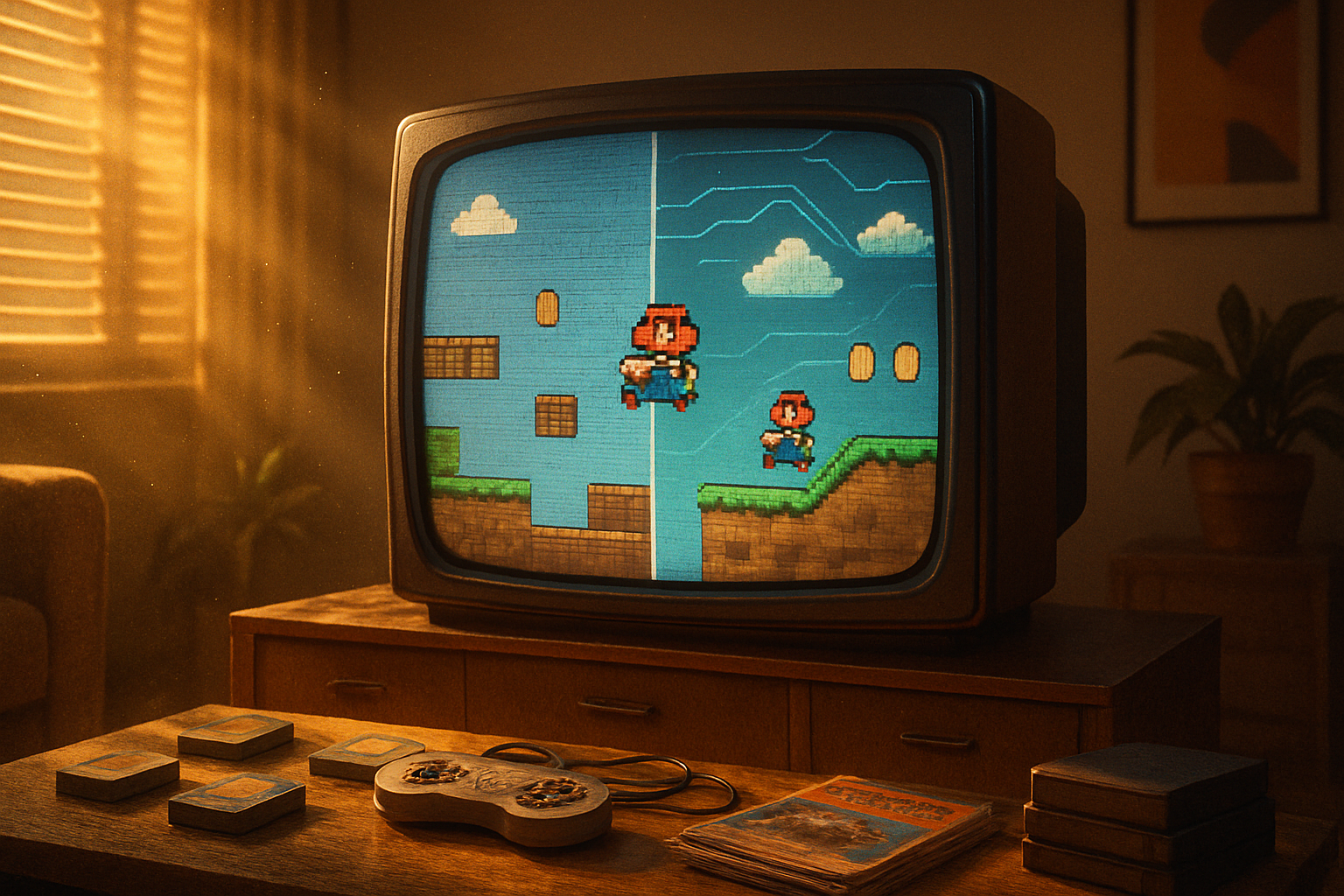
The night my childhood looked back at me
I booted a 1992 cartridge on an emulator and froze. The hero I used to know-eight pixels of stubborn bravery-looked like someone had sneezed on his pixels. A half-hour with a community-built AI upscaler later, his outline was crisp, his colors less muddy, and the memory of running through pixelated grass felt alive again.
That moment is everywhere now: fans and studios re-entering their old libraries and asking the same question-what happens when an algorithm gets to touch your childhood?
Why AI? Because nostalgia ages like bread
Nostalgia is a fragile, selective chemistry: we remember the thrill, not the scanlines, but the artifacts are what remain on the cartridges. The human brain forgives, the hardware does not. AI offers something bluntly useful: the ability to infer missing detail and make low-resolution sprites and textures readable again without rebuilding everything by hand.
Think of AI as a conservator with a paintbrush: it can restore flaking murals, but if it decides Michelangelo needed neon highlights, you have a problem.
What “restoring” actually means (and what it doesn’t)
People use AI to do several things to old games:
- Upscale sprites and textures - making them sharper at higher resolutions.
- Interpolate frames - smoothing choppy 15–20 fps animations to modern framerates.
- Reconstruct lost or damaged assets - filling in missing tiles, reassembling sprite sheets.
- Enhance audio - separating and cleaning music and voice tracks.
These tasks are accomplished with machine-learning models trained on large datasets to guess plausible high-resolution detail from low-resolution inputs. Popular practical tools include ESRGAN and its offshoots for image upscaling (ESRGAN GitHub, Real-ESRGAN), sprite/illustration-specific networks like waifu2x (waifu2x GitHub), and GAN-based face restoration tools such as GFPGAN when characters need facial touch-ups (GFPGAN GitHub).
A typical restoration workflow
- Dump assets from the ROM or capture frames from emulation.
- Separate sprites, tiles and background layers where possible.
- Preprocess (clean borders, remove scaling artifacts, de-dither).
- Choose or train a model tuned for pixel art.
- Run inference to upscale or enhance.
- Reassemble and test in motion; fix temporal artifacts.
- Manual touch-ups by human artists.
That last step is important. Purely automated results often require a human to keep expressions consistent, correct hallucinated details, and ensure animations don’t wobble.
The hard parts - technical and aesthetic
AI restoration is seductive, but full of hard trade-offs.
Hallucination vs. fidelity - Neural nets invent plausible detail. Great for aesthetics; dangerous for authenticity. The network will happily redraw a character’s nose differently each time if not constrained.
Temporal coherence - Single-frame upscalers may make each frame look great, but characters flicker and “morph” across frames. Fixing that demands optical-flow-aware models or temporal loss functions.
Pixel-art specificity - Pixel art is not just low-res photography. It obeys hard-edged rules-snapped pixels, limited palettes, intentional jaggies. Generic photo-upscalers can blur or round these features. Specialized models or loss functions that preserve edges and palette constraints are essential.
Tile atlases & palette palettes - Games store graphics in sheets with shared palettes. Upscaling each tile independently can break color harmony. Restoration workflows often need to respect palette indices or remap colors globally.
Input quality - Compressed or captured footage brings scanlines, blur, and interlacing. Preprocessing to remove capture artifacts is often as important as the model itself.
Legal and ethical constraints - Copying ROMs, releasing remasters and reusing trademarked assets raises copyright dilemmas. The Electronic Frontier Foundation has long covered emulation, preservation, and the legal tightrope around retro software preservation (
Real examples (fan projects and lessons learned)
Community upscales - Fans have used ESRGAN variants to upscale SNES and Genesis sprites to make widescreen or 4K-friendly versions. Results range from jaw-dropping to uncanny; projects that pair AI with hand edits do best.
Frame interpolation experiments - Hobbyists have used temporal neural methods to smooth old FMV or low-framerate cutscenes. When optical flow is robust, motion becomes buttery; when it isn’t, ghosting ruins faces and objects.
Audio remastering - Source separation models and denoisers can isolate music from effects, letting fans remaster chiptunes. The same tech can also “enhance” compressed speech, occasionally inventing phonemes that were never there.
If you want to see these tools in action, look at the code and repos that power the hobby: Real-ESRGAN, waifu2x, and GFPGAN.
Preservation vs. rewriting: the ethics of touching the past
There are two ways to misapply restoration tech:
Overzealous beautification - When AI makes a sprite into a different artistic object, it changes the authorial intent. The restored game is no longer the same artifact you remember.
Hidden ‘improvements’ - Patching gameplay or physics because the restorer wants a smoother experience destroys the historical record.
Responsible restoration treats the original as primary. AI should be used to remove artifacts that the medium introduced (scanlines, compression), not to replace deliberate design choices. If a frame is fuzz because of hardware limits, decide whether you’re preserving that limitation as part of the experience.
The debate is ethical as well as aesthetic. Organizations like the Internet Archive host large retro-game collections and emphasize preservation for cultural value (Internet Archive - Console Living Room). Meanwhile, legal frameworks complicate what preservationists can do without explicit publisher consent.
Why this matters beyond warm fuzzies
Nostalgia feels private, but games are cultural documents ripe for study. Restored assets allow historians to:
- Study early design conventions and constraints.
- Make games accessible to modern audiences without forcing them to find obsolete hardware.
- Use old games as datasets for research into art, music, storytelling and human-computer interaction.
There’s also an economic angle: clean, high-resolution versions of classic IP can be monetized-if rights holders choose to do so responsibly.
Practical tips for hobbyists who want to restore responsibly
- Preserve originals first. Keep raw ROMs and unmodified captures; never overwrite.
- Use specialized models for pixel art; test on short clips before batch processing.
- Watch for temporal artifacts - always view animations in sequence.
- Keep color palettes consistent when working with tile-based games.
- Document your workflow so others can reproduce and critique it.
- Respect copyright and the wishes of original creators where possible.
A short list of resources to learn and experiment
- ESRGAN / Real-ESRGAN - image super-resolution for hobbyists and pros (
- waifu2x - tuned for illustration and pixel-like art (
- GFPGAN - face-restoration tool commonly used in character touch-ups (
- EFF - background on emulation, preservation and law (
- Internet Archive - examples and archives of playable retro titles (
The emotional ledger: what AI gives and what it takes
Restoration can be profoundly moving. A clean image of a long-forgotten sprite brings back feelings and context that slippery emulation cannot. It can make old friendships and Saturday afternoons feel tactically real again.
But there’s loss. When AI invents detail that never existed, it can also rewrite personal memory. You may remember beating a boss who no longer looks like the one you grew up with. The restored version becomes a different thing: not truth, but a plausible variant.
So ask yourself before you click “apply”: do you want archaeological fidelity, or a cinematic reimagining? Both are valid. Both deserve honesty and documentation.
Final verdict: a tool, not a tombstone
AI is neither miracle nor menace. It’s a powerful, messy toolkit that, when used with care, can rescue games from obsolescence and let new audiences experience them without a console fossil hunt. But the thing that made those games matter-design, limits, personality-doesn’t automatically survive an upscale. It needs human judgment.
If you love the past, treat it like a living patient: stabilize it, relieve suffering, but don’t replace its organs because you think modern anatomy looks cleaner.
If you want to get involved: support preservation bodies, read up on legal best practices, and try a small restoration project where you keep the original intact and publish your process. That way the future will have both artifacts and options-historic truth and humane upgrades, side by side.
References
- ESRGAN / Real-ESRGAN: https://github.com/xinntao/ESRGAN and https://github.com/xinntao/Real-ESRGAN
- waifu2x: https://github.com/nagadomi/waifu2x
- GFPGAN: https://github.com/TencentARC/GFPGAN
- EFF on emulation and preservation: https://www.eff.org/issues/emulation
- Internet Archive - Console Living Room: https://archive.org/details/consolelivingroom
- Why nostalgia matters (psychology perspective): https://greatergood.berkeley.edu/article/item/why_nostalgia_is_good_for_you