· retrotech · 6 min read
The Untold Story of MSX: How This Japanese Phoenix Tried to Rise in the International Market
MSX was Japan’s audacious bid to create a single, cross-manufacturer standard for home computers. This article traces its rise, the corporate and geopolitical tangle around it, why it thrived in some countries and failed in others, and why retro fans still care.
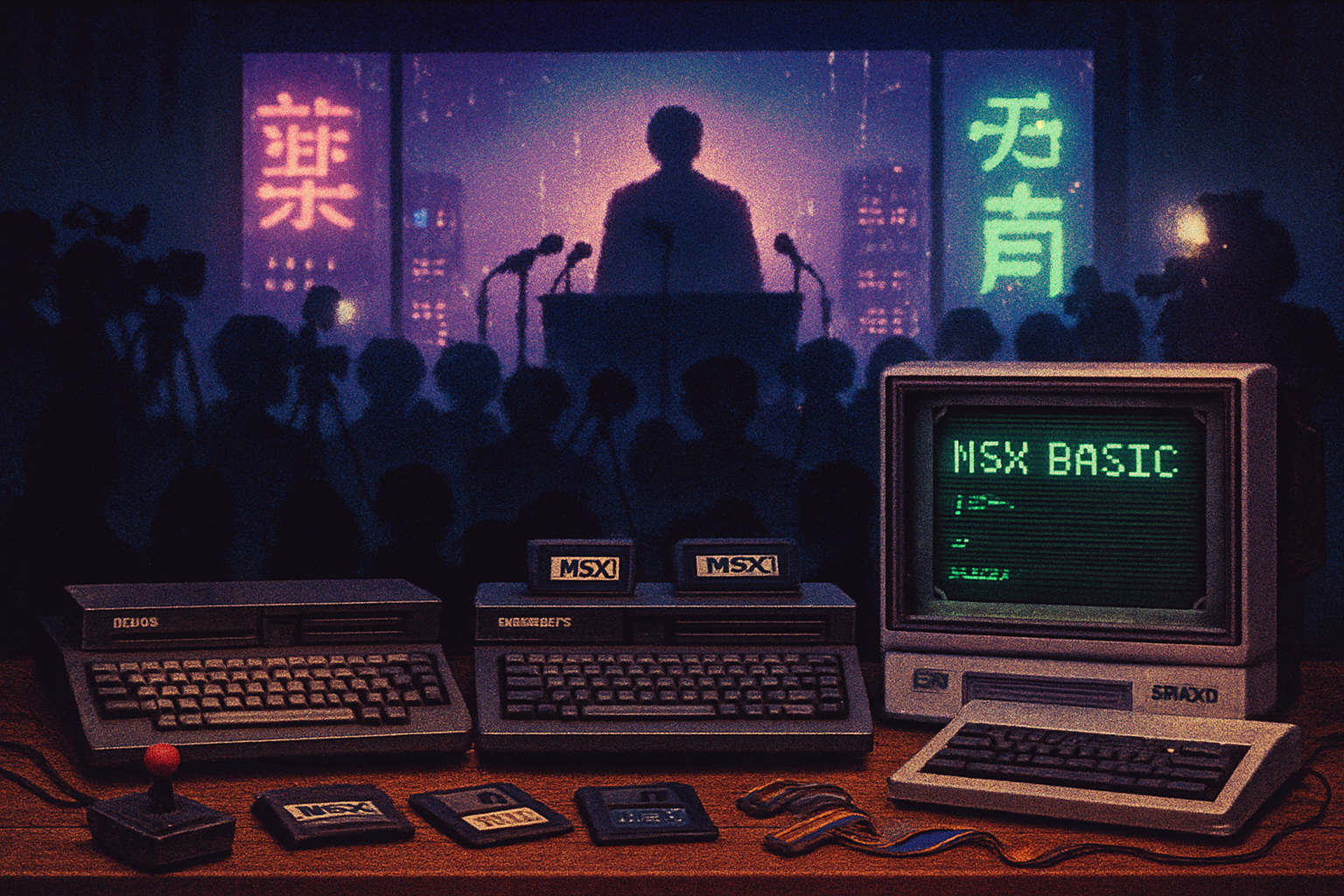
They took the stage in Tokyo with a confident slogan: make one standard that every manufacturer can build to, and the software world will follow. It sounded almost boring in its ambition - until you remember how often “boring” standards are the scaffolding of empires.
Japan’s MSX began as a practical, slightly imperial idea: unify the scattered 8-bit home-computer market to make software portable and simplify retail. In practice it became a half-success, a cultural touchstone in some countries, and a curious near-miss on the world stage.
The opening scene: arrogance dressed as order
Imagine the mid-1980s: arcades were loud, home consoles were getting frighteningly good, and dozens of manufacturers sold incompatible microcomputers with unique BASIC dialects and incompatible cartridges. Kazuhiko Nishi - the charismatic executive at ASCII - and Microsoft Japan sought to change that. The result was MSX, announced in 1983, a standard built around the Zilog Z80 CPU and Microsoft’s MSX-BASIC, meant to guarantee that software would run across machines from Sony, Panasonic, Sharp, Yamaha and many others [https://en.wikipedia.org/wiki/MSX].
It was fighting fragmentation with specification. There was a moral clarity to it: if you own the standard, you get the apps, and if everyone agrees on the standard, software publishers can sell everywhere without rewriting the code on every platform.
What MSX actually was (and how it worked)
- A hardware standard, not a single machine. Many companies could and did build MSX-compatible hardware.
- Built on the familiar Zilog Z80 CPU and shipped with MSX-BASIC, a Microsoft-developed dialect that sat in ROM so a new machine booted straight into a usable environment [https://en.wikipedia.org/wiki/MSX-BASIC].
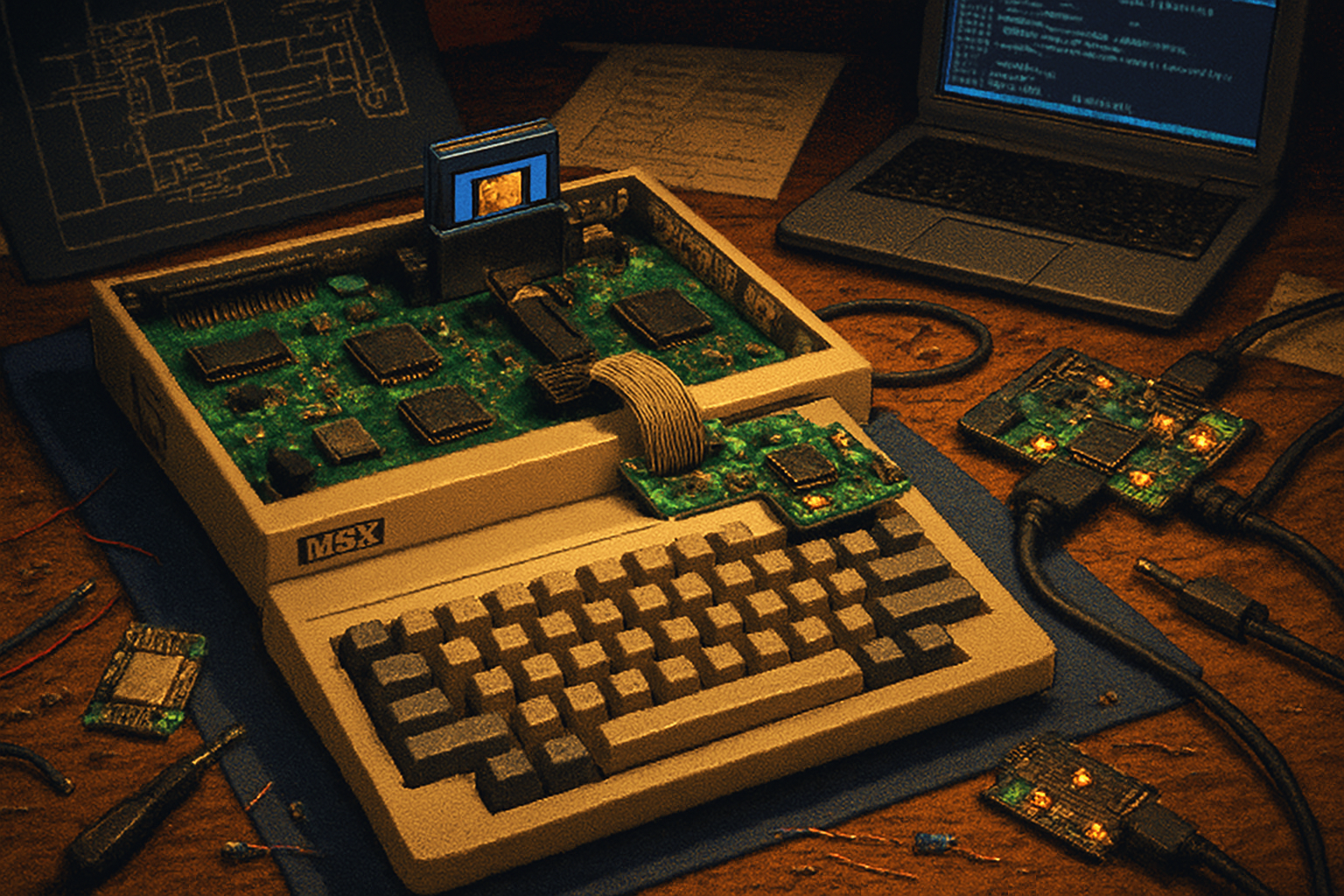
- Modular - cartridge slots, standard ports, expansion options. The idea was cross-compatibility: cartridges and floppy software should run on any MSX machine.
- It evolved - MSX2 (mid-1980s) improved graphics and memory, and later MSX Turbo R tried to modernize the architecture again [
Put simply: MSX was the “PC-compatible” idea for 8-bit home machines. It was bureaucratic, tidy, and - compared with the wild west of early 80s home computing - sensible.
Who signed up - and why it mattered
MSX wasn’t some niche hobby project. Major consumer-electronics firms adopted the standard: Sony, Panasonic (Matsushita), Toshiba, Sharp, Sanyo, Philips, and several others released MSX models for their local markets. That corporate buy-in gave MSX instant retail legitimacy in places where those brands mattered.
Software houses followed. In Japan especially, Konami and other publishers produced excellent MSX titles; notably, Hideo Kojima’s Metal Gear debuted on the MSX2, not on a Nintendo console [https://en.wikipedia.org/wiki/Metal_Gear_(1987_video_game)], which tells you how serious some developers took the platform.
Early momentum - not quite a wave
In Japan and parts of Europe, MSX gained traction. Consumers liked familiar brand names and a guaranteed software library. In markets such as the Netherlands, Spain and Brazil, MSX machines became staples in homes and schools. For certain countries, MSX was the default PC - the computer you learned programming on, the one your favorite games ran on, the first machine you typed a BASIC program into.
But “traction” is not the same as “domination.”
Why MSX failed to become the global standard it seemed destined to be
There’s a rare cruelty to standards: you can be right and still lose.
Market timing and incumbents
- In North America the Commodore 64 and Apple II already had entrenched ecosystems, massive retail presence, and developer loyalty. Retailers and consumers didn’t need another format.
- The impending rise of IBM PC compatibles and MS-DOS for business further shifted developer and retailer attention away from 8-bit home standards.
Nintendo’s console juggernaut
- The Famicom/NES had a seismic effect on gaming. Consoles started to eat the market for home entertainment software - cheaper, sleeker, and stocked with arcade-quality games. Developers followed the money to consoles, where the lifecycle and sales numbers were irresistible [
Corporate self-interest and shifting priorities
- Many Japanese electronics giants had built businesses around differentiation. They liked MSX as an idea - until they realized they could instead leverage their own ecosystems and branding. Proprietary features and product lines frequently distracted firms from pushing a single global standard.
A standard with layers
- MSX guaranteed software compatibility at its core, but successive revisions (MSX2, MSX2+, Turbo R) and optional audio/video modules meant that there were degrees of compatibility. For software houses that wanted the loudest colors or FM sound, the “lowest common denominator” argument weakened. Developers still had to target specific configurations to take advantage of advanced features.
Weak US strategy
- Microsoft’s role was crucial for BASIC and firmware, but the company didn’t aggressively push the MSX standard in the U.S. like it later pushed MS-DOS on IBM-compatible hardware. The coalition that would have been required to dethrone the Commodores and Apples of the world didn’t form.
Distribution, branding and marketing
- Success in consumer electronics is half product and half retail math. Where MSX lacked a strong, coordinated retail push in the U.S. and the UK, consoles and incumbent micros dominated shelves and advertising budgets.
The result: MSX prospered regionally but never became the universal standard its creators had pitched.
The political and economic backdrop - more than a tech story
This is a textbook case of how geopolitics and business incentives shape technology. Japan’s electronics industry was powerful, but it was also competitive and decentralized. Companies were simultaneously collaborators (MSX standard) and competitors (own chipsets, own branding). Meanwhile, outside Japan the market structure didn’t favor a Japanese-led standard unless an American or European ally lent significant economic muscle.
Another factor is taste: consumers buy experiences, not specifications. If the best action game in town is on Nintendo, then hardware compatibility matters less than the catalogue of hits.
The final act: expensive, late, and too little
When MSX Turbo R arrived in 1990 promising a leap forward, the world had moved on. 16-bit consoles, 16-bit home computers, and the impending 32-bit era meant expectations had shifted. The Turbo R was technologically interesting but commercially too late to change the trajectory.
By the early 1990s the standard was a niche. But that’s not an epitaph; it’s the beginning of a cult.
Legacy: why MSX still matters to retro fans (and what it taught the industry)
- Cultural legacy - In countries where MSX was prominent, it shaped a generation of programmers and game developers.
- Software lineage - Important franchises and developers cut their teeth on MSX hardware. Kojima’s Metal Gear is the most famous example [
- Community and preservation - Emulators like openMSX and active preservation communities ensure the platform’s software and history survive [
Lessons for product designers and strategists:
- Standards need pushers and shepherds. A good idea needs a coalition that will bear short-term losses to secure long-term lock-in.
- Timing is everything. A platform born to standardize an era that’s already digitizing around other winners has an uphill battle.
- Corporate incentives will always strain cooperation. Companies collaborate up to the edge of competitive advantage - then they pull back.
Final thought - a phoenix with a peculiar flight path
MSX didn’t die so much as transform into a cultural artifact: a platform that was technically sensible, regionally beloved, and globally frustrated. It was a Japanese phoenix that rose briefly and brightly where local conditions favored it - then failed to set the whole world alight.
That’s not failure so much as the bittersweet fate of many great ideas: they’re brilliant, partial, and full of lessons.
Further reading
- MSX (Wikipedia): https://en.wikipedia.org/wiki/MSX
- MSX-BASIC (Wikipedia): https://en.wikipedia.org/wiki/MSX-BASIC
- MSX2 (Wikipedia): https://en.wikipedia.org/wiki/MSX2
- MSX Turbo R (Wikipedia): https://en.wikipedia.org/wiki/MSX_Turbo_R
- Metal Gear (1987): https://en.wikipedia.org/wiki/Metal_Gear_(1987_video_game)
- openMSX emulator: https://openmsx.org/