· culture · 4 min read
The Rise and Fall of Compaq: Lessons from a Tech Giant
Compaq exploded from a scrappy start-up into the world's leading PC maker - and then unraveled. This essay traces the key decisions, triumphs and missteps that carried Compaq from garage ingenuity to a messy merger with HP, and extracts practical lessons for today's tech companies.
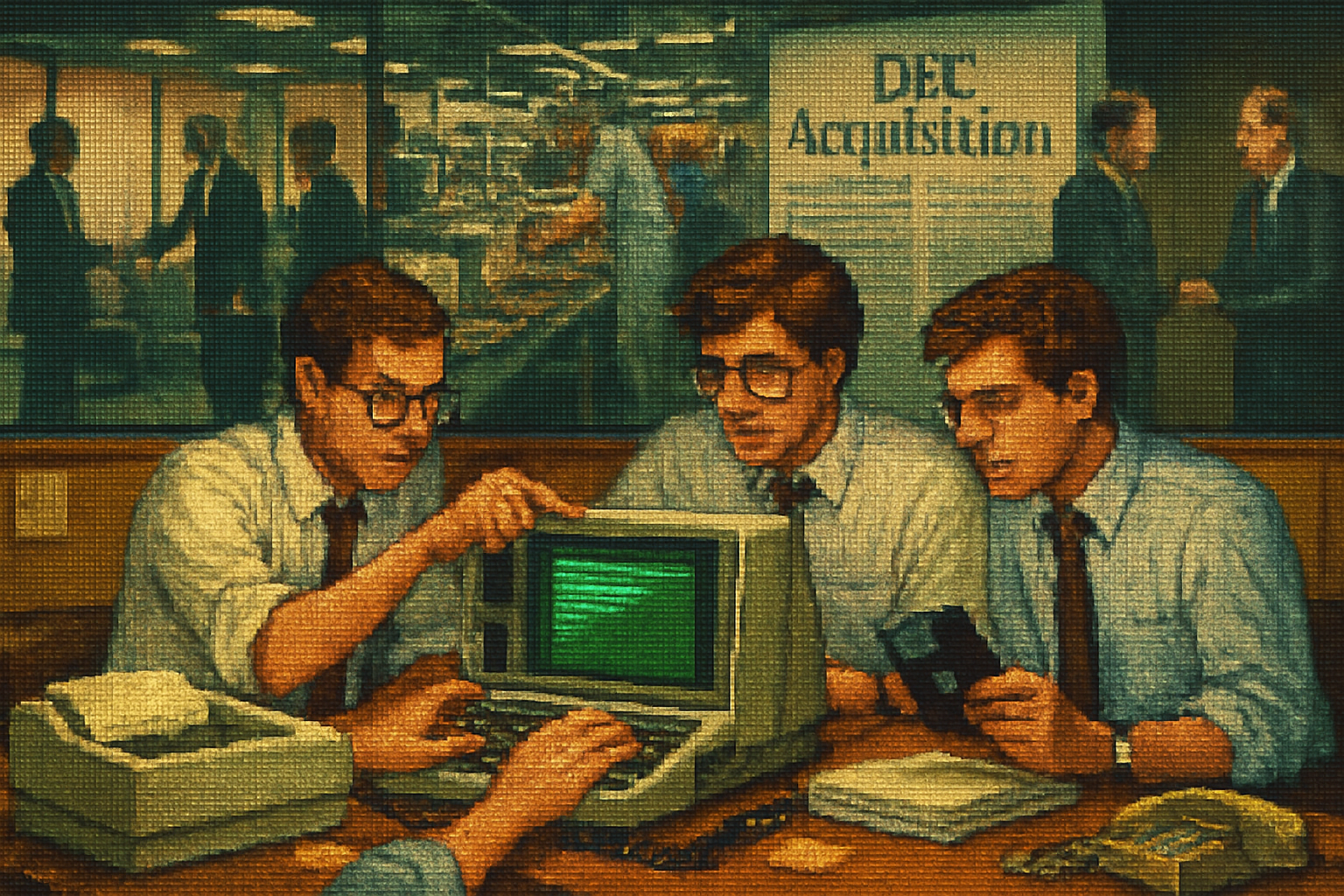
In 1983 three engineers folded a personal computer into a suitcase-sized chassis and held it up to the marketplace like a dare. It worked. It ran the same software as IBM’s PCs. It was faster, cheaper, and-crucially-compatible. Overnight, a company that had been a bold imitation became a threat. That company was Compaq.
Compaq’s story reads like a compressed novel of Silicon Valley ambition: brilliant engineering, ruthless execution, explosive growth, hubris, and finally, a series of strategic errors that turned market leadership into acquisition. For anyone who sells hardware, builds platforms, or worries that today’s “dominant” company might be tomorrow’s cautionary tale, Compaq offers clear - and uncomfortable - lessons.
How Compaq rose: three practical miracles
Compaq’s ascent wasn’t mystical. It was a textbook execution of a few simple advantages, amplified by luck and timing.
1) Product-market fit through compatibility
Compaq didn’t invent the personal computer. It cloned it-carefully. By creating a BIOS that behaved like IBM’s without copying code (a clean-room reverse-engineering approach), Compaq made machines that ran the existing universe of PC software and peripherals. That meant customers got choice without lock‑in. Compatibility was the product.
- Result - Buyers could get the same value as IBM systems at lower price or higher performance.
(See: the company and the Compaq Portable’s origin story: https://en.wikipedia.org/wiki/Compaq and https://en.wikipedia.org/wiki/Compaq_Portable)
2) Engineering discipline and speed
Compaq shipped reliable, high-performance systems quickly. The founders - Rod Canion, Jim Harris and Bill Murto - were engineers first, salespeople second. The company prioritized quality, which mattered to corporate customers buying fleets of PCs. Speed of iteration and a culture that rewarded execution let Compaq punch above its weight.
3) Distribution and enterprise focus
Compaq angled for corporate buyers and OEM business, and later mixed in aggressive retail presence. Their sales teams built relationships that made Compaq a default procurement option for many institutions. The combination of compatibility, reliability, and a field organization that could close big deals created a durable advantage.
Why Compaq became dominant
By the early-to-mid 1990s, Compaq had become the world’s largest supplier of PC systems. That rise was driven by:
- An expanding product line (desktops, laptops, servers)
- Relentless cost-management and economies of scale
- Corporate contracts and volume sales
- A brand that, for a time, signaled serious quality
Across the decade, Compaq moved from upstart to incumbent. But dominance came with its own dangers.
(Background on the company’s trajectory: https://en.wikipedia.org/wiki/Compaq)
Where Compaq went wrong: five structural failures
Success hardened into habits. Those habits calcified into strategic blind spots.
1) Confusion about the business model: growth vs. profitability
As Compaq scaled, earnings mattered less than growth for a period. Leadership pursued top-line expansion aggressively-into consumer retail, into servers, into new geographies-often sacrificing margins. When competition intensified, those thin margins were exposed.
2) The wrong acquisitions, poorly integrated
Compaq’s late-90s purchases-most famously Digital Equipment Corporation (DEC) in 1998-were intended to transform the company into a full-spectrum enterprise vendor. They instead created integration headaches, cultural clash, and complexity that diluted Compaq’s hardware focus. Buying breadth is easy; integrating product lines, salesforces and cultures is brutally hard.
(See the DEC acquisition for context: https://en.wikipedia.org/wiki/Digital_Equipment_Corporation#Acquisition_by_Compaq)
3) Losing the distribution war to the direct model
Michael Dell’s direct-to-consumer and build-to-order model undercut Compaq on price and inventory efficiency. Compaq’s heavier reliance on retail channels and channel partners meant slower response times and higher inventory costs. The company tried to be everything to everyone, and lost its edge in the one area-operation-level cost structure-where differentiation mattered.
4) Executive churn and strategic incoherence
Compaq replaced founders with new leaders; in 1991 Rod Canion was pushed out, and later Eckhard Pfeiffer became the face of breakneck expansion. Leadership turbulence produced conflicting priorities: rapid market-share grabs, then defensive price wars, then attempted enterprise transformation. Ambition outran strategy.
5) Commoditization of hardware
PCs became a utility. Margins collapsed as manufacturers competed on price rather than features. No matter how big Compaq was, that structural erosion required either relentless operational efficiency or a profitable shift toward higher-margin services-neither of which Compaq accomplished successfully before fate intervened.
The endgame: an undignified merger
In 2001–2002, Hewlett-Packard acquired Compaq in a bruising deal shepherded by HP’s CEO, Carly Fiorina. The merger was fought in boardrooms and public opinion and remains controversial to this day. For many, the acquisition marked the final vindication of Compaq’s loss of strategic direction-an industry consolidation born of diminished options.
(HP’s acquisition: https://en.wikipedia.org/wiki/Compaq#Acquisition_by_HP)
What managers and founders should learn from Compaq
Compaq’s life-cycle contains clear moral and practical lessons. Below are the most actionable.
Lesson 1 - Know which part of the stack you compete on
Compaq won by being the best IBM-compatible hardware supplier. When margins compressed, the company tried to become a services-and-enterprise software player overnight. Modern companies must ask: are we optimizing distribution, product, platform, or software? Trying to be all things at once usually produces mediocrity in every domain.
Lesson 2 - Integration is a strategy, not an afterthought
Acquisitions should answer a precise question (