· retrotech · 5 min read
Revisiting the AIM Away Message: The Art of Subtlety in Digital Communication
A short, nostalgic look at the away message-AIM’s tiny stage-and how that micro-genre evolved into modern status updates, Stories, and Slack emojis. Practical guidelines for doing subtlety well in a world that mistakes volume for meaning.
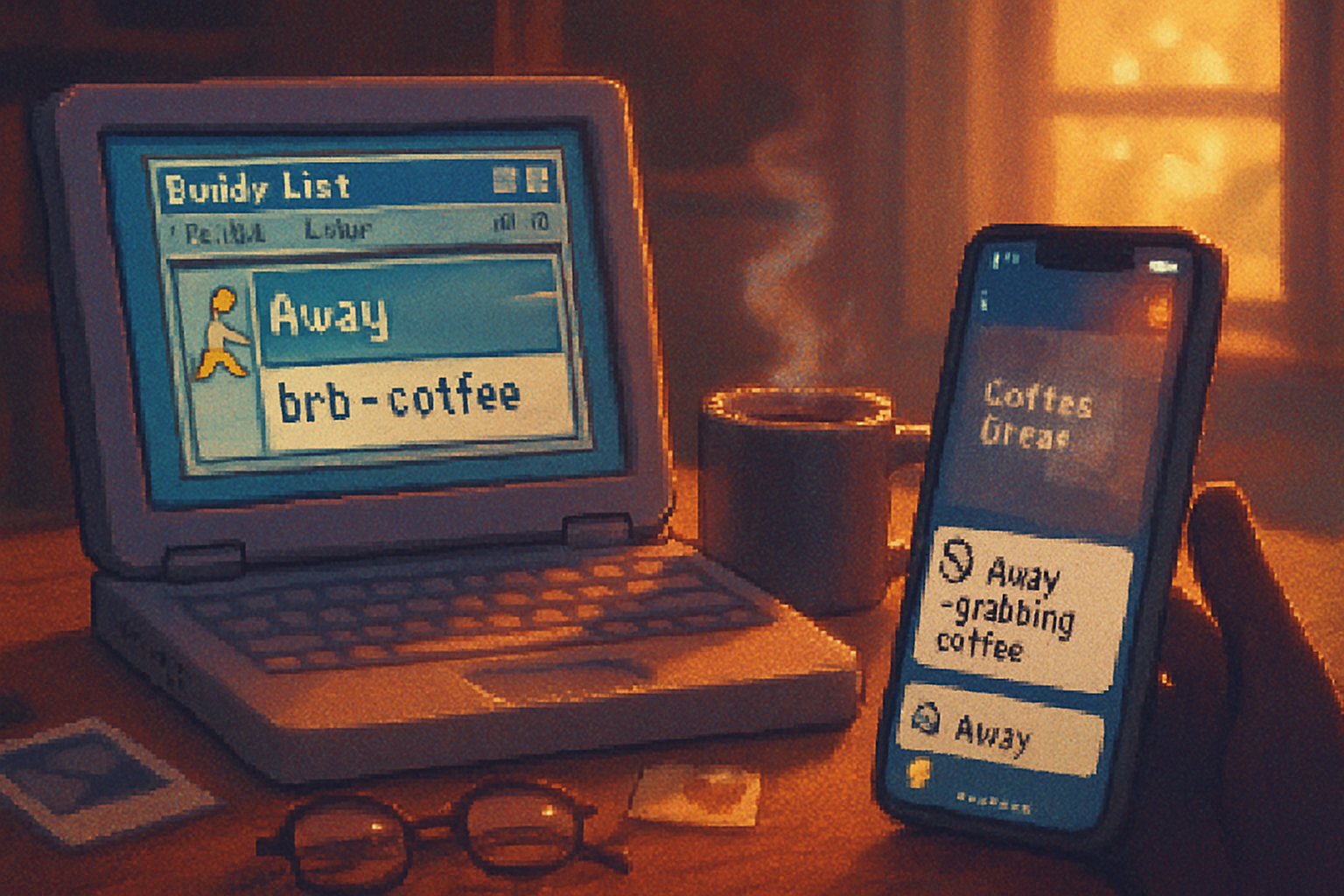
It began with three words: “brb-coffee.”
You remember the ritual. You’d log onto AOL Instant Messenger, type something half-private in the tiny away box, and the world on your friends list would read it like a headline. That short string of text performed multiple acts at once: announcement, mood-signaling, flirtation, boundary-setting, and occasionally, low-grade theatre.
That single, banal ritual was more than a convenience; it was a new language. And like every language, it taught people how to signal who they were, who they wanted to be seen as, and what kinds of contact they were willing to accept.
Why the away message mattered
Away messages looked small but behaved like a lever. They changed how people managed attention.
- Availability - It answered the basic social question-am I interruptible?-without a phone call.
- Identity - A clever line, a lyric, or a mood emoji let people curate an instantaneous persona.
- Connection - They created micro-opportunities for intimacy-cryptic messages, inside jokes, public whispering.
AOL Instant Messenger’s away box was more than UI; it was an affordance that shaped behavior. (See a short history of AOL Instant Messenger for context: https://en.wikipedia.org/wiki/AOL_Instant_Messenger.)
The mechanics of subtlety: what an away message does well
Think of an away message as a dimmer switch for social life rather than an alarm bell.
- It scales attention gently. Not “call me”; it says “not now.” Subtlety lets the other person decide what to do next.
- It performs emotion at a distance. Instead of spilling feelings in a message thread, you place a sign on your digital door.
- It allows for plausible deniability. A cryptic lyric can be an earnest confession or ironic distance. The ambiguity is the feature.
This isn’t quaint nostalgia. The psychological functions remain central to modern presence systems: the green dot, the “last seen at,” the ephemeral Story. See more on presence concepts: https://en.wikipedia.org/wiki/Presence_information.
How away messages mutated into modern status updates
The form did not die; it multiplied and mutated.
- Status updates (Facebook/Twitter/X bios) made the away message public and permanent. The stage grew, the act changed.
- “Last seen” and read receipts (WhatsApp, iMessage) inverted things-people could track absence and demand explanations.
- Stories and ephemeral statuses (Instagram, Snapchat) returned the away message’s temporality - visible, performative, but transient.
- Slack/Discord hybridized availability with work signaling - emoji + timer + context, public within teams, performative within organizations.
Each change altered the social contract.
- Permanence increases stakes. A bio is a billboard; an away message was a sticky note.
- Visibility expands audience. Public statuses invite performance and policing.
- Granularity grows. Modern platforms let you specify who sees what-audience control is an ethical tool and a power play.
The emotional economy of small signals
We underestimate short messages. A single line-”in a meeting,” “brain fried,” “on a plane”-moves other people’s emotional labor. It tells them whether to escalate, to wait, to check in later.
Small signals buy people time. They are a low-cost way of preserving social capital. Or, when abused, they become cheap manipulations: weaponized vagueness, passive-aggression, or performative unavailability.
A few recurring patterns:
- The boundary-setter - clear, concise, and useful. Example: “In a meeting until 3pm-urgent texts only.” Calm, adult.
- The performative poet - lyric fragments and song lines. Deliciously ambiguous. Useful for courting attention, but fragile in professional spaces.
- The ghosting buffer - vague phrases that deflect responsibility-”busy” or “offline for a bit.” They protect the author but can inflict anxiety.
Good away messages - templates that do the job
Here are concise templates you can actually use depending on context. They respect other people’s time while keeping your dignity.
- Professional - Slack / Teams:
- “On deep work until 2pm-DM for urgent items.”
- “Heads down on deliverable; I’ll reply after standup.”
- Hybrid / Social:
- “At the dentist, will reply later-send memes.”
- “Phone on airplane mode. Replies after landing ✈️”
- Playful / Intimate:
- “Fetching coffee for the emotional engine. BRB.” (winks)
- “If you’re reading this, leave a song rec. I’ll reply with one.”
Short, specific, and with an implied action earns the highest social return.
When subtlety becomes cruelty: the traps
Subtlety is an art. It can be kind or cruel.
- Passive-aggression - The snarky line meant for one person becomes public pettiness.
- Surveillance - “Last seen” and read receipts turn absence into evidence. People become accused of emotional sloth.
- Overperformance - Constant performative statuses signal insecurity. If every line is a soliloquy, nothing means much.
The aim should be to reduce friction, not manufacture drama.
Rules of thumb for modern status craft
- Audience first. Who reads this? Colleagues, friends, the public? Customize.
- Purpose next. Signal availability, share a mood, request a response, or entertain? Don’t confuse goals.
- Keep it brief. Subtlety is about restraint. A clear three- to eight-word line often outperforms a paragraph.
- Use affordances. If your platform has “do not disturb,” use it. If you can schedule a status, schedule it.
- Be honest within limits. You don’t need to list every emotion. Offer enough to orient others.
The small theater of the everyday
The genius of the away message was that it made absence legible. It turned a private state into a public micro-claim: “I exist, but not right now.” That modest dramaturgy taught us how to manage desire, make requests, and practice small mercies.
Today we have richer tools and harsher audiences. Statuses are louder, more permanent, and more surveilled. The instinct to be performative is stronger, too. Which is why the old art-brevity, clarity, ironic distance-remains valuable.
If you want to be interesting, be intentionally unavailable sometimes. Not to punish; to create breathing room. Social life is oxygen. You notice it only when it’s missing. A good away message is a small valve that keeps the air moving.
References
- AOL Instant Messenger - history and context: https://en.wikipedia.org/wiki/AOL_Instant_Messenger
- Presence information (how systems represent availability): https://en.wikipedia.org/wiki/Presence_information