· retrotech · 7 min read
Nostalgic Bytes: How Encarta Influenced Modern Educational Software
Encarta was a tiny, curated museum in a CD-ROM. Its design choices - multimedia articles, search-first UX, playful learning tools and curated authority - quietly seeded many patterns in today’s e-learning platforms. This article traces that lineage and imagines how the spirit of Encarta could be revived for modern learners.
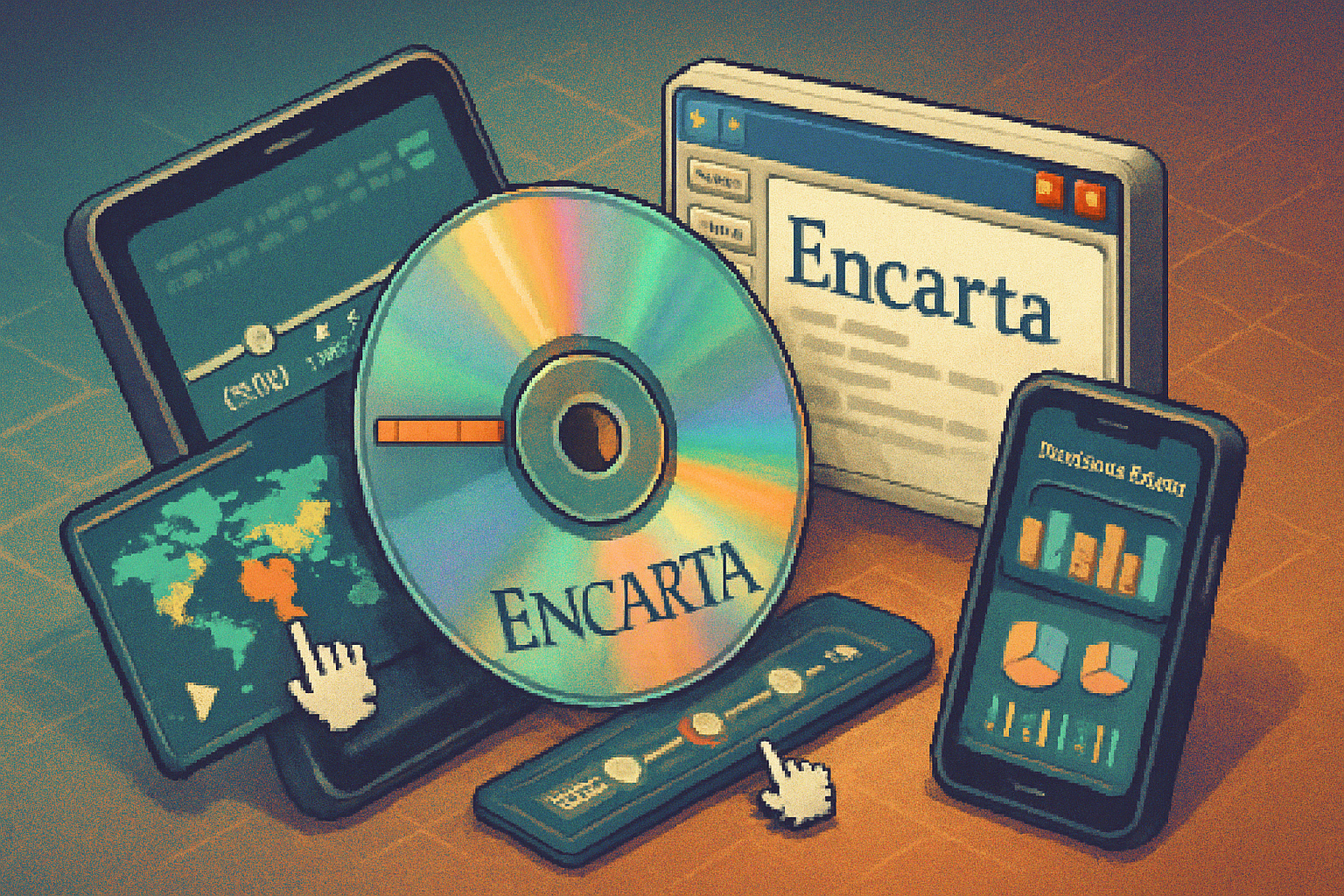
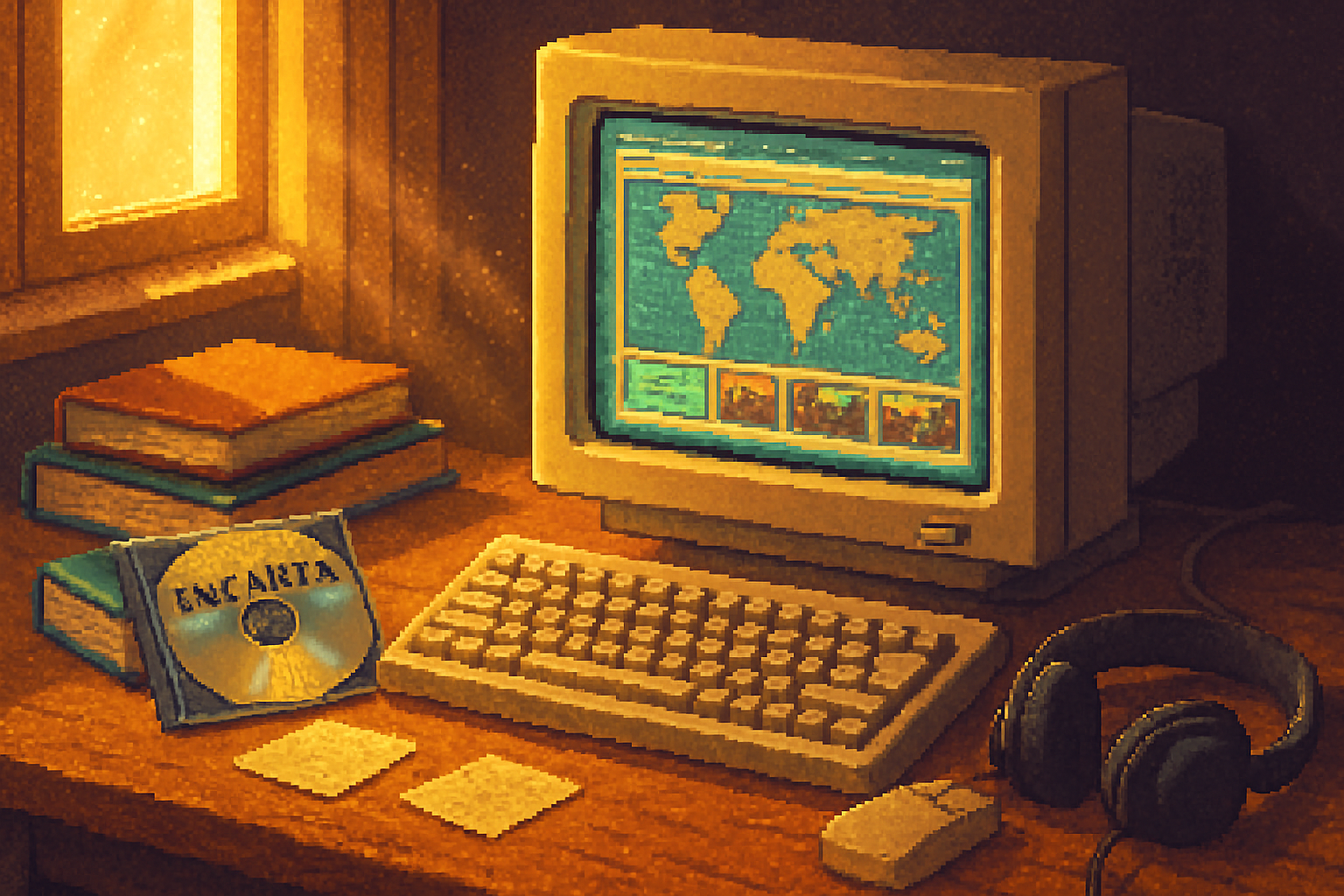
January 1998: a thirteen-year-old me sat cross-legged on a carpet, the Encarta CD-ROM whirring like a small, patient engine. I typed “volcano” and the screen returned a friendly article, a clickable map, a video clip of lava, and a hokey quiz that made geology feel like a game. It wasn’t the internet, and that was the point. Encarta felt complete. It had authority, polish, and a sense of closure that the wild web would never quite replicate.
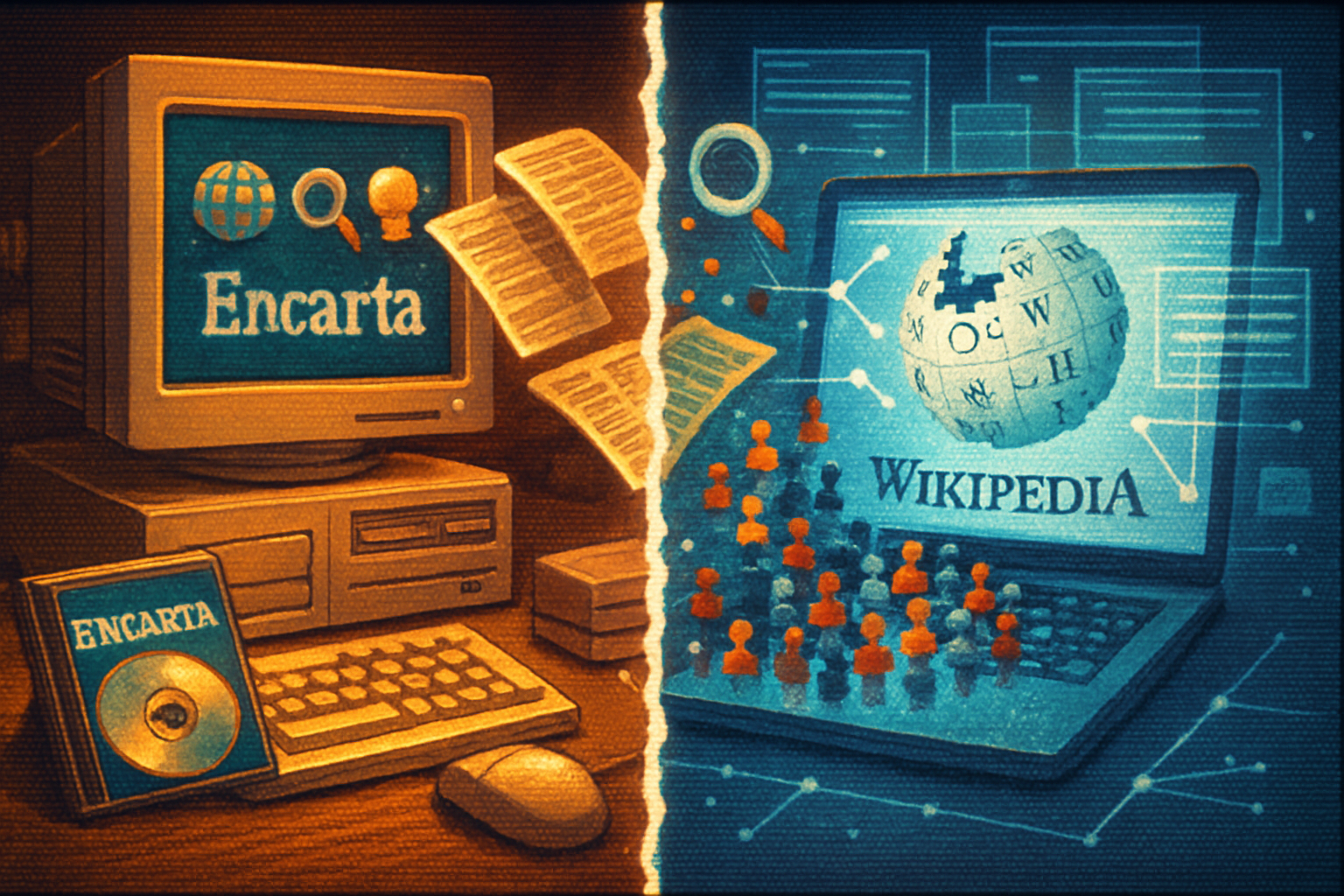
Encarta was not just software; it was an argument about what knowledge should feel like: packaged, curated, multimedia, and pleasurable to explore. Microsoft launched Encarta in 1993 as a CD-ROM encyclopedia and later expanded it online; it was discontinued in 2009 as the web and Wikipedia ascended [https://en.wikipedia.org/wiki/Microsoft_Encarta]. The demise was inevitable. Yet the influence of its interface choices, pedagogical toys, and product thinking lives on in places you might not immediately credit: modern e-learning platforms, interactive apps, digital textbooks, and even adaptive tutoring systems.
This piece maps that influence, calls out what worked (and what didn’t), and sketches how the “spirit of Encarta” could be reborn for learners in 2026.
What Encarta actually brought to the table
Encarta’s magic was simplicity dressed as sophistication. Strip away nostalgia and you have several concrete design primitives that were novel for the time and remain influential.
- Multimedia-first articles - prose interwoven with images, audio clips, short video sequences, and maps. The idea: explain, then show - or better, explain while showing.
- Embedded interactive widgets - timelines, maps with clickable regions, and simple animations that let learners manipulate variables (e.g., layers on a map, chronology sliders).
- Search-centred navigation - you could search for a term and land on a compact, authoritative packet of knowledge rather than a scattered list of links.
- Curated authority and editorial voice - Encarta had named editorial teams and a curated editorial perspective, which gave trust in an era before crowd-sourced fact-checking.
- Offline availability - CD-ROMs meant whole libraries could be used without internet - crucial in low-bandwidth environments.
- Low-stakes assessments - quizzes and “Did you know?” facts made exploration playful.
Those design decisions weren’t academic. They solved real problems faced by learners and teachers at the time: limited connectivity, uneven information quality, and the need for a single, trusted resource.
Where Encarta’s DNA shows up today
You can see the echoes of Encarta across the modern edtech landscape. Here are a few concrete parallels.
Khan Academy and curated micro-lessons - Short, media-rich explainer units with exercises reflect Encarta’s bite-sized, multimedia packets. Khan Academy’s curated pathways borrow the idea of assembled, trustworthy learning sequences [
Britannica and curated authority online - Encyclopedias moved online, but the editorial lineage of Encarta survives in Britannica’s efforts to combine editorial rigor with multimedia presentation [
Interactive e-books and enhanced textbooks - Many modern e-textbooks embed videos, simulations, and assessments directly in the reading flow - an explicit descendant of Encarta’s integrated widgets.
Learning Management Systems (LMS) and modular content - Systems like Canvas and Moodle allow content packages - modules that mix media, readings, and quizzes - echoing Encarta’s self-contained article packets.
Educational apps and games - The playful quizzes and low-stakes interactivity of Encarta prefigure the gamification trend that now powers Duolingo, Kahoot, and similar services.
Offline-first design - In regions with poor connectivity, offline-capable learning packages (e.g., Kolibri) are a practical resurrection of Encarta’s offline promise.
Each of these systems improved on aspects of Encarta - better adaptive algorithms, cloud collaboration, mobile-first design - but many inherit the core conviction that media-rich, logically-packaged content helps learning.
What Encarta got wrong (and why we shouldn’t copy it blindly)
Not everything was noble about Encarta. A candid revival should learn from its mistakes.
Proprietary gatekeeping - Encarta was paywalled and centrally edited. That made it authoritative but limited its reach and stifled community contribution. Wikipedia’s rise shows the power of openness.
Static updates vs. living knowledge - The CD-ROM model made updates slow and expensive. The web’s rapid iteration model crushed that cadence.
A top-down voice - Editorial authority was strong, but it could also be tone-deaf or culturally narrow.
Poor integration with classroom workflows - Encarta was more of a reference than an integrated classroom tool with analytics, assignment workflows, and teacher dashboards.
Any modern product inspired by Encarta needs to blend its strengths with the openness, agility, and community-mindedness of the contemporary web.
Could the spirit of Encarta be revived? Absolutely. Here’s how.
“Revive Encarta” doesn’t mean cloning the 1997 UI. It means extracting its best lessons and rebuilding them with modern tech and pedagogy.
A modern “Encarta 2.0” should aim for three core promises:
- Curated, multimedia-first learning packets - polished, trustworthy, and modular.
- Offline-first availability for low-bandwidth contexts.
- Teacher-friendly integrations with analytics, assignments, and adaptable pathways.
Below are product features and a suggested minimum viable product (MVP).
Essential features for Encarta Reimagined
- Modular Multimedia Articles
- Short, searchable learning packets with text, images, short video, interactive timelines and maps, and a 2–3 question quick quiz.
- Offline-first Progressive Web App (PWA)
- Installable on phones/tablets. Cache modules for offline use. Sync when online.
- Adaptive learning pathways
- Simple personalization - pretests route learners to modules; quick analytics show what to revisit.
- Teacher dashboard and shareable playlists
- Teachers create playlists of modules, assign pre/post checks, and get anonymized class analytics.
- Sources and provenance
- Each claim has a visible provenance link (editor, date, sources). Allow community-suggested corrections with editorial review.
- Micro-credentials and low-stakes badges
- Tiny certificates for completing modules - signaling motivation rather than gatekeeping.
- Localized content and community contributions
- Allow licensed local publishers/educators to contribute or adapt modules under clear licensing.
- Privacy-first analytics
- Simple, aggregated metrics that respect student privacy.
Imagined tech stack
- Frontend - React or Svelte for PWA, service workers for offline caching.
- Backend - Headless CMS (e.g., Strapi) holding modular content; optional GraphQL for efficient delivery.
- Media - Adaptive streaming for video, vector maps and SVG timelines for small size.
- AI - LLM-assisted summarization for educators to quickly make module drafts; moderated suggestions rather than automated publishing.
- Delivery - CDN + regional sync nodes to allow low-latency offline sync in low-bandwidth regions.
Business model options (learned from Encarta’s failure)
- Freemium core + institution licenses - free access to basic modules, paid features for advanced analytics and LMS integration.
- Public–private partnerships - subsidized deployments for schools in low-bandwidth regions.
- Publisher partnerships - white-label modules sold to districts or publishers while keeping a free public tier.
A sketch of an MVP learning flow
- Student opens the PWA, searches “volcano”.
- The app returns a 6-minute multimedia packet - 500–700 words, 2 images, a 90-second explainer video, an interactive map showing volcano belts, and a 3-question quick quiz.
- Student completes the quizzes; the app suggests two follow-up modules and a 5-minute simulation where the student manipulates eruption variables.
- Teacher sees aggregated class performance and assigns a short project linking the volcano module to a local field trip.
It’s simple, purposeful, and intentionally bounded - the opposite of the infinite-scroll research rabbit hole.
The social and ethical guardrails
If you build a curated learning product, you must be explicit about editorial choices.
- Transparency - show who edited the module, what sources were used, and when it was last updated.
- Openness - allow community contributions but with editorial review to avoid the descent into mendacity.
- Equity - prioritize offline access and localization to avoid creating a polished product for only the well-connected.
Final defense of nostalgia (and the last warning)
Nostalgia can be deceptive. We remember the good parts: tidy interfaces, helpful animations, and a sense of intellectual completeness. We forget the reasons those interfaces existed - limited connectivity, scarcity of good media, and a pre-web economics that favored gatekeepers.
But nostalgia is also a map. Encarta shows that learners like things that are polished, curated, and fun to explore. They like the feeling that a single resource understands the subject and has done the heavy lifting. Modern edtech should not merely chase novelty - it should bring the rigor and delight of Encarta into the realities of a connected, plural, and often offline world.
So yes: revive the spirit. But do it with humility, openness, and a modular mind. Give learners tools that feel finished, teachers tools that work with classrooms, and communities the ability to contribute without surrendering truth. Build something that doesn’t make knowledge look like a museum exhibit - make it look like a museum you can walk into, rearrange, and help curate.
References
- Microsoft Encarta - Wikipedia: https://en.wikipedia.org/wiki/Microsoft_Encarta
- Khan Academy: https://www.khanacademy.org/
- Britannica: https://www.britannica.com/