· retrotech · 8 min read
Encarta vs. Wikipedia: The Battle for Digital Knowledge
A comparative exploration of Microsoft Encarta and Wikipedia - two rival philosophies of knowledge. How did editorial control, community participation, accuracy, and business models shape their destinies? And could a modern, curated Encarta thrive in an era built on network effects and free information?
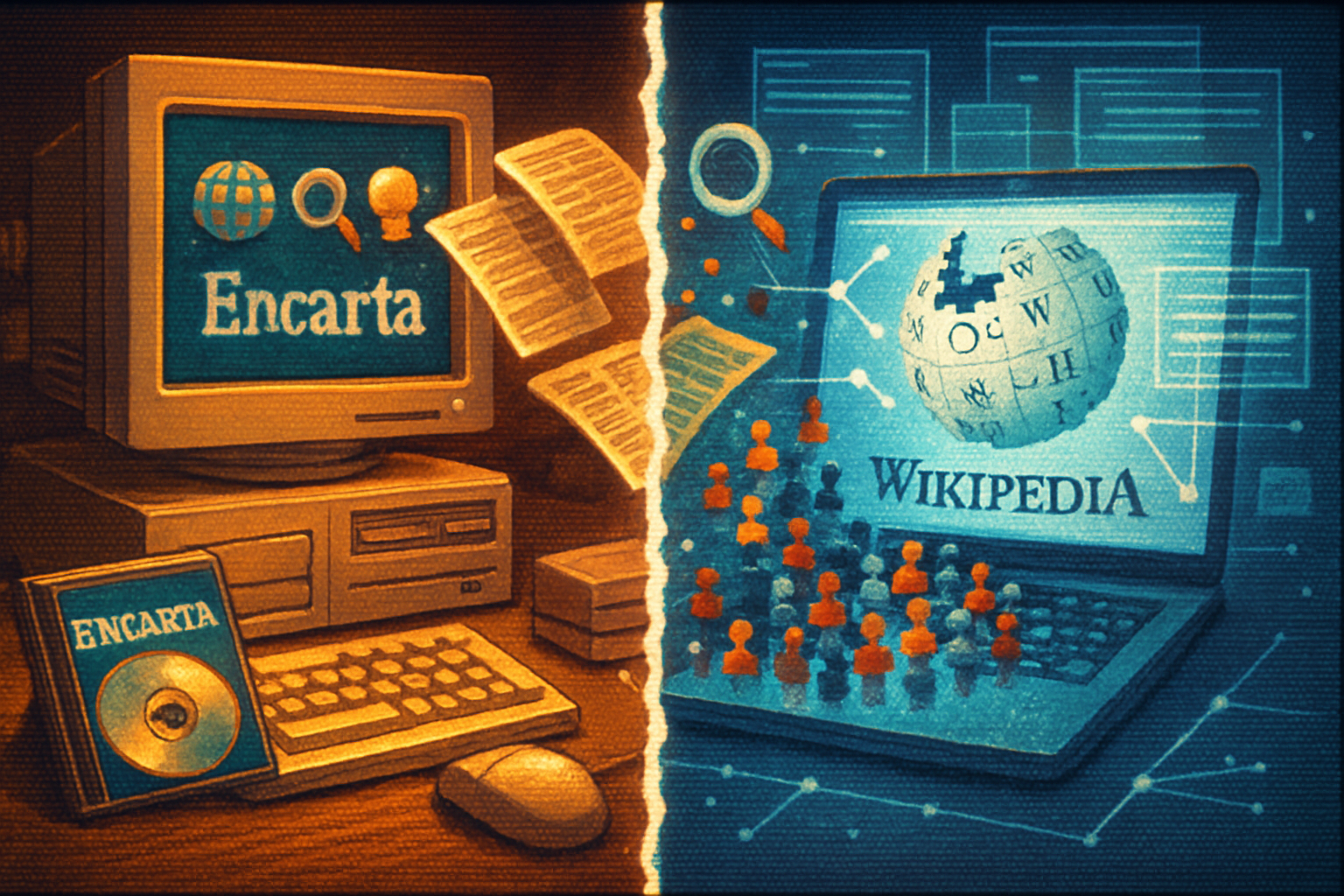
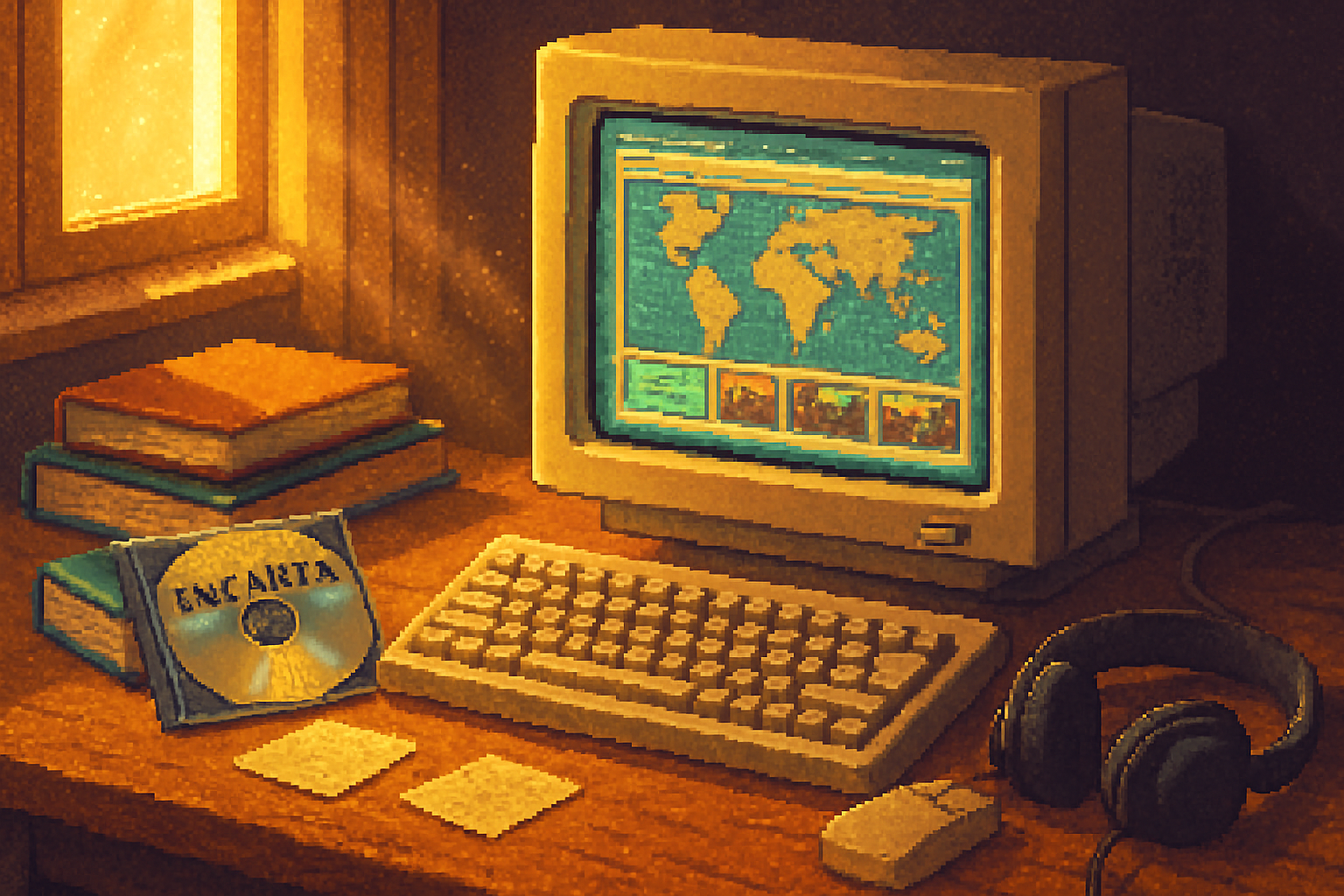
When my sister booted our family PC in 1997 and slid the Encarta CD into the tray, the house fell into a different quiet. No browser tabs. No notifications. Just a tidy, authoritative universe of articles, images, and multimedia that had been carefully chosen, edited, and stamped with a corporate imprimatur. It felt adult. It felt finished.
Fast-forward: a teenager in 2005 folds open a laptop, types a question into Google, and lands on an article assembled, edited, and constantly revised by strangers across the globe. The tone is conversational. The article is long. The edit history is longer. The teenager trusts it. Or at least, trusts that it will be updated by tomorrow.
Two moments. Two philosophies. Two business models.
This is the story of Encarta versus Wikipedia - a clash between curated authority and open collaboration - and what that fight tells us about how we want our facts delivered.
A quick primer: what were Encarta and Wikipedia?
Encarta was Microsoft’s packaged encyclopedia (launched 1993, expanded through CD-ROMs and later the web). It employed paid editors, licensors, and multimedia teams. It was curated, closed, and monetized through sales and bundling with Windows and educational products. See the Encarta overview on Wikipedia for dates and background: https://en.wikipedia.org/wiki/Encarta.
Wikipedia launched in 2001 as an open, wiki-based encyclopedia where volunteer editors could write and edit entries. It relied on community norms, transparent edit histories, and a model of openness that encouraged scale. More on Wikipedia: https://en.wikipedia.org/wiki/Wikipedia.
Encarta closed in 2009 as Microsoft bowed to the economics of the web and the impossibility of competing with a free, rapidly expanding information commons (news coverage at the time from the BBC: https://news.bbc.co.uk/2/hi/technology/8301735.stm).
Two rival philosophies of knowledge curation
Think of knowledge as food.
Encarta was a fine-dining restaurant. The plates are served by trained hands. The menu is limited, but carefully prepared. Liquor licenses and inspectors make sure hygiene is OK. You pay for the privilege.
Wikipedia is an immense, chaotic food market. Anyone can set up a stall and start selling. Some stalls are spectacular. Some are horrible. The best stuff spreads because it’s visible, tastier, cheaper, and often free.
These metaphors map onto real differences:
Editorial control - Encarta employed subject-matter editors and contracted writers. Wikipedia relies on distributed volunteer editors and policies like verifiability and neutral point of view.
Transparency - Encarta’s editorial decisions were opaque. Wikipedia displays edit histories, talk pages, and citations publicly.
Speed and scale - Wikipedia scales horizontally - thousands of small edits update pages in minutes. Encarta scales slowly and is limited by paid editorial capacity.
Incentives - Encarta’s incentives were commercial and reputational for Microsoft. Wikipedia’s incentives are reputational within a community and, critically, network-driven - the more contributors and readers, the stronger the product.
Accuracy: the famous Nature experiment and what it really meant
The oft-cited 2005 Nature paper that compared Wikipedia and Britannica found a similar number of errors in a sample of science entries - a result that shocked many (Nature: “Internet encyclopaedias go head to head” https://www.nature.com/articles/438900a). But the finding is nuanced.
The sample was limited (scientific articles only). Errors were of different sorts. Wikipedia’s errors were often of omission or phrasing; Britannica’s were more likely to be dated or subtly biased.
Accuracy isn’t a single axis. It comprises factual correctness, sourcing, comprehensiveness, readability, and the likelihood of being corrected quickly.
Wikipedia’s model trades a higher baseline noise (vandalism, rough prose) for rapid correction and eventual comprehensiveness. Encarta offered lower noise but limited reach and updates.
So - similar accuracy under certain conditions, but different guarantees. One is guaranteed by centralized gatekeeping. The other is guaranteed by crowdsourced correction and transparency.
User engagement: passive consumption vs. active stewardship
Encarta treated users like consumers. The product delivered vetted facts and multimedia; the user consumed. Education systems loved it because teachers could rely on a consistent, controlled source.
Wikipedia treats users as participants. The ability to edit is a design choice that converts readers into custodians - or saboteurs. That participatory architecture produces two powerful advantages:
Feedback loops - wrong facts tend to be corrected because people who notice errors can edit directly.
Community norms and governance - policies, administrators, and dispute-resolution systems create a scaffolding that scales beyond any single commercial team.
Engagement became a feature, not an afterthought. In the attention economy, that’s everything.
Business model and sustainability
Encarta’s model was straightforward: sell a product (CDs, later subscriptions), bundle with software, or license content. It required constant editorial expense and a buyer willing to pay for a closed product.
Wikipedia’s model is donation-driven and non-profit. Costs scale with traffic (server costs, community support), but the labor - millions of hours of volunteer editing - is effectively subsidized by the community.
Network effects matter. Google sends traffic to Wikipedia; Wikipedia benefits from being indexed and shared for free. Encarta could not match that viral visibility without becoming free - which would have undermined its revenue.
The wildcards: bias, vandalism, and trust
Bias - Encarta reflected editorial choices, licensing agreements, and Microsoft’s worldview. Wikipedia reflects the biases of its dominant editor cohort (which historically skewed Western, male, and technically-oriented). Neither is neutral; both are contestable.
Vandalism - Wikipedia gets vandalized. It gets fixed. Encarta didn’t have vandalism, but it could carry errors longer because fewer eyes saw every article.
Trust - People often think about trust as binary. It’s not. For many routine queries, immediate accessibility and perceived currency matter more than formal provenance. Wikipedia wins there; Encarta won with institutional trust.
Could a modern Encarta survive today?
Short answer: Yes - but only as a niche product. Not as a universal replacement for Wikipedia.
Why it’s hard:
Network effects - Wikipedia’s scale is magnetic. It’s where readers, editors, and search engines point. A new curated encyclopedia must buy attention.
Expectations of free access - People expect basic facts to be free. Even deep users resist paywalls when the free alternative is ‘good enough.’
Velocity - News cycles and scientific updates move fast. A slow editorial team struggles to keep up without massive investment.
Where a modern Encarta could thrive:
Specialization - Deep, peer-reviewed work in high-trust domains (medical, legal, cultural heritage). Think of the Stanford Encyclopedia of Philosophy as a model - an academically curated product that survives because of expertise and institutional backing:
Hybrid models - Paid, expert-curated content layered on top of open content. Imagine a Wikipedia-like base with an Encarta-quality overlay for verified, “publisher certified” entries.
Platform partnerships - Embed curated content into educational platforms, museums, and corporate learning systems where buyers will pay for reliability and curation.
AI-assisted editing - Use large language models to draft and surface updates, then have expert editors verify. This reduces editorial cost while maintaining quality - provided the verification step is ironclad (and watch out for hallucinations).
Examples of survivable strategies:
Encyclopaedia Britannica shifted to a digital, subscription-friendly model and survived where Encarta didn’t (Britannica stopped print in 2012 and pivoted online: https://www.nytimes.com/2012/03/14/education/encyclopaedia-britannica-to-stop-print-editions.html).
Niche encyclopedias (medical, legal, philosophical) survive because their audiences value authoritative curation and are willing to pay or support institutional models.
Design for a modern Encarta: the blueprint
If you were building Encarta 2.0, you’d need:
- Clear positioning - decide whether you’re depth-first (authoritative essays) or trusted-snapshot-first (concise, verified facts).
- Hybrid labor model - paid experts + community curators + AI-assisted drafting. Experts review, community flags, AI accelerates drafts.
- Transparent provenance - article-level metadata about authorship, reviewers, timestamps, and evidence.
- Sustainable funding - subscriptions for institutions, licensing to educational vendors, and grants.
- SEO and discoverability play - a free or freemium layer to attract search traffic and funnel serious users to paid content.
- Community governance - even curated platforms need feedback loops to catch errors and evolve.
Verdict: who wins the battle for digital knowledge?
Winner in scale and ubiquity: Wikipedia. It captured the low-cost, high-velocity, participatory end of the market and centralized the world’s attention on an open commons.
Winner in curated trust (possible but niche): a modern Encarta could win in domains where authority, provenance, and liability matter (medicine, law, formal education). But it won’t unseat Wikipedia as the default gateway for everyday facts.
In the end, the contest isn’t zero-sum. Different readers want different things. Some prefer the tidy, chef-prepared meal of a curated encyclopedia. Most, most of the time, prefer the sprawling market where someone will likely have the answer by the time they blink.
Encarta failed to become free and social in time. Wikipedia won the network. The lesson isn’t that one model is morally superior; it’s that architecture shapes behavior. “Who gets to edit the world’s knowledge” is as much a social question as a technical one.
And if you miss the days of quiet, CD-driven certainty, take heart: there are still corners of the internet where experts tend the flame. They’re smaller. They cost money. They’re better lit.
References
- Encarta - Wikipedia: https://en.wikipedia.org/wiki/Encarta
- Wikipedia - Wikipedia: https://en.wikipedia.org/wiki/Wikipedia
- “Internet encyclopaedias go head to head,” Nature, 2005: https://www.nature.com/articles/438900a
- Microsoft retires Encarta, BBC News, Oct 2009: https://news.bbc.co.uk/2/hi/technology/8301735.stm
- Encyclopaedia Britannica ends print editions, The New York Times, 2012: https://www.nytimes.com/2012/03/14/education/encyclopaedia-britannica-to-stop-print-editions.html
- Stanford Encyclopedia of Philosophy: https://plato.stanford.edu/