· culture · 6 min read
Ringtones That Defined a Generation: The Nokia Symphonic Revolution
How a seven-note guitar phrase from 1902 became the sonic logo of an era - and why the Nokia tune rewired how we understood phones, identity and attention during the late '90s and early 2000s.
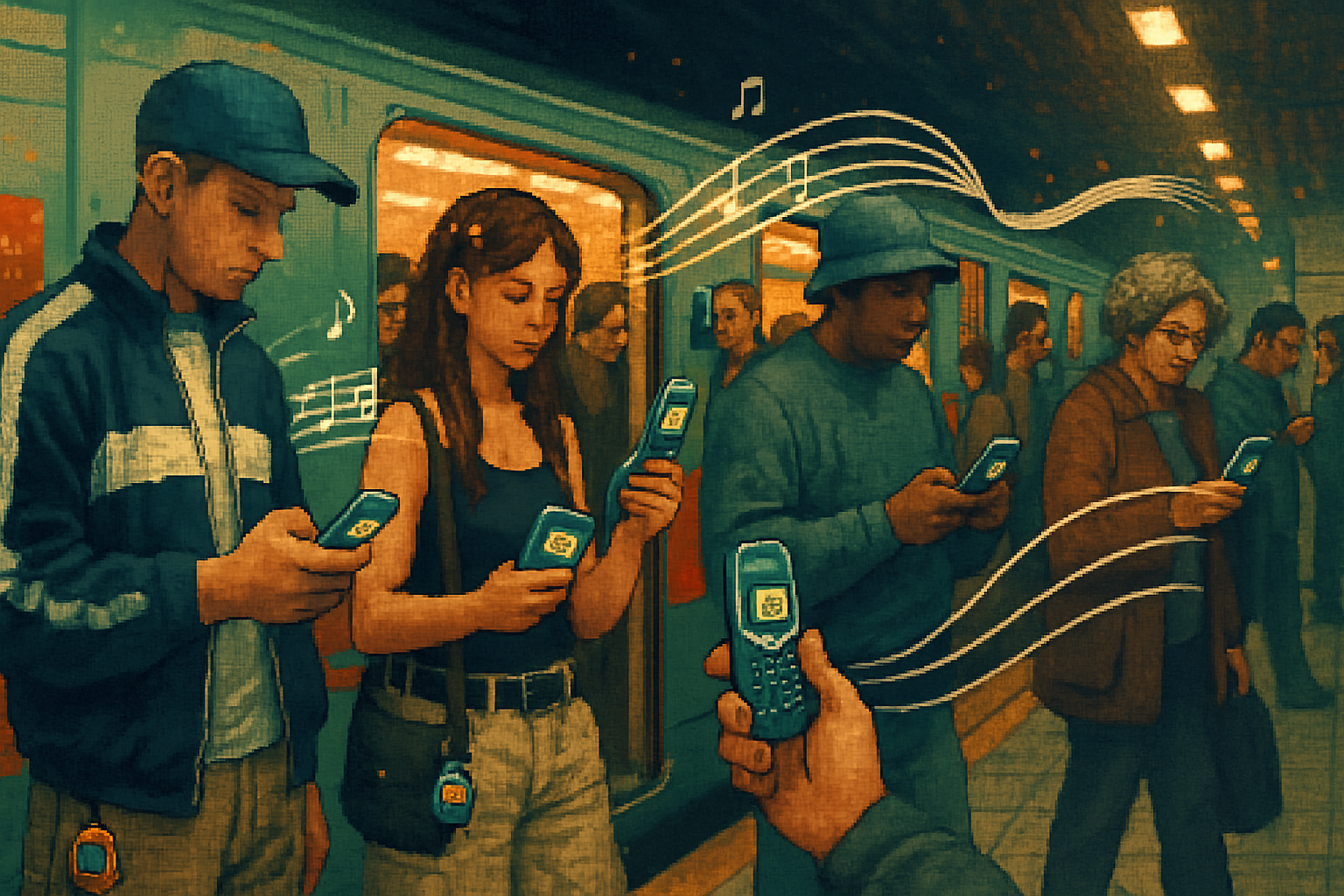
It was the sound of a moving crowd pausing mid-sentence.
You were on a school bus, a tram, or in a cinema queue in 2001 when that little arpeggio cut through - not loud, but impossible to ignore. Heads tilted, pockets were fished, conversations sputtered back to life. The tune wasn’t a pop chart hit; it was shorter than a commercial break. But for millions worldwide, it performed the same job as a national anthem: summoned attention, announced presence, and quietly declared membership.
The seven notes that took over the planet
The Nokia tune - that chilly, perfectly engineered earworm - traces back to Francisco Tárrega’s 1902 guitar piece “Gran Vals.” Nokia adopted a tiny phrase from that composition and, beginning in the mid-1990s, stamped it on its phones as a default ringtone. The melody is awkwardly elegant: just enough information to be recognizable, not enough to be exhausting. If you’re curious for the provenance, see the short history on Wikipedia’s Nokia tune page and the original Gran Vals.
Nokia first shipped the melody in 1994. The company didn’t merely choose a catchy jingle - it chose an aural identity that could travel across continents without translation. It was a sound that meant “someone is trying to reach you” and, by extension, “you are reachable.” Simple, immediate, intimate.
Why that little phrase worked (and keeps working in memory)
Think of the melody as the acoustic equivalent of a logo: compact, repeatable, and optimized for low bandwidth. A few reasons it embedded itself so deeply:
- Brevity as design. Phone speakers were tinny. Long, lush music would blur; a short, clear motif cut through noise and signal degradation.
- Memorable contour. The tune’s shape - rising and resolving - hooks onto human pattern-recognition. It’s practically a Pavlovian trigger.
- Default ubiquity. Unlike a curated playlist, defaults scale. Put the same sound into tens of millions of pockets and you create a shared sonic environment.
- Brand utility. Nokia wasn’t selling an emotion as much as they were selling ubiquity. The tune became an audible shorthand for the Nokia brand.
Those small engineering decisions had cultural consequences. People learned to read contexts by tone. They judged a person’s phone by the ringtone they chose (or didn’t bother to change).
From beeps to symphonies: the tech that shaped our ears
Mobile audio evolved in three distinct waves, and Nokia’s tune rode - and helped define - all three.
- Monophonic beeps (late ’90s). Early handsets could play only single notes. Ringtones were short, synthesized and inevitably charming in their limitations. The Nokia tune was a perfect fit.
- Polyphonic (early 2000s). Phones began to play multiple notes simultaneously via MIDI-like engines. Suddenly, ringtones could approximate full chords. Classics were reorchestrated - pop songs, TV themes, badly tuned Beethoven.
- Realtones / MP3s (mid-2000s). With enough memory and data, phones could play actual recorded audio. The market exploded - downloadable snippets, novelty sounds, celebrity voice clips.
Each technological leap increased variety but diluted the shared sonic commons. When everyone had a different ringtone, that quiet communal soundtrack - the one that made a city feel like a single organism - fragmented into thousands of individualized alerts.
The ringtone economy - small sounds, huge money
An industry sprouted around the desire to personalize. Artists and publishers licensed clips, mobile operators sold downloads, and standalone services produced bespoke tones. Ringtones were not a novelty; they were currency. For several years in the 2000s the market for paid ringtones and ringback tones was a multi-billion-dollar business - an explicit example of how tiny cultural tokens monetize attention.
This spawned absurdities: ringtone charts, ringtone ad placements, and “ringtone wars” at parties where people tried to outdo each other with increasingly elaborate sounds. But the commercial logic is straightforward: if attention is scarce, make people pay for the right to direct it.
Rituals, etiquette, and social signaling
Ringtones were not neutral. They became a social grammar.
- Class & status. High-quality realtones and custom tones signaled disposable income and technical savvy. A purchased MP3 said you had both a card and the patience to load it onto a phone.
- Taste profiles. Your ringtone declared your musical allegiance faster than a Bandcamp link. Metal, pop, classical - each choice communicated identity.
- Public etiquette. The Nokia tune culpably catalyzed debates about public manners. Its ubiquity meant it was more often heard in inappropriate places, which birthed the modern etiquette of silent modes and vibrate culture.
There was an irony here: the ringtone is both a tool to announce presence and a serial interrupter of presence. It made solitude porous.
Iconic moments and cultural footprints
The tune showed up everywhere - TV shows, films, comedy routines - because a single plucked phrase could stand in for an entire era of connectivity. News outlets and commentators used it as shorthand for the rise of mobile ubiquity. Advertisers borrowed it; pranksters remixed it. It felt less like a melody and more like a shared memory you could hum in unison.
A few notable patterns:
- Advertising and sonic branding - Nokia used the tune as a sonic logo, decades before brands took sound as seriously as visuals.
- Ringtone remixes - DJs and amateur producers made trance and club versions of the Nokia motif. It was both tribute and satire.
- Social backlash - as ringtones multiplied and phones got louder, public spaces adapted. Cinemas, libraries, and classrooms instituted soundproof rules or turned polite ire into memes.
Why the Nokia tune mattered beyond nostalgia
Ringtones are about attention. The Nokia tune was the prototype of modern audio branding and the early architecture of attention economies.
- It trained people to react instantly to tiny sounds - a behavioral conditioning that underpins push notifications today.
- It demonstrated that an ephemeral piece of sound could do what logos, slogans, and mascots used to do - own a corner of public consciousness.
- Its rise-and-fall arc shows how shared cultural artifacts can be engineered - then monetized - and later dissolved by choice and technology.
In short: the Nokia tune taught a generation to listen for interruptions and to treat interruptions as important.
Legacy: what remains after the ringtone era
The smartphone era relegated default ringtones to obscurity. Notifications multiplied; soundscapes atomized. But the legacy survives in three ways:
- Sonic branding - companies now design custom notification sounds. Apple has its ascending notes. Netflix uses a short chime. The idea of a branded sonic logo is mainstream.
- Behavioral conditioning - our reflexive glances at screens are an inheritance from the era when a ringtone could stop a room.
- Nostalgia and remix culture - the Nokia tune still shows up in memes, art, and reissues. It’s a cultural artifact as much as a melody.
An elegy, and a practical afterthought
The Nokia tune was never just a ringtone. It was a small, designed intrusion that rewired public spaces and private attention. It made being reachable a social condition rather than a technical fact. Like many innovations that scale quickly, it became both beloved and resented. It taught us how to be interrupted politely - until we learned to ignore interruptions altogether.
If you feel a sudden urge to hum it now, don’t be ashamed. The tune lives in the grooves of a generation’s memory, a seven-note fossil everyone carries even if the phone in your pocket no longer plays it by default.
References
- “Nokia tune” - Wikipedia: https://en.wikipedia.org/wiki/Nokia_tune
- “Gran Vals” - Wikipedia (Francisco Tárrega): https://en.wikipedia.org/wiki/Gran_Vals
- “Ringtone” - Wikipedia (overview of ringtone formats and market): https://en.wikipedia.org/wiki/Ringtone