· culture · 7 min read
From Pixelated Planets to VR Worlds: How Retro Sci-Fi Games Shaped Future Gaming Technology
How eight-bit aliens, wireframe galaxies, and clumsy headsets did more than entertain-they seeded the technical ideas that power modern 3D engines, VR, networked play, AI behavior and procedural universes.
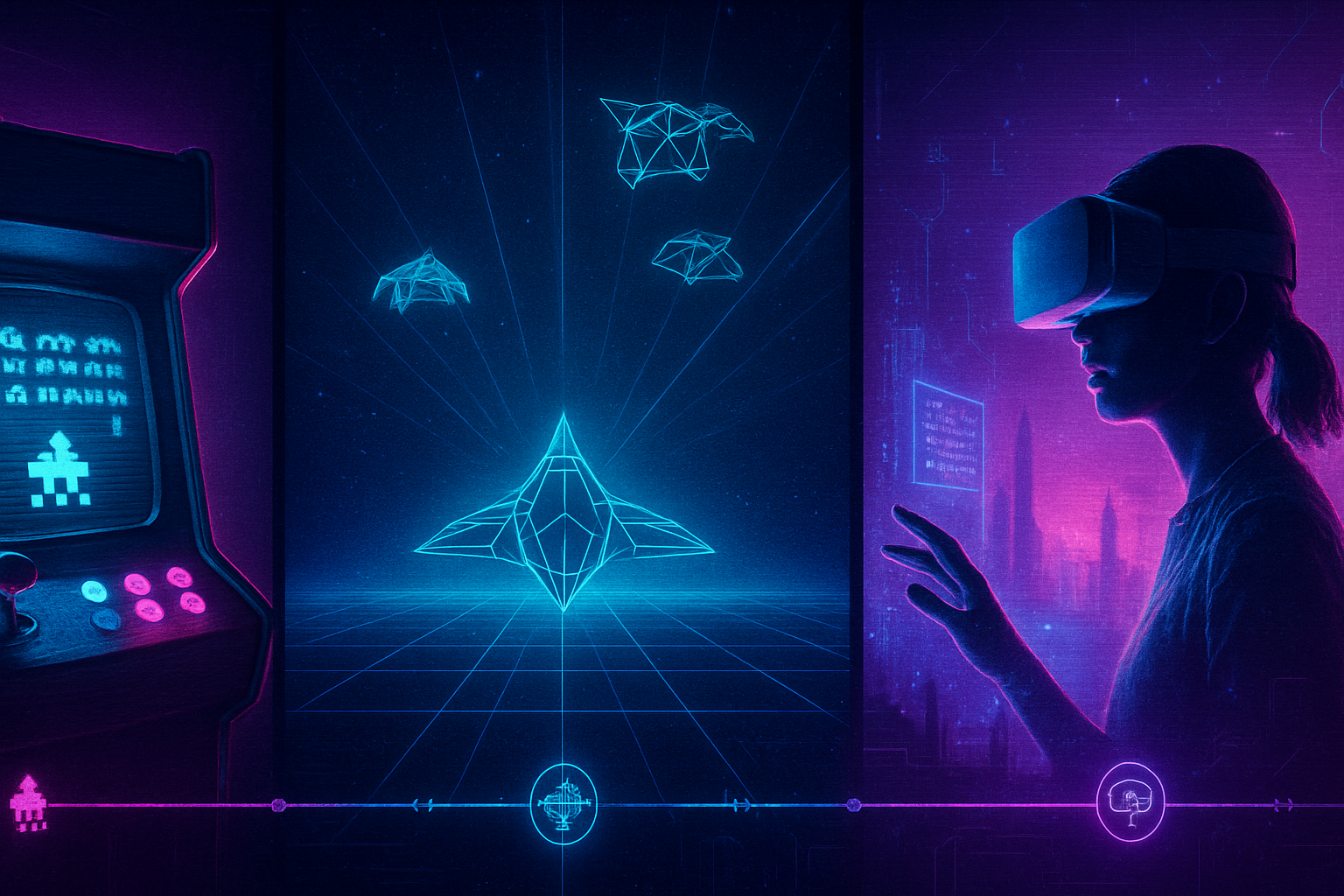
I was eight the first time I mistook a row of relentless, blocky aliens for fate. Space Invaders ate my quarters, my pride, and an afternoon I’ll never get back. The cabinet hummed, the monotone sound looped, and something important happened: a handful of pixels taught a generation how to believe a machine could be a world.
That confession is the right place to start. Retro sci‑fi games-those cramped, imaginative artifacts made of cheap ROM and cheaper optimism-did more than offer cathartic alien-hunting. They were laboratories. Engineers, designers and bored teenagers reverse‑engineered the future inside them.
Why retro sci‑fi matters more than nostalgia
You can call Space Invaders, Elite, Doom, or Star Fox quaint. You can laugh at Virtual Boy’s red glare. But technical ideas don’t respect polish. They propagate. The constraints of older hardware forced creative solutions; creative solutions became conventions; conventions hardened into hardware and libraries.
Think of early sci‑fi games as seeds. They landed in poor soil, sprouted clever roots, and later forests of modern tech grew from them. Below: the most consequential seeds, and the crooked, brilliant ways they grew.
Wireframes and cold polygons: the birth of real‑time 3D
- Problem - Early machines had no power for textured, high‑poly scenes. 2D sprites were cheap; polygons were expensive.
- Solution - Wireframe and polygonal engines reduced geometry to lines and flat shapes.
Games like Elite used wireframe graphics and clever math to simulate a vast galaxy on tiny hardware [Elite]. The arcade revolution-seen in titles such as Namco and Sega polygon racers-pushed developers to trade rich sprites for fast polygons. Then home consoles followed: the Super FX chip inside Star Fox put polygonal worlds on the SNES long before GPUs were household staples [Super_FX].
The upshot: those early polygon hacks forced graphics problems to be expressed as engineering problems-floating point transforms, clipping, culling. Those problems became the specs hardware vendors solved with fixed‑function pipelines and eventually programmable GPUs [Graphics_processing_unit].
Relevant reading: Elite [https://en.wikipedia.org/wiki/Elite_(video_game)], Super FX chip [https://en.wikipedia.org/wiki/Super_FX], GPU history [https://en.wikipedia.org/wiki/Graphics_processing_unit].
Procedural generation: how a handful of rules became entire galaxies
Space trading and exploration had a storage problem: a believable galaxy needs millions of systems. The solution was elegant and cruel: generate it on the fly.
David Braben and Ian Bell’s Elite used procedural algorithms to create a galaxy that felt enormous despite severe memory limits [Elite]. Similarly, the roguelike lineage (Rogue and its descendants) used algorithmic level generation to keep experiences fresh [Roguelike].
Modern open worlds, survival games, and ongoing live services still use the same idea-only now we have better random number generators and GPUs to render them. Procedural generation is the economy of scale in virtual worlds: cheaper to compute than to author by hand.
See: Roguelike background [https://en.wikipedia.org/wiki/Roguelike].
The first‑person leap: from corridors to immersion
The shift from top‑down or side‑scroll to first‑person perspectives was an empathy trick. Walk where the character walks and the world starts to feel like yours.
Wolfenstein 3D and Doom made those corridors terrifying and networked Doom made them social [Doom (1993 video game)]. Doom’s engine introduced sector-based level design, texture mapping, and an ingenious way of faking 3D that let people build, share, and battle across networks.
Quake moved from illusion to true 3D, and with it came modern shaders, lightmaps, and the concept of a 3D space as a sandbox for physics and multiplayer interaction [Quake (video game)].
References: Doom [https://en.wikipedia.org/wiki/Doom_(1993_video_game)], Quake [https://en.wikipedia.org/wiki/Quake_(video_game)].
Networking: from text rooms to global battlefields
Before graphical multiplayer, there were MUDs-textual, communal worlds where people met, plotted and occasionally attempted romance at 1200 baud [MUD]. Early sci‑fi text adventures, like Infocom’s adaptation of The Hitchhiker’s Guide to the Galaxy, showed how story could survive without graphics [Hitchhiker’s Guide game].
The trick for shooters was to make many brains see the same, narrow universe at once. Doom’s early multiplayer showed us the social power of direct, low‑latency shared play. Quake formalized client‑server networking, netcode strategies, and the expectation that players worldwide could inhabit the same fragile simulation.
Read: MUDs [https://en.wikipedia.org/wiki/MUD], Infocom [https://en.wikipedia.org/wiki/The_Hitchhiker%27s_Guide_to_the_Galaxy_(video_game)].
Input and immersion: the long road to modern controllers and VR
Retro sci‑fi demanded novel interfaces. Arcade joysticks, custom gun controllers, steering wheels-these were early experiments in embodiment. The Rumble Pak and force feedback motors brought tactile menace to controllers; the idea that virtual impacts should register in the palm predates the consumer triumphs [Rumble_Pak].
Virtual reality’s consumer lineage is strewn with noble failures and curious prototypes. Ivan Sutherland’s head‑mounted display in the 1960s provided the first proof that you could see a synthetic world overlaid on the real one [Head‑mounted_display]. In arcades and labs, companies like Virtuality offered bulky VR pods in the early 1990s, and Nintendo’s Virtual Boy proved that a cheap stereoscopic approach wasn’t enough to buy long‑term immersion [Virtuality (company)], [Virtual_Boy].
Modern VR-inside‑out tracking, low‑latency displays, ergonomic controllers-stands on the shoulders of those awkward, visionary devices.
Cite: Sutherland [https://en.wikipedia.org/wiki/Head-mounted_display#Early_research], Virtuality [https://en.wikipedia.org/wiki/Virtuality_(company)], Virtual Boy [https://en.wikipedia.org/wiki/Virtual_Boy], Rumble Pak [https://en.wikipedia.org/wiki/Rumble_Pak].
AI, behavior and the illusion of life
Enemy ships that dodge and hunt, traders who respond to supply and demand, NPCs who give the impression of personality-these were early experiments in automating believable behavior.
Retro sci‑fi’s AI was cheery mechanical crud: state machines, scripted routines, simple heuristics. But constraints forced clarity. If you wanted a convincing opponent with two kilobytes of RAM, you had to be viciously efficient about behavior. Those patterns evolved into behavior trees, goal‑oriented action planners, and later statistical and ML‑based systems used in modern NPCs.
You can draw a line from Elite’s trader heuristics to the complex economies of modern space sims, and from Doom’s enemy routing to contemporary crowd behavior systems in AAA titles.
Physics: from arcade heuristics to simulated laws
Early sci‑fi shooters faked physics-gravity was a constant number and explosions were animated sprites. Descent, however, offered true six degrees of freedom inside tunnels, forcing developers to wrestle with 3D kinematics early on [Descent (video game)].
These tricks matured into full physics engines (Havok, PhysX) that underpin modern destruction, ragdolls, and simulated vehicle dynamics. The demand for believable sci‑fi motion pushed middleware and GPUs to take on physics as a first‑class citizen.
See Descent [https://en.wikipedia.org/wiki/Descent_(video_game)].
How those seeds became industries
- Hardware design - Polygonal demands birthed GPUs. Arcade needs drove custom silicon that migrated into consoles, then PCs.
- Tools and pipelines - Level editors, map formats, and asset pipelines matured from Doom’s WADs to modern engines (Unreal, Unity).
- Business models - Persistent worlds, modding communities, and shared server culture grew from text‑based MUDs and early multiplayer shooters.
In short: problems of old hardware became product requirements for new hardware. That’s how technology advances-through multiplication of constraints.
A few case studies
- Elite → Procedural galaxies and emergent systems still seen in No Man’s Sky.
- Doom → The mod community, shareable maps, and LAN partying that made multiplayer social and competitive.
- Star Fox / Super FX → Proof that consumer silicon could do real‑time 3D, pressuring GPU vendors.
- Virtuality / Virtual Boy → Early VR prototypes teaching the industry what latency, comfort, and scale actually require.
What retro sci‑fi didn’t do (and why that matters)
They didn’t perfect everything. They occasionally glorified cramped design with epigrammatic rules, and sometimes their social models (read: multiplayer communities) were toxic by default. They handed us technical blueprints-but not always the social solutions for online life.
Modern developers borrow the tech but must also fix the social architecture around it. Multiplayer systems are still playing catch‑up on moderation, inclusion, and the economic incentives that tilt player behavior.
Final reckoning: the future is mostly a remix
If you want to meet the ancestor of modern game tech, don’t tour a corporate lab-visit an arcade or a dusty emulator collection. The ideas were simple and stubborn: make a world, make it feel consistent, and make other people fit in it.
Retro sci‑fi games didn’t predict everything. They were hacky, limited, and often hilariously wrong. But they chased the right questions: How do you render a convincing world? How do you populate it? How do you let people play together inside it? Answer those, and the rest-graphics, VR, cloud streaming, AI-become engineering details.
So next time you sneer at a pixelated spaceship, remember: beneath those eight melancholic sprites is a thesis about immersion. The future of gaming is not a clean break from the past. It’s a long, sometimes sentimental remix-welding yesterday’s hacks into tomorrow’s hardware.