· retrogaming · 6 min read
The NES: Revolutionizing Multiplayer Gaming with a Legacy of Iconic Titles
A retrospective on how the Nintendo Entertainment System reshaped multiplayer - from the quiet ritual of swapping controllers in Super Mario Bros. to the frenetic teamwork of Contra - and how those patterns echoed through generations of consoles.
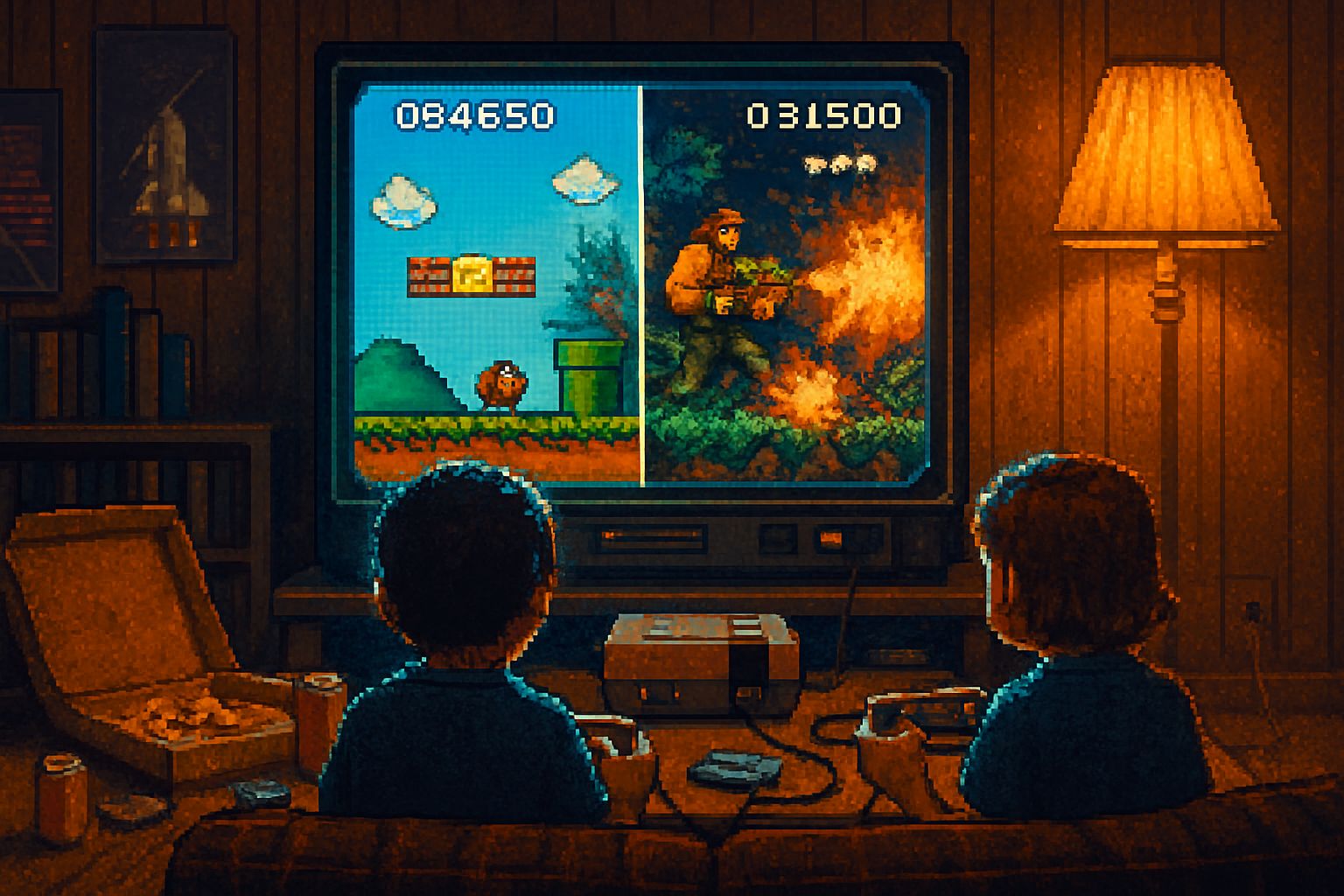
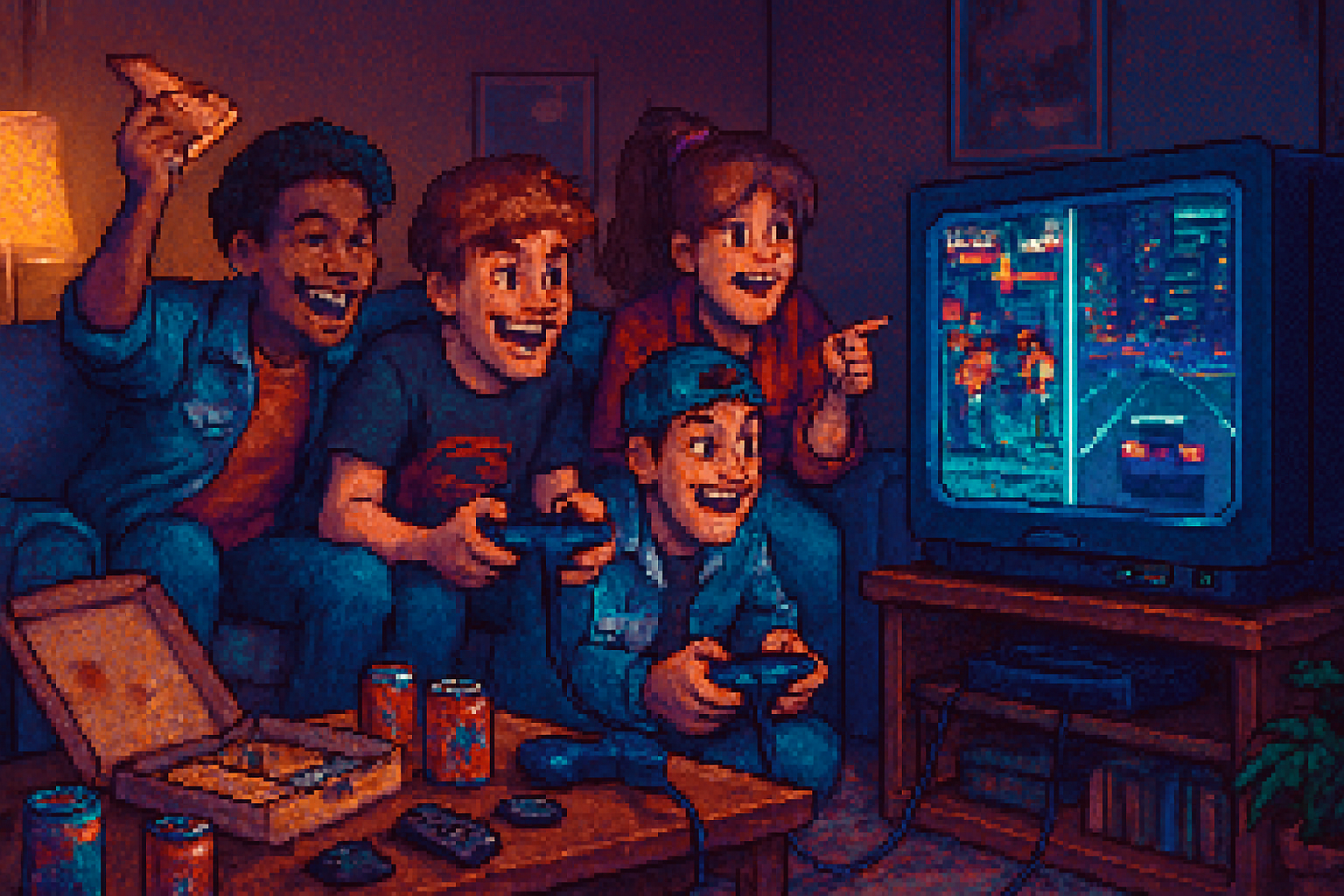
It’s a small, undignified scene that recurs in the memories of anyone who grew up with an NES: two kids hunched on a sagging couch, knees knocking, one of them with mustard on his shirt, both arguing - softly, urgently - over whether to take the next warp pipe or try again to beat the boss. One player is on the pad; the other is the world’s most invested spectator. When the screen flashes “Game Over,” the ritual is immediate. Controllers are swapped. Life continues.
That ritual - the handoff, the cheer, the blame - is the social DNA the NES helped inoculate into home gaming. It didn’t invent multiplayer. Arcades had been doing simultaneous, cooperative, and competitive play for a decade. But the Nintendo Entertainment System (NES) brought multiplayer inside the living room and made it a design constraint, a feature, and a cultural engine.
The context: from arcade cabinets to the living room
When the NES reached North America in 1985, the market had just survived a catastrophic crash. Consoles were expected to be cheap toys with little software depth. Nintendo treated the home console as an opportunity to recreate the arcade’s social energy while tempering it for families, not raucous coin-op floors.
Two practical realities shaped how multiplayer looked on the system:
- Hardware constraints - two controller ports, limited memory and CPU cycles. Designers had to make deliberate choices about whether a game would let two players act simultaneously, take turns, or compete indirectly.
- Market positioning - Nintendo pitched the system to families. Multiplayer had to be accessible to a child and an adult, a novice and a sibling who’d already sunk 48 lives into the same level.
The result was a set of patterns - alternating turns, simultaneous cooperative play, indirect competition, and emergent social rituals - that would become design templates for decades.
Alternating play: Super Mario Bros. and the spectator sport of platforming
Few images are as archetypal as two siblings taking turns in Super Mario Bros. (1985). The game’s multiplayer is simple and sly: Player 1 plays until they die or finish a level; then Player 2 takes over. There’s no split-screen, no simultaneous control - just possession of the game session and the pressure that comes with it.
Why was this significant?
- It turned single-player design into shared performance. Levels were puzzles to be discussed aloud, secrets to be pointed at, strategies to be tried and improved across play sessions.
- Alternating play amplified suspense. Watching someone else take an impossible jump feels cruel in the best way. You learn the level’s rhythms by watching as much as by doing.
- It established social roles - the player, the coach, the critic. Those roles persist in modern multiplayer streams and cooperative games.
Super Mario Bros. also taught designers how to make levels that worked for shared attention: short segments between safe points, memorable set-pieces, and recurring power-ups that rewarded observational learning. These are not incidental flourishes; they’re social design choices.
(See Super Mario Bros. for more on the game’s design and cultural impact: https://en.wikipedia.org/wiki/Super_Mario_Bros.)
Simultaneous co-op: Contra and the poetry of coordinated destruction
If Super Mario Bros. is about performance and ritual, Contra (1987) is a different religion: shared survival through synchronized violence. Contra offered simultaneous two-player cooperative run-and-gun action - each player with independent movement, overlapping fire, and situations that demanded coordination.
Contra’s significance goes beyond explosions:
- It created mechanical interdependence. Levels and enemy patterns could be designed specifically to require or reward coordinated action.
- It fostered emergent teamwork. Players discovered implicit strategies (covering each other, staggering jumps, coordinating power-ups) that weren’t in the manual.
- It seeded cultural artifacts - most famously, the Konami Code (Up, Up, Down, Down, Left, Right, Left, Right, B, A, Start) - which became part of gaming lore and made multiplayer attempts slightly less fatalistic by offering 30 lives to a coordinated pair. (See the Konami Code: https://en.wikipedia.org/wiki/Konami_code and Contra: https://en.wikipedia.org/wiki/Contra_(video_game)).
Contra made the friendly shooter - a two-person sprint against absurd odds - a genre staple. The shared adrenaline of dodging bullets and reviving each other on the fly is a direct tonal ancestor to every co-op shooter that followed.
Competition, peripherals, and the urge to expand party size
Nintendo’s two-controller standard defined much of the system’s multiplayer identity, but developers and third parties pushed beyond it.
- Competitive sports and board-game adaptations on the NES often used split rules or alternating turns, translating complex multiplayer systems into the console’s constraints.
- Peripherals such as the NES Four Score and Satellite (adapters that added four-controller support) hinted at bigger-party ambitions, allowing for chaotic, pub-style experiences that foreshadowed later party games and LAN crazes.
These experiments showed that the NES wasn’t just a platform for one-on-one rivalry or two-person camaraderie. It was a testbed for how social play could scale (and fail gloriously) under technical limits.
Design lessons the NES taught future consoles
The NES established several multiplayer precedents that echoed through subsequent hardware generations:
- Make multiplayer a social ritual, not just a mode. Swapping controllers, offering advice, and crowding a single screen are social behaviors that developers learned to design for.
- Balance the game for shared attention. Short loops, checkpointing, and cooperative-friendly mechanics made multiplayer palatable for mixed skill groups.
- Respect the economy of attention. With limited memory for UI and split-screen, designers learned to streamline information so two players could focus on the same action.
- Offer both competition and cooperation. The console era that followed attempted to provide both modalities - sometimes within the same franchise.
Modern consoles inherited these lessons while adding online matchmaking, persistent progression, and massive player counts. But the NES’s original constraints forced clarity: if you only have two controllers and one TV, what kind of social experience do you want to make? That clarity produced games that were mechanically tight and socially fertile.
The emotional legacy: why couch co-op still matters
There’s a sentimental rationality to why people miss NES-style multiplayer. Online play is efficient; it’s global and anonymous. It lacks the small cruelties and quiet joys of elbowing someone for the controller, of yelling “No, wait! Don’t go in the pipe!” The NES didn’t just ship cartridges - it shipped rituals.
Indie designers rediscovered those rituals when many of them grew up on the NES. Titles that emphasize local co-op, drop-in/drop-out play, and shared screens are aesthetic homages and design testaments to what the NES taught us about togetherness.
Closing: a console of tiny, repeated ceremonies
If modern multiplayer is a cathedral - vast, networked, colossal - the NES is a chapel. Its services were small. They were noisy. They involved bad pizza and sharper sibling rivalries. But they were also formative. The console taught designers how to translate social life into rules and pixels.
So when you see two players lunging at a single screen in a modern indie co-op game, remember the bench where that ritual formed: two controller ports, limited RAM, and a stubborn belief that playing together at home was worth designing for. That belief is the NES’s quiet gift to gaming: multiplayer as a lived, repeatable human ceremony.
Further reading and sources
- Nintendo Entertainment System - https://en.wikipedia.org/wiki/Nintendo_Entertainment_System
- Super Mario Bros. - https://en.wikipedia.org/wiki/Super_Mario_Bros.
- Contra - https://en.wikipedia.org/wiki/Contra_(video_game)
- Cooperative video game - https://en.wikipedia.org/wiki/Cooperative_video_game
- Konami code - https://en.wikipedia.org/wiki/Konami_code