· retrogaming · 7 min read
Top 10 Must-Play Neo Geo AES Titles: The Emulator's Ultimate Playlist
A curated list of ten Neo Geo AES classics every emulator enthusiast should play - with gameplay notes, historical context, and practical emulator tips to make these cartridge-costing-more-than-your-car gems sing on modern hardware.
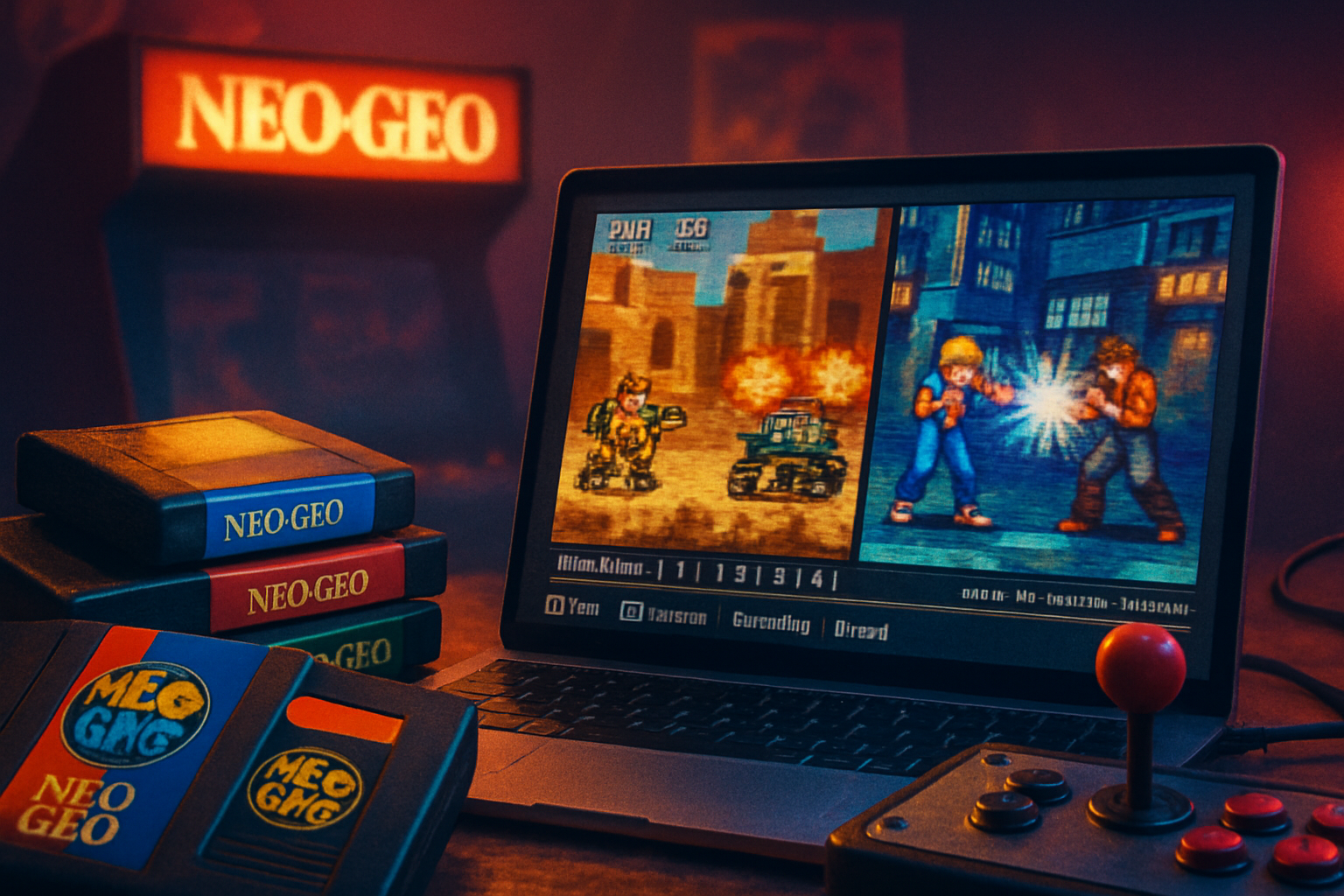
There’s a particular memory you never forget: the first time you saw a Neo Geo cartridge. It looked like a brick, and it behaved like a jewel. People paid house prices for those things. Which is why, for the rest of us, emulation is less theft and more archeology - a way to dust off a cultural artifact without remortgaging the house.
Below: ten Neo Geo AES games that define the system’s character - from pixel-perfect warriors to guns-blazing run-and-gun masterpieces - with short notes on what to feel, what to look for, and how modern emulators make them better without betraying them.
Why the AES matters (and why you should emulate)
- The Neo Geo AES was home to arcade-perfect cartridges and an aesthetic that married lush hand-drawn sprites with arcade-level performance. See the system overview on Wikipedia for the hard facts: Neo Geo (system).
- Physically owning AES carts costs a fortune. Emulation democratizes access while offering technical enhancements that the original hardware lacked - save states, scaling, input mapping, netplay, shaders, and quality-of-life fixes.
How I scored these ten: variety, historical weight, mechanical clarity, and the moment you finish a match/run and want to play again.
Top 10 Neo Geo AES titles every emulator playlist needs
- Metal Slug 3 - The runaway circus of sprites
- Quick facts - Run-and-gun. SNK (1999).
- Gameplay snapshot - Explosive, goofy, and relentlessly inventive. Levels twist between grounded warzones and surreal detours - camels with rockets, underwater bosses, branching routes.
- Why it matters - Metal Slug 3 is the crescendo of the series’ craftsmanship: fluid animation, comedic enemy design, and pacing that teaches you the meaning of “bullet ballet.”
- Emulator tips - Play with integer scaling or crt-like shaders to respect the original pixel edges; enable rewind for the first few hours (you’ll die a lot). Use controller mapping for two players.
- The King of Fighters ‘98 - The Great Equalizer
- Quick facts - Team-based fighting. SNK (1998). Widely regarded as the series’ high-water mark.
- Gameplay snapshot - Tight, fast, and supremely balanced - pick any favorite and you’re rarely at a disadvantage.
- Why it matters - A nononsense ladder for learning KOF’s economy and team tactics; it’s where the community went to train and stay honest.
- Emulator tips - Use netplay-enabled builds (Fightcade or RetroArch + Kaillera-like services) for authentic 1v1s; set low input latency and disable frame-throttling hacks that add lag.
- Samurai Shodown II - Elegance with a katana’s edge
- Quick facts - Weapon-based fighter. SNK (1994).
- Gameplay snapshot - Slow, purposeful, and deadly; one slash changes the round’s rhythm.
- Why it matters - A counterpoint to combo-heavy fighters - it taught players how to value each decision and how to fear a landed hit.
- Emulator tips - Use slow-motion replays sparingly - the original pacing is part of the design. Try scanline shaders if you like the arcade glow.
- Garou - Mark of the Wolves - Late-era perfection
- Quick facts - 2D fighting. SNK (1999).
- Gameplay snapshot - Refined engine, modern-feeling mechanics, cinematic animation.
- Why it matters - A graceful evolution of the SNK fighting lineage; it’s tactically rich and easy to pick up, hard to master.
- Emulator tips - Many re-releases exist. For authenticity, use FBNeo or MAME with proper DIP switch settings; for netplay, use the versions with rollback if available.
- Fatal Fury Special - The fighter that birthed a legend
- Quick facts - One of SNK’s foundational fighters.
- Gameplay snapshot - Broad move sets, iconic characters, early attempts at multi-plane fighting.
- Why it matters - It’s where motifs that powered KOF were forged; you can see fighting-game history being sketched in real time.
- Emulator tips - For newcomers, run with save states to practise combos; enable controller hotkeys for quick credits/play resets like the arcade.
- The Last Blade 2 - Beauty and melancholy in two buttons
- Quick facts - Neo Geo samurai fighter. SNK (1998).
- Gameplay snapshot - Romantic, slower-paced duels emphasizing spacing and timing.
- Why it matters - One of the most aesthetically haunting fighters on the system - exquisite art and music that outclass many modern indies.
- Emulator tips - Use high-quality audio resampling if your build supports it - the soundtrack matters. Graphical filters can soften jagged fonts but keep sprite integrity.
- Blazing Star - A shooter with focus and flash
- Quick facts - Side-scrolling shmup. Yumekobo / SNK (1998).
- Gameplay snapshot - Tight controls, dramatic enemy patterns, and some of the Neo Geo’s most aggressive sprite work.
- Why it matters - One of the system’s best shooters and a textbook in pattern recognition and risk/reward.
- Emulator tips - Frame smoothing can ruin rhythm in shmups. Prefer raw rendering or integer scaling; use save states to practice boss patterns.
- Windjammers - Competitive arcades distilled
- Quick facts - Sports/arcade hybrid. Data East (1994).
- Gameplay snapshot - Fast, precise, and unforgiving - half-pong, half-air hockey, all style.
- Why it matters - An elegant competitive game with brutal timing. It’s a multiplayer jewel that taught us quick reads and reflex superiority.
- Emulator tips - Prioritize input latency; for online play, rollback netcode versions or Fightcade communities are essential for fair matches.
- Neo Turf Masters - Golf as arcade poetry
- Quick facts - Golf. Nazca Corporation (1996).
- Gameplay snapshot - Accessible controls, deep course strategy, and pixel-perfect presentation.
- Why it matters - It proves the AES could make leisurely sports feel urgent and tense.
- Emulator tips - Use scaling with a pleasing aspect ratio and enjoy replays with smooth interpolation. Save states make exploring course shots less punishing.
- Shock Troopers - Top-down chaos perfected
- Quick facts - Top-down run-and-gun. Saurus / SNK (1997).
- Gameplay snapshot - Multiple routes, weapon pickups, and high-octane screen-clearing mayhem.
- Why it matters - It captures the frantic joy of ’90s arcade shooters and rewards aggressive plays.
- Emulator tips - Use fullscreen scaling and experiment with filter sets; many players prefer the clean pixel look for top-down shooters.
How emulators enhance - without betraying - the AES experience
Emulation is a toolkit, not an argument. Here’s what modern emulators do that the AES could not:
- Save states and rewind - Practise the boss, not the boot sequence.
- Filters and shaders - From clean integer scaling to CRT shaders that fake phosphor bloom - for mood, not forgiveness.
- Input mapping and low-lag modes - Use USB fightsticks, map macros, and disable frameskip to preserve responsiveness.
- Netplay and community - Fightcade and RetroArch communities let you fight or co-op with players around the world - the closest thing to local-cabinet camaraderie.
- Preservation - Cartridge dumps keep the history alive. Use reputable sources and respect IP: if you own the cart, use your own dump wherever possible. See the general concept of emulators:
Recommended emulator stack (practical)
- FinalBurn Neo (FBNeo) - Accurate, fast, and widely used for Neo Geo games in modern packs.
- MAME - The gold standard for archival accuracy; heavier, but exacting.
- RetroArch (with FBNeo core) - For an all-in-one frontend, shaders, netplay, and wide-platform support.
- Fightcade - For nostalgic online multiplayer (especially for KOF, Samurai Shodown, and other fighting staples).
A few final notes for the conscientious emulator player
- Authenticity vs convenience - If you want pixel-perfect timing and DIP switch accuracy, use MAME or unmodified FBNeo builds. If you want convenience (save states, shaders, online matchmaking), RetroArch is friendly without being sacrilegious.
- Respect copyright - Emulation unlocks cultural treasures. Keep it respectful - support official re-releases where possible, and remember the industry survived because people paid for the originals.
The Neo Geo AES was expensive by design: it sold exclusivity. Emulation strips away the price tag and leaves the thing that matters - the games. These ten titles are a cross-section of what made the system feel special: artistry carved in pixels, mechanical clarity, and the arcade’s social electricity. Plug in a controller, pick one, and let the past remind you how good games can feel.
Further reading and references
- Neo Geo (system) - https://en.wikipedia.org/wiki/Neo_Geo
- Metal Slug 3 - https://en.wikipedia.org/wiki/Metal_Slug_3
- The King of Fighters ‘98 - https://en.wikipedia.org/wiki/The_King_of_Fighters_‘98
- Samurai Shodown II - https://en.wikipedia.org/wiki/Samurai_Shodown_II
- Garou - Mark of the Wolves -
- Fatal Fury Special - https://en.wikipedia.org/wiki/Fatal_Fury_Special
- The Last Blade 2 - https://en.wikipedia.org/wiki/The_Last_Blade_2
- Blazing Star - https://en.wikipedia.org/wiki/Blazing_Star
- Windjammers - https://en.wikipedia.org/wiki/Windjammers
- Neo Turf Masters - https://en.wikipedia.org/wiki/Neo_Turf_Masters
- Shock Troopers - https://en.wikipedia.org/wiki/Shock_Troopers
- Video game emulator - https://en.wikipedia.org/wiki/Video_game_emulator
- RetroArch - https://www.retroarch.com/