· culture · 7 min read
MiniDisc vs. Vinyl: The Ultimate Battle of Nostalgic Formats
A playful, in-depth comparison of MiniDiscs and vinyl records - their histories, sound, ritual, fanbases, and why each survives as an act of deliberate taste rather than convenience.
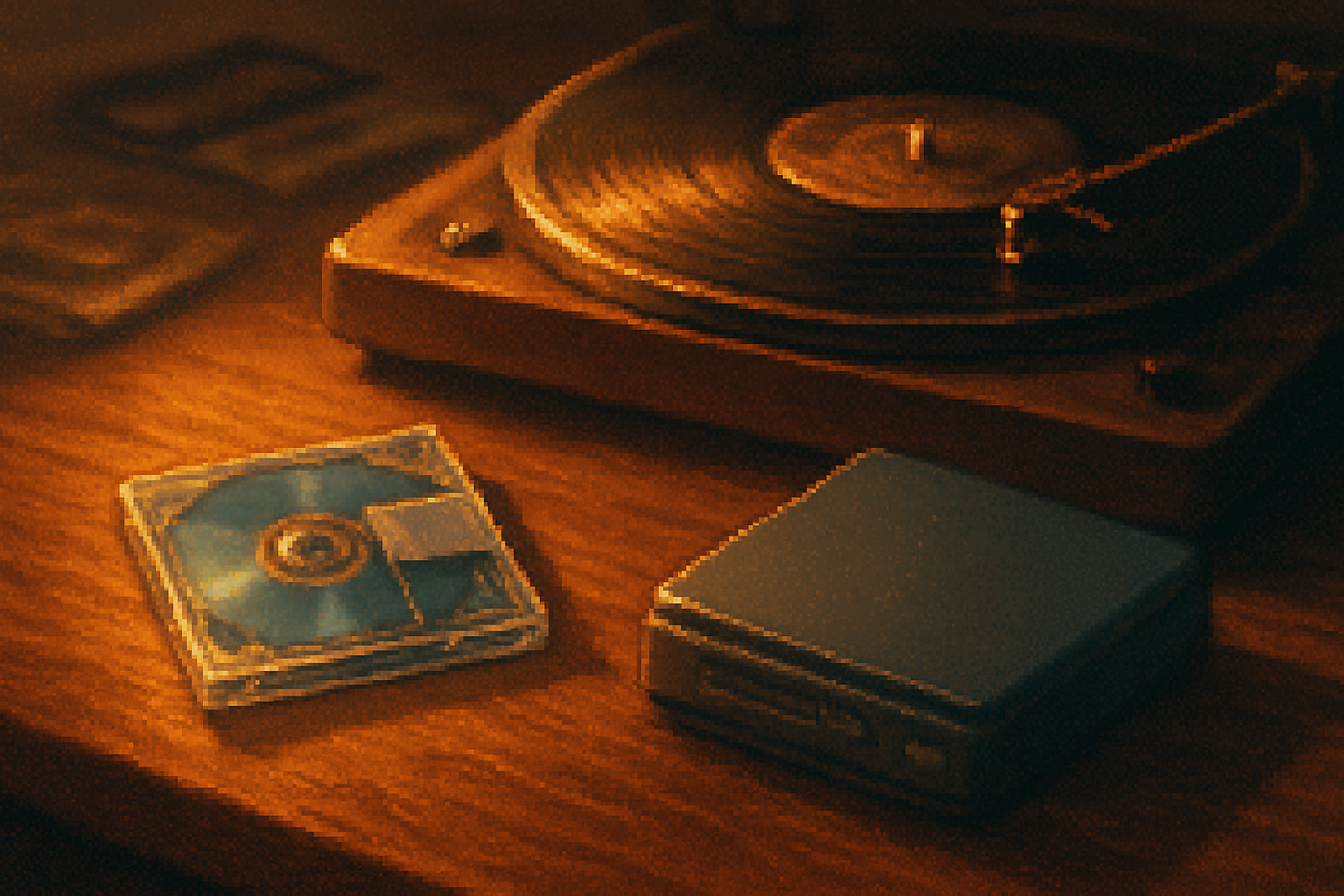
I found a MiniDisc once in the glovebox of a friend’s car, next to a pack of gum and a receipt for something inexplicably called a “mix tape session.” The disc was unlabeled, sullenly indifferent. I pressed it into a Walkman like a pilgrim touching relics. It spun. It carried the faint, clinical warmth of human intention recorded and preserved - a private radio captured in miniature.
A week later I was at a record store breathing in the smell of cardboard and lacquer, running my finger along grooves like a bored priestess. The clerk handed me a copy of a long-out-of-print jazz album and smiled as if entrusting me with a secret.
There it is: two rituals, both insistently physical, both stubbornly out of step with streaming’s immaculate convenience. One is the Swiss Army knife of portable digital - clever, compact, slightly nerdy. The other is the cathedral of analog - ornate, ceremonious, sometimes absurdly costly. Both are proof that music formats are really about identity, memory, and the pleasantly masochistic choices we make in the name of taste.
Origins and the tidy miracle of design
MiniDisc - Sony introduced the MiniDisc in 1992 as a magneto-optical, recordable digital format intended to replace the cassette for portable use. It offered random access, editing on the fly, and durable plastic cartridges that protected the disc inside. For a time it quietly flourished in Japan and among tech-minded collectors worldwide.
Vinyl - The vinyl LP’s story stretches back to the early 20th century, but its cultural shape was set after World War II. Vinyl dominated listening rooms for decades, then retreated under CD and later streaming. Yet it has staged a remarkable comeback - a revival tied to tangibility, sound, and collectibility.
Both were responses to a problem: how to hold music so it feels like something rather than a service.
Sound quality: Warm grooves vs. clinical precision
Vinyl’s claim - Warmth. Harmonic distortion that many call “life.” Analog tracks are continuous waveforms; to some ears they’re more natural. A vinyl cut can be a performance itself - a particular mastering, a distinct pressing. That variability is a feature, not a bug.
MiniDisc’s claim - Accuracy and consistency. MiniDiscs use ATRAC (Sony’s codec) and, later, other digital encodings. They reproduce the same waveform every time. No pops, no needle, no surface noise in a properly recorded MD.
Reality check: if you give a trained audiophile a blind ABX test, the results are often less decisive than their rhetoric. Context matters: master, pressing, turntable quality, cartridge alignment, analog chain, and the digitization bitrate all change the outcome.
Short version: if you worship ritual and coloration, vinyl will seduce you. If you worship reproducible fidelity and portability, MiniDisc will please you.
Portability, convenience, and the romance of friction
Portability - MiniDisc wins hands down. Tiny cartridges, portable players, the ability to re-edit recordings - it’s the format for obsessive archivists. It’s the format for people who once made mixtapes and labeled them with compulsive calm.
Convenience - Vinyl loses here in the obvious, glorious way. You don’t queue tracks with a fingertip; you arrange moments. You flip sides. You get up to nudge the tonearm. It’s the format that forces presence.
Analogy: MiniDisc is a pocket watch engineered to an inch; vinyl is the grandfather clock in the hallway that demands you stop for a moment to listen to the chime.
Durability, longevity, and the tyranny of storage
MiniDisc - The cartridges protect the disc, and the format resists surface wear. But the electronics - players, battery types, specific codecs - age. Finding a working portable MD player or replacement battery can feel like archaeology.
Vinyl - Vulnerable to scratches, warps, and bad sleeves. But a well-stored LP can last a lifetime and beyond. You can play it on many turntables with minimal compatibility fuss.
Economic caveat: vinyl kicks you in the wallet for storage space. Shelves full of records are a love affair that requires real estate.
The ritual: ceremony versus utility
This is where the choices become moral statements.
Vinyl ritual - The ceremony is the point. Unwrap, inspect, remove inner sleeve, set record, lower tonearm, listen intently. The process screens for attention: either you show up or you don’t.
MiniDisc ritual - A different kind of ritual - labeling, editing, compiling. It’s the ritual of the editor rather than the worshipper. The MiniDisc fan is often a curator of moments - precise, tidy, quietly smug about metadata.
Both rituals tell you what the owner values: performance or curation; atmosphere or portability.
Fanbases: peculiarities and stereotypes
Vinyl collectors - often sentimental, sometimes snobbish, frequently sincere. They love stories: pressing plants, mastering engineers, first-press sleeves. There’s a social component - record stores, crate-digging, swap meets. They argue about analog warmth with the religious certainty of a doctrinal text.
MiniDisc aficionados - a smaller, ganz-niche tribe. They’re the archivists and engineers of nostalgia: meticulous, pragmatic, and a little nerdy. They like editing tracks and building perfect on-the-go sets. They suffer from the delicious smugness of possessing something rare but practical.
These caricatures are useful because they’re true often enough to be funny. But actual people are messier: hipsters who own turntables and MD players, audiophiles who secretly stream, collectors who love both for different moods.
Collectibility and market dynamics
Vinyl - healthy resale market. Some pressings appreciate massively. Rarity, condition, and pressing provenance matter. Vinyl is an asset class for a certain kind of speculator.
MiniDisc - niche scarcity. There are rare commercial releases and shrink-wrapped obscura that fetch curious prices among collectors - especially Japanese issues, promo discs, and certain bootlegs. But the market is small and devotionally specific.
If you want investment potential and social clout at parties, vinyl wins. If you want esoteric bragging rights and the thrill of a small, intense community - MiniDisc rewards deeper dives.
Cost and accessibility
Vinyl - entry-level turntables are inexpensive, but serious setups are not. Records themselves range from cheap reissues to bank-account-clearing rarities.
MiniDisc - used players and blanks are inexpensive; high-end players are vintage electronics that can be pricey to restore. The biggest cost is time - learning to manage the quirks of the format.
Which should you choose? A cheat sheet
Buy vinyl if:
- You like ceremony and ritual.
- You value the tactile, visual, and social aspects of music.
- You want an investment you can proudly display.
Buy MiniDisc if:
- You value portability and control (editing, track sequencing).
- You like the idea of a compact, private archive.
- You enjoy collecting obscure hardware and mastering eccentric maintenance skills.
Buy both if you’re someone who likes to indulge different moods. Nobody’s keeping score.
The bigger truth: formats are identity projects
MiniDisc and vinyl are less about fidelity specs than about modes of listening. Vinyl asks you to slow down, to be present and to accept imperfection as texture. MiniDisc invites precision, mobility, and the quiet pleasure of curation.
Music formats are, at heart, choirs in which we sing our tastes aloud. Choosing a format is less about audio engineering and more about the story you want to tell about yourself.
So: which wins the ultimate battle? Neither. The point of this duel is not to annihilate the opponent but to reveal what you secretly worship. If you want to impress strangers at a coffee shop, buy vinyl. If you want to be able to shove an entire mixtape into your pocket and edit it at a bus stop, buy a MiniDisc.
Both are delightfully inconvenient. Both resist the seamlessness of streaming. Both, in their peculiar ways, demand attention. And in a world designed to minimize friction, insisting on friction is an act of taste. Keep one on your shelf. Keep one in your jacket. Keep one for living rooms, and the other for secret journeys.
After all, nostalgia without a little trouble is just a playlist.