· retrogaming · 6 min read
The LEGAL Grey Area: Understanding the Legitimacy of Sega Genesis ROMs and Emulators
A clear-eyed guide to the tangled law around Sega Genesis ROMs and emulators - what case law says, what the DMCA changes, and practical steps to enjoy retro games without stepping into blatant illegality.
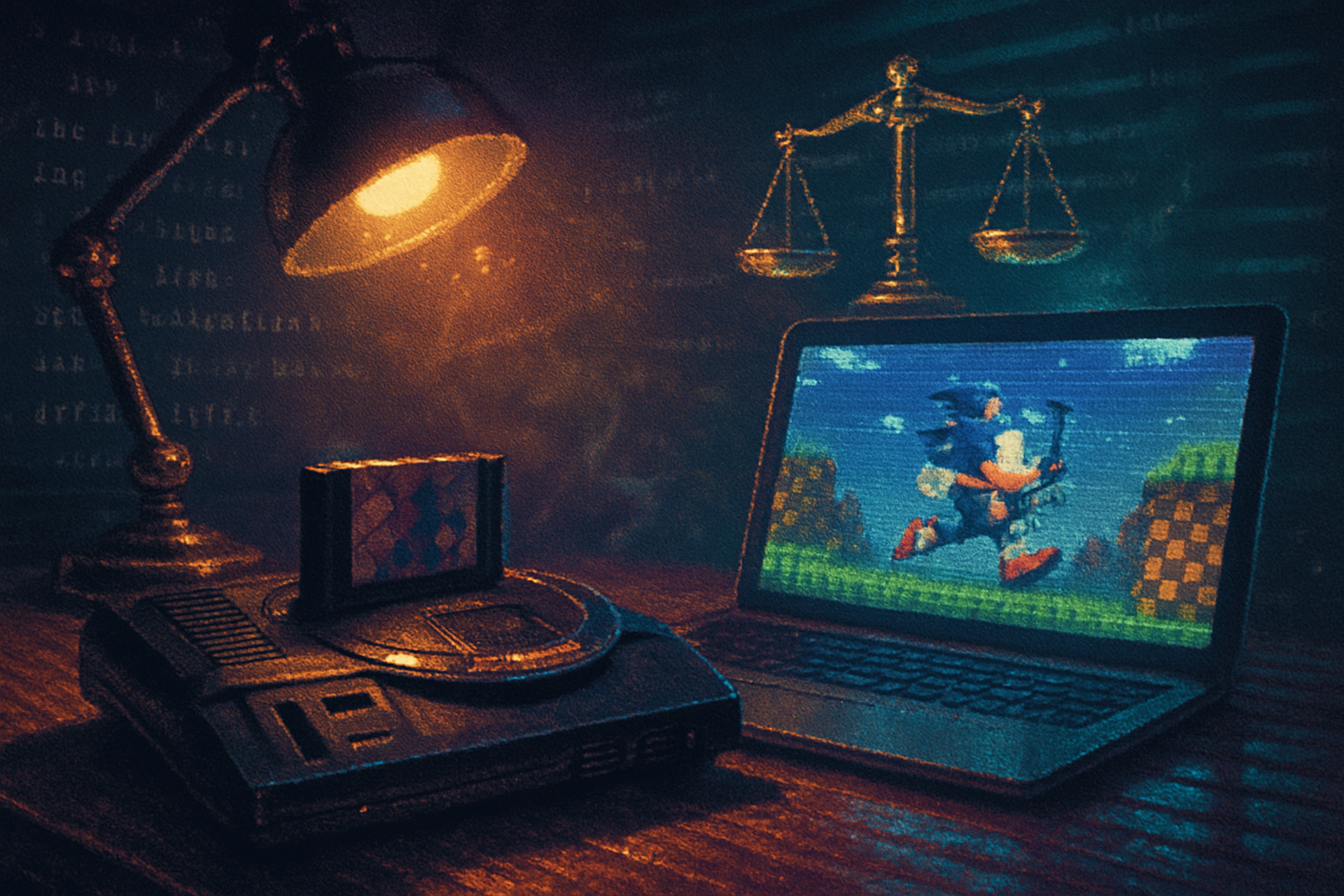
I bought a dusty Genesis at a yard sale once, blew on the cartridge like a devout ritual, then looked at my modern laptop and thought: why can’t I play this on the couch without hauling the CRT out of storage? That impulse - convenience mixed with nostalgia - is where the legal fog begins.
The romance of retro gaming collides with copyright law in a way that is equal parts sentimental and litigious. Below is your practical, slightly sardonic guide through the legal morass of Genesis ROMs and emulators: what courts have said, what the DMCA changed, and how to stay on the right side of the law (or as close as the law currently allows).
The short answer (spoiler)
- Emulators are usually legal if they are written without copying copyrighted code.
- Downloading ROM files from the internet is usually illegal unless the copyright holder has authorized distribution or the work is in the public domain.
- Making a ROM of a cartridge you own sits in a murky, jurisdiction-dependent spot - sometimes defensible, often risky.
Read on for the long, grubbier answer.
What the courts have said - the good and the narrow
Two important U.S. appellate decisions matter when people argue that emulation is inherently illegal:
Sega v. Accolade (9th Cir. 1992) - the court recognized that reverse engineering to discover unprotected functional elements can be fair use in limited circumstances. The case involved copying bits to study compatibility; the Ninth Circuit’s reasoning gave a foothold for legal emulation work. See a summary at
Sony v. Connectix (9th Cir. 2000) - Connectix developed a PlayStation emulator (Virtual Game Station) using clean-room techniques and reverse engineering. The Ninth Circuit found that intermediate copying for reverse engineering to achieve interoperability was fair use. See
These rulings are encouraging: they say emulators themselves - if developed without theft of copyrighted code - can be lawful. But they do not bless downloading and distributing ROMs.
The dark heart: ROMs and copyright
A ROM (Read-Only Memory) is a direct copy of the game code - the copyright-protected expression. Distributing or downloading ROM files is functionally the same as distributing MP3s of a copyrighted album without permission: generally copyright infringement.
“Abandonware” - the internet folklore that old games are free because no one enforces rights - is nonsense. Copyright does not expire because a company disappears or ignores a title. Unless a game is explicitly released into the public domain, or the rights-holder authorizes distribution, it remains protected.
For more practical discussion of emulation and ROM distribution, see the Electronic Frontier Foundation resources.
The DMCA complication
The Digital Millennium Copyright Act (DMCA), specifically 17 U.S.C. §1201, added a layer of difficulty: it outlaws circumvention of technological protection measures (TPMs). That means even if you own a cartridge, using specialized hardware/software to bypass encryption on a console or cartridge could violate the DMCA.
There is a carve-out: the Copyright Office runs a triennial exemption process that sometimes permits specific noninfringing uses (e.g., preservation by libraries or archival work, or jailbreaking consoles for interoperability). These exemptions are narrow, time-limited, and must be checked each cycle. See the U.S. Copyright Office’s DMCA exemptions page: https://www.copyright.gov/1201/
Making a backup of a game you own - is it legal?
Short answer: maybe, but don’t bet the house on it.
17 U.S.C. §117 allows an owner of a copy of a computer program to make another copy if it is an essential step in utilizing the program. But modern courts and many EULAs (end-user license agreements) complicate matters:
- Many consoles and cartridges are licensed, not sold, meaning your rights may be contractually limited.
- If the cartridge is protected by TPMs, circumventing those protections to make a backup may violate the DMCA.
Legal scholars recommend documenting ownership, avoiding circumvention, and checking local law before making or distributing ROMs.
For the statutory language, see 17 U.S.C. §117 via Cornell LII: https://www.law.cornell.edu/uscode/text/17/117
BIOS, firmware, and other copyrighted bits
Some emulators require a console BIOS or firmware to run accurately. BIOS files are typically copyrighted. Using a BIOS dumped from a console you own sits in the same grey area: you own the hardware but not the right to distribute or, in some cases, to circumvent protections to extract that BIOS. Downloading BIOS files from the net is usually infringement.
How different jurisdictions matter
This article focuses on the U.S., but laws vary worldwide:
- EU and UK copyright laws have different rules and exceptions for interoperability and preservation.
- Some countries have stronger fair use or interoperability defenses; others have stricter anti-circumvention rules.
Always check the law where you live. International forums and communities often conflate U.S. case law as universal - it is not.
Practical checklist: how to stay as legal as possible
If you want to enjoy Genesis (or any retro system) while minimizing legal risk, follow this checklist:
- Prefer official re-releases. Buy games from legitimate digital stores, official compilations, or reissues (e.g., Sega’s digital releases and collections).
- Use emulators with clean-room origins. Open-source emulators developed without copying console code are safer (from a copyright perspective).
- Avoid downloading ROMs from torrent or ROM sites. They’re almost always unauthorized distributions.
- If you own the cartridge and want a backup, avoid circumventing DRM. Where possible, use methods that don’t break TPMs or rely on manufacturer tools. Keep proof of ownership (photos, receipts).
- Don’t distribute ROMs or BIOS files. Sharing is the part that will attract the most legal heat.
- For preservation or academic use, work with institutions (libraries, museums) that may qualify for exemptions under the DMCA process.
- Check your jurisdiction - copyright rules and DMCA equivalents vary.
Alternatives that are clearly legal
- Buy official re-releases or digital ports from Steam, GOG, Nintendo/Sony/Microsoft stores, or the publisher’s own shops.
- Play on licensed mini-consoles (if available).
- Support homebrew and open-source reimplementations (some projects re-create mechanics without using copyrighted assets).
- Collect physical hardware and cartridges; it’s low-tech but unquestionably legal to own and play if you’re not circumventing protections.
Why preservation still matters
There is a moral and cultural argument too: many old games are at risk of being lost. Preservationists push for legal pathways to archive and study games. Courts sometimes recognize this in limited ways; legislators and libraries are slowly catching up. If you care about games as cultural artifacts, supporting legitimate preservation efforts is both legally safer and ethically sound.
Final, incorruptible truth
An emulator is not a crime; a ROM download from an unauthorized site usually is. The law is a patchwork of sensible rulings, maddening statutory traps, and evolving exemptions. If you want comfort and zero legal fog, buy official re-releases, or play on the original hardware. If you care about preservation, do it transparently - through institutions or advocacy - not through anonymous torrents.
Nostalgia is a powerful drug. Treat it kindly, and try not to get indicted for the side effects.
References
- Electronic Frontier Foundation - Emulation: https://www.eff.org/issues/emulation
- U.S. Copyright Office - Section 1201: https://www.copyright.gov/1201/
- 17 U.S.C. §117 (Cornell LII): https://www.law.cornell.edu/uscode/text/17/117
- Sega v. Accolade (case overview): https://en.wikipedia.org/wiki/Sega_v._Accolade
- Sony v. Connectix (case overview): https://en.wikipedia.org/wiki/Sony_Computer_Entertainment,_Inc._v._Connectix_Corp.