· retrogaming · 8 min read
The Homebrew Revolution: How Fans Are Reviving Nintendo 64 Classics
A new generation of tinkerers, coders and artists is pulling the Nintendo 64 out of the attic and putting it back on the mantelpiece - sometimes improved, sometimes rewritten, and often gloriously weird. This is the story of the modern N64 homebrew scene: the tools, the projects, the people, and the ethical tightrope they walk.
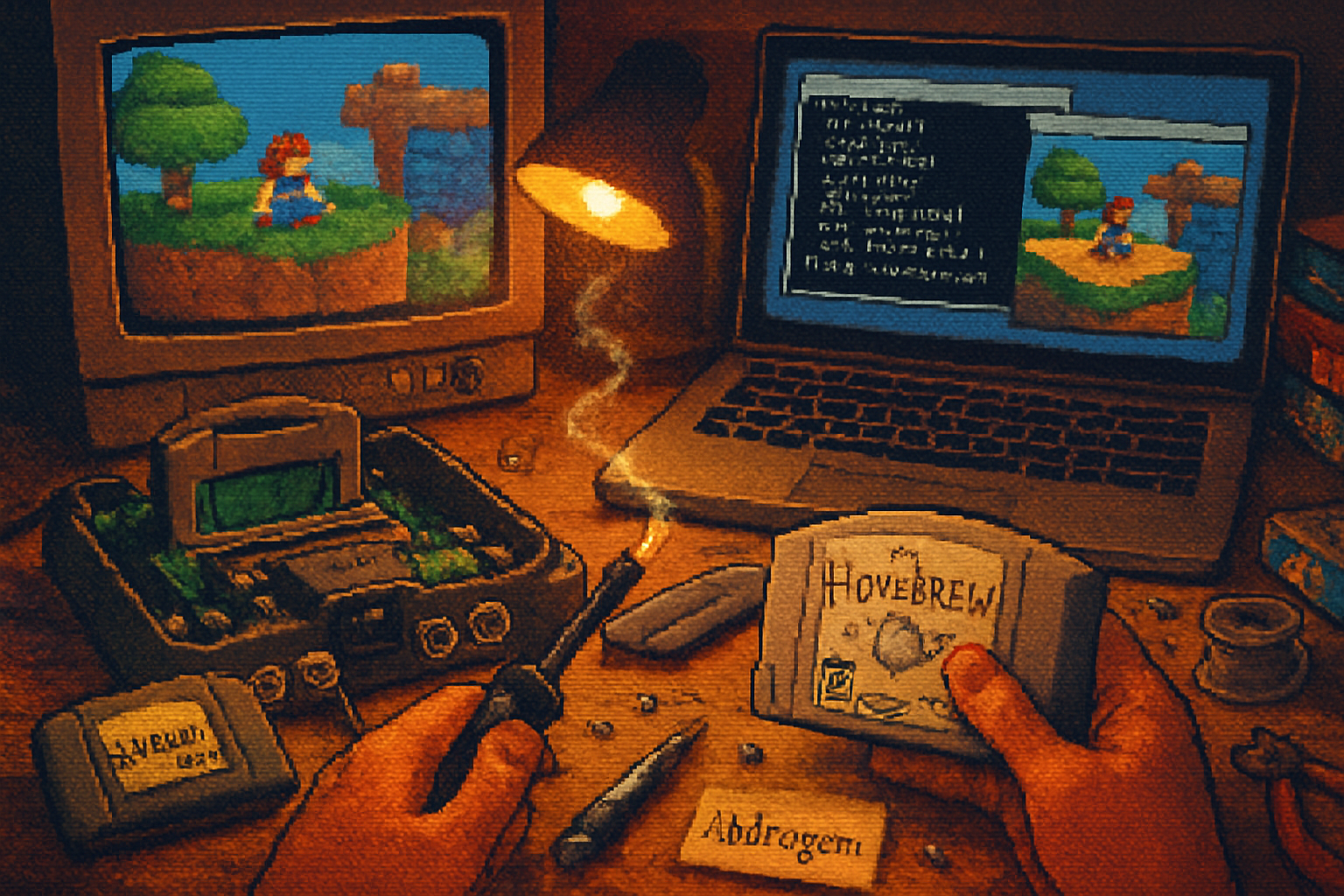
It began at a flea market, of course. A man in a leather jacket, hunched over a CRT, pressing the start button on a cartridge that looked like something from a museum. The room’s fluorescent light hummed. The cartridge’s label was hand-drawn. The game was… wrong - in the best possible way. Wider, smoother, with a puzzle that the official release never had. I watched a circle of teenagers cheer. They were playing something built by someone who loved the machine too much to leave its flaws unchallenged.
This is the peculiar, irresistible phenomenon of N64 homebrew: an eccentric, global cottage industry of developers, artists, and solder-wielding romantics who are reviving, tweaking, and reimagining Nintendo 64 classics - and sometimes writing brand-new games from scratch.
Why the N64? Why now?
The N64 is a mess that works. Architecturally it’s glorious and maddening: a MIPS R4300i CPU, a Reality Coprocessor split between the RSP (vector microcode processor) and RDP (rasterizer), and a cartridge form factor that resists modern conveniences. Complexity is a filter: it keeps casual ports away and rewards obsessive knowledge. That friction has turned into a feature for hobbyists.
Also: nostalgia. Kids who grew up with the N64 are now skilled engineers, pixel artists, and indie devs. They want to prove they can still make something astonishing out of the box they loved.
What “homebrew” actually covers
Homebrew is not one thing. Expect to find four broad categories:
- ROM hacks and mods - fan-made modifications that change levels, textures, physics, camera behavior, or story elements of an existing game.
- Ports and restorations - projects that aim to bring older N64 games to modern displays, higher framerates, or new platforms without losing the original feel.
- Original games made for N64 hardware - brand-new titles compiled for the console, released as ROMs or on real cartridges.
- Tools and utilities - emulators, development libraries, build pipelines and cartridge-flashing tools that make all of the above possible.
A day in the life of an N64 homebrewer (interview)
I spoke to two active contributors in the scene. They asked for handles - this is common; legal exposure and privacy matter to people working on fan content.
Developer “Riven” (pseudonym), who focuses on ROM hacks and texture overhauls:
“I started by changing a skybox and ended up rebuilding an entire level’s geometry. The N64 forces you to optimize; you can’t throw raw polygons at it like a modern engine. That limitation becomes a design tool.”
Riven walks through a typical workflow: extract assets with emulators, edit them in modern tools, reinsert with patchers, test in an emulator, then iterate on real hardware using a flashcart.
Developer “Marty” (Marta Lopez, uses a handle) builds original games for the N64:
“If you want the sound of an N64, you can’t fake it perfectly. The audio pipeline, the RSP microcode, the texture cache - they interact in ways that are fun to discover but brutal to debug.”
Marty’s process is more low-level: writing game logic in C (or sometimes assembly), compiling with a MIPS-targeting toolchain, linking with libraries that expose the RCP, and using an EverDrive to playtest on a console.
The toolbox: what people actually use
If the scene has a religion, its sacraments are these tools.
libdragon - an open-source N64 development library that provides a clean, community-maintained way to talk to the hardware. It’s the backbone for many original homebrew titles. (See: https://github.com/DragonMinded/libdragon)
GCC/MIPS toolchains - modern compilers that target the N64’s MIPS architecture. You’ll see cross-compilers like the mipsel toolchains used in build systems.
Emulators - Mupen64Plus and other emulators remain essential for fast iteration and debugging. They’re also how modders create and test patches before trying hardware. (See: https://mupen64plus.org)
Flashcarts / cartridge programmers - the EverDrive 64 (and similar products) let you run a compiled ROM on actual N64 hardware from an SD card. They’re invaluable for final tests and for selling or distributing physical builds. (See: https://krikzz.com/product/everdrive-64)
Patching and asset tools - extractors, texture replacers, and hex editors. Communities share scripts and pipelines to swap textures, replace music, or alter levels.
Build automation - GitHub, cross-compilation scripts, and CI for builds. It sounds pretentious but several projects use automated builds to produce plaintext ROMs and cartridge-ready images.
Emulation front-ends and shader stacks - RetroArch and related tools are used for modern scaling, shader-based filters, and frame-limiter tweaks during testing. (See: https://www.retroarch.com)
A concise build pipeline (example)
- Set up a MIPS cross-compiler and libdragon.
- Write game logic in C, optimize inner loops in assembly where needed.
- Compile, link, and produce a .z64/.n64 ROM.
- Test in an emulator (fast iteration).
- Burn onto an EverDrive or compatible cart for real-hardware testing.
- Iterate based on timing and audio differences seen on the console.
A typical compile command looks brutally simple in spirit:
make CC=mipsel-unknown-elf-gcc LD=mipsel-unknown-elf-ld LIBS=-ldragond(Replace names with your toolchain. The exact flags are project-dependent.)
Notable strands of creativity
Widescreen and framerate patches - Fans have made games that feel newer - higher framerates, widescreen support, and corrected camera behavior - without rewriting the whole engine.
Texture packs and HD art - A small army of artists is remastering textures and UI elements while keeping polygon counts low, a careful dance between fidelity and the N64’s tiny texture cache.
Entirely new cartridge releases - Small teams are selling limited-run cartridges manufactured by boutique producers. These are physical objects - heavy, specific, and tactile in a way a Steam release never is.
Cross-pollination with indie design - Developers use N64 constraints as a playground for unique mechanics. The console’s limitations encourage inventive traps, puzzles, and audiovisual style.
Legal and ethical landmines
Love for a console doesn’t erase copyright.
ROM hacking and fan remakes can infringe on IP. Many homebrewers operate in a tolerant grey zone - projects are shared for free, and teams avoid monetizing copyrighted content.
When you release a new game on N64 hardware, selling your original code on a cartridge is usually safe. Releasing a modified ROM of a first-party title and selling it is asking for trouble.
The community self-polices a surprising amount. Projects that respect IP - or that transform it significantly - tend to be left alone. Still - nobody wants a legal machete to the neck.
If you’re building, be deliberate. Ask for permission when possible. When you can’t, be transparent and non-commercial.
The hardware renaissance - why cartridges are back
Cartridges are cool again. They’re collectible, instantly loadable, and they force developers to think about memory and streaming in ways SSDs don’t. Boutique manufacturers now produce run-limited N64 PCBs and shells, and producing a small batch of real cartridges is no longer the madcap fantasy it once was.
That said, cartridge production still has physical costs: mask ROM programming services, shell manufacturing, label printing, and shipping. But for many creators those costs are part of the charm.
Where to find the community
- Discord servers and small forums dedicated to N64 homebrew (search for “N64 homebrew” or “n64dev”)
- Reddit communities like r/Nintendo64 and r/romhacking
- GitHub - many projects publish code, build scripts, and assets
- itch.io - a surprising number of N64-style originals and homebrew ROMs are listed there: https://itch.io/games/platform-nintendo-64
- ROM hacking archives and documentation sites such as https://www.romhacking.net
Why it matters - beyond nostalgia
N64 homebrew is not a quaint preservation hobby. It’s a laboratory in constraint-driven design. When people work inside a system that pushes back, they invent elegant solutions. The result matters for three reasons:
- Cultural preservation - people rediscover and keep alive a fragile era of design decisions and aesthetic taste.
- Technical craft - modern developers learn optimization, low-level audio and graphics programming, and hardware debugging in ways modern platforms often hide from them.
- Community and shared delight - these projects are often gifts - fan labor distributed as patches, ROMs, and occasionally, beautiful physical cartridges.
A brief manifesto for newcomers
- Start small - retexture a level, then move up to mechanics.
- Use emulators for quick testing and hardware for final validation.
- Learn the RSP/RDP quirks - they’re your new aesthetic constraints.
- Respect IP - don’t sell modified ROMs without permission.
- Share your work, and document your pipeline. Your tools will become someone else’s launchpad.
Final note - the weird, charitable heart of it all
Homebrew can be petty, brilliant, messy, and generous. There are tiny teams who spend months rewriting a single boss encounter just to see if they can make it better. There are artists who retexture HUDs because that’s the kind of human thing that feels like a prayer. The N64 scene is not a museum; it’s a workshop where people take apart the past and put it back together with new intention.
If you want to watch an old console look a little less like a shrine and a little more like a functioning tool, step into the homebrew world. It smells faintly of solder flux and nostalgia, and it will teach you to love constraints.
References & further reading
- libdragon (open-source N64 library): https://github.com/DragonMinded/libdragon
- Mupen64Plus emulator: https://mupen64plus.org
- EverDrive 64 (flashcart and development hardware): https://krikzz.com/product/everdrive-64
- RetroArch (emulation front-end): https://www.retroarch.com
- Itch.io - Nintendo 64 tagged games: https://itch.io/games/platform-nintendo-64
- RomHacking.net (community archive and projects): https://www.romhacking.net