· culture · 8 min read
From Pixels to Film: A Digital Native’s Journey into 35mm Photography
A digital photographer trades instant feedback for patience, discovering how the constraints and unpredictability of 35mm film reshape seeing, craft, and creative meaning - with practical tips to help you make the leap.
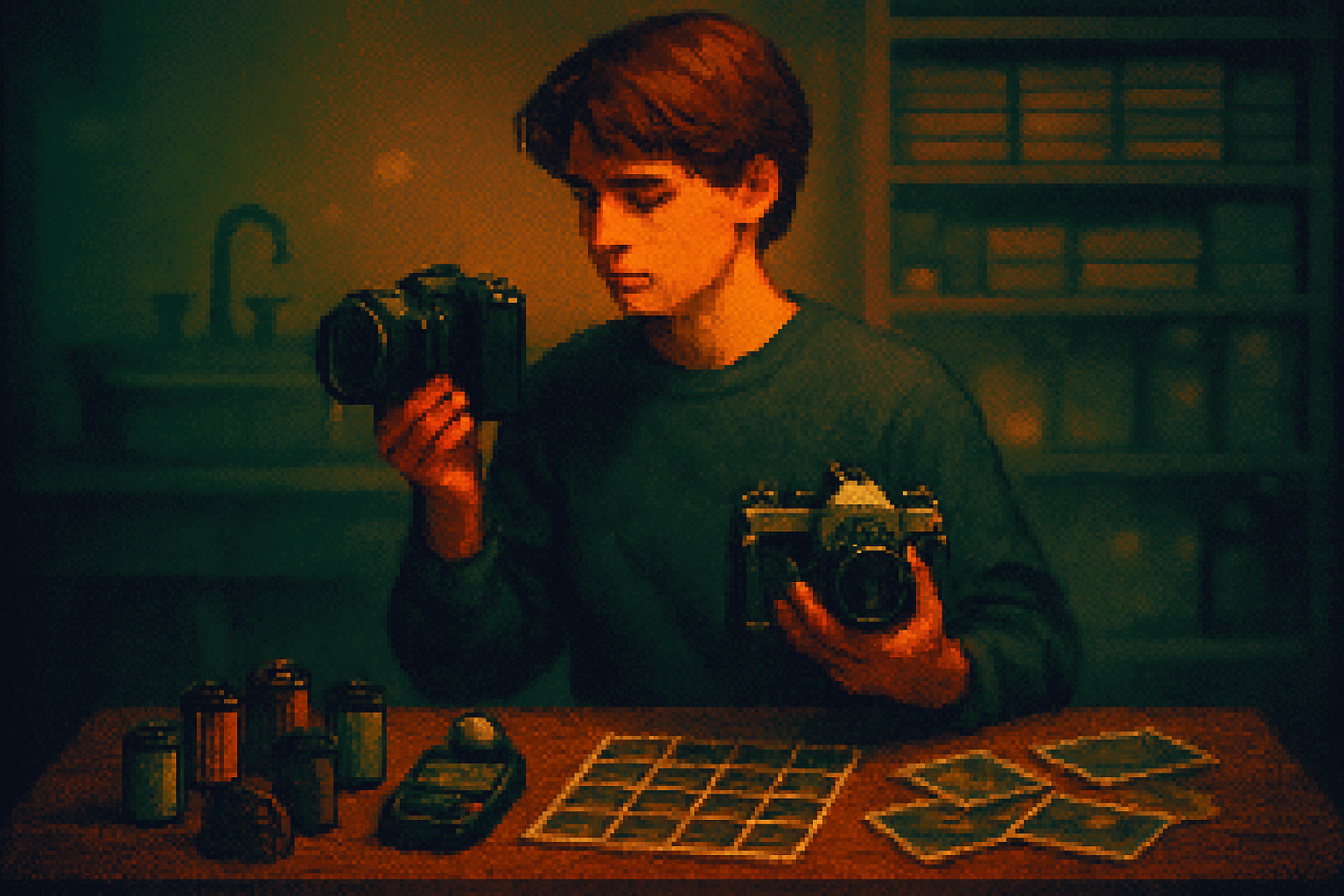
I learned patience from a camera I couldn’t curse at.
It was a friend’s battered Nikon FM2 - no autofocus, no LCD, no histogram, no pity. I pressed the shutter and waited for rolls to finish, for development, for a scan that would tell me whether I had been prescient or merely lucky. The first time I saw my own hands printed with grain and tonal depth I hadn’t expected, something shifted. The photograph wasn’t just a file. It had a feel. It had consequence.
That story will sound quaint to those who grew up with film and maddeningly romantic to pixel natives who have never known a darkroom smell. But there’s a practical reason to try it: film imposes constraints that force you to become a better photographer. It punishes sloppy habits, rewards deliberation, and gives you a handful of aesthetic qualities - grain, highlight roll-off, color character - that digital can imitate but rarely inhabit.
Why go back?
- Because limitations are useful. A 36-exposure roll is a tiny curriculum in discipline.
- Because film has character. Grain is a texture; highlight roll-off is a personality trait.
- Because patience changes your eye. You slow down. You think about light, not histograms.
If you still think film is just nostalgia, keep reading. If you already own a light meter, fine - the rest is for the rest of us.
What changes when you switch: the mental shift
Digital teaches speed: try, delete, try again. Film teaches intention: frame, expose, live with your choice. That psychological difference is the single biggest adjustment.
Practical consequences:
- Fewer frames = more previsualization.
- No instant feedback = trust your metering and judgement (or learn to meter better).
- Finite cost per exposure = you shoot with more purpose.
Gear primer (what to buy and why)
- Camera body - pick a mechanical SLR or rangefinder you like the feel of. Classics: Nikon FM/FE series, Canon AE-1, Pentax K1000, Olympus OM-1, Leica M rangefinders (if your bank account allows daydreaming). Look for light seals maintenance and shutter curtain condition when buying used.
- Lenses - your digital lens collection will work if they’re the right mount. Prime lenses teach you composition; a 50mm or 35mm is a forgiving, versatile start.
- Light meter - many film cameras have built-in meters, but a dedicated incident/spot meter (or a reliable smartphone meter app used wisely) will speed your learning.
- Accessories - a couple of batteries if your meter needs them, a film changing bag if you shoot in bright light with medium format backs (mostly for more advanced usage), a good camera strap.
Film stocks - the practical shortlist
Color negative (most forgiving, easier scanning/printing):
- Kodak Portra 160/400 - skin tones and latitude. Kodak Portra is the go-to for portraits.
- Kodak Ektar 100 - extremely fine-grained, vivid color, great for landscapes.
Black and white:
- Ilford HP5+ / Kodak Tri-X - classic grain, wide latitude, pushable for low light. See Ilford HP5+ for details.
Slide film (reversal):
- Fuji Velvia or Provia - brilliant colors, but exposure-critical. Use them when you can meter precisely.
ISO choices and what they mean
- 100–200 - fine grain, sunny days, landscapes.
- 400 - a versatile all-rounder; good balance of grain and speed.
- 800+ - useful for low light and street photography; expect pronounced grain.
A rule of thumb: choose film speed for the light and the look you want, not to mimic digital high-ISO noise. Grain can be glorious if embraced.
Exposure - basic philosophy and tips
Digital habit: expose for shadows (recoverable). Film habit: expose for highlights (protect them).
Why? Negative film has latitude in the shadows but clipped highlights are gone. Slide film has almost no latitude and therefore demands accuracy.
Practical exposure tips:
- Sunny 16 - on a bright day, set aperture to f/16 and shutter to reciprocal of film speed (ISO 100 → 1/100s, typically 1/125). It’s a baseline teacher.
- When unsure, err toward protecting highlights - underexpose slightly? Yes. Overexpose? With color negative film you can often push slightly for richer skin tones, but blown highlights are unrecoverable.
- Bracket selectively - if a scene is high contrast, take a frame at meter, then one stop down and one stop up if you can afford it.
Focusing, composition, and the luxury of limits
- Manual focus trains you. Use depth of field tables or hyperfocal focusing for landscapes and street work.
- Square the frame with intention. With limited frames, you compose rather than spray-and-pray.
- Think in layers - foreground, subject, background. Film rewards subtlety.
Loading, unloading, and film care
- Load and unload in subdued light when possible. In a pinch, a quick change in daylight will usually be fine for 35mm, but avoid prolonged exposure to direct sun.
- Store exposed film in a zipped bag and refrigerate if you can’t develop soon (especially color film). Let cold film come to room temperature before opening to avoid condensation.
Developing: lab vs. DIY
- Lab processing - fastest, most reliable. Labs can develop, print, and scan. Good labs will also correct simple mistakes and are a social hub for analog photographers.
- Home development - rewarding and cost-effective for B&W. With C-41 (color negative) home processing kits available, some shoot color at home - but expect a learning curve.
Pushing and pulling
- “Push” development (rating film at higher ISO and developing longer) increases apparent contrast and grain - useful in low light but changes the look.
- “Pulling” can reduce contrast and smooth highlights. Both demand consistent technique and test rolls.
Scanning and digitizing
- Flatbed with transparency unit vs dedicated film scanner - dedicated 35mm scanners often produce better detail for enlargements; good flatbeds are faster for mixed media.
- Target 4000–5000 dpi for archival scans you’d like to print at larger sizes. For web sharing, 2400 dpi or even 3000 dpi can be fine.
- Consider professional drum/film scanning for gallery prints.
Costs and time - the unvarnished accounting
- Film - roughly $5–10 per roll depending on type and where you live.
- Development - $5–15 per roll for color negative at a lab; B&W home processing can drop that cost after startup.
- Scans - $5–20 per roll depending on resolution. Expect $15–40 total per roll if you want good scans from a lab.
The important number isn’t exact dollars but the behavioral effect: cost per frame makes you treat each exposure like a small investment.
Common mistakes and how to avoid them
- Shooting too fast - slow down. Count exposures on a roll like banknotes.
- Ignoring the meter - learn to read it, and learn when to override it (backlight, snow scenes, subjects with strong highlights).
- Expecting digital immediacy - accept delays. The delay is the point.
Aesthetic qualities film gives you that pixels can’t quite fake
- Grain - organic texture that digital noise emulates poorly. It sits in the highlights and shadows differently than sensor noise.
- Highlight roll-off - film often compresses bright tones gracefully instead of clipping them abruptly.
- Color rendition - certain emulsions have a signature - Portra’s skin rendering, Ektar’s punch, Tri-X’s soul.
- Archival negatives - properly stored negatives are robust physical records.
Workflow example (a realistic beginner loop)
- Choose a camera and one or two film stocks (one color negative 400, one B&W 400).
- Shoot one roll to learn - keep notes on lens, settings, scene.
- Send the roll to a reputable lab for development and scanning (get TIFF or high-quality JPGs).
- Review scans critically. Note recurring exposure/focus/composition errors.
- Adjust and repeat. Practice emphasis on one mistake at a time.
Stories that teach
An acquaintance shot a wedding on Tri-X because she loved the grainy look. She underexposed in a dim church and pushed the film two stops at development. The result was dramatic, with grain and contrast that matched the ceremony’s mood. She wouldn’t have gotten that out of a cleaned-up digital raw file without heavy processing that would still look, to her clients, like a stylistic choice rather than an inevitability.
Another friend shot portraits on Portra and learned to trust a single measure: “Expose for the highlights in the face.” It gave the skin a dimensional calm that his digital portraits - over-processed to look like film - couldn’t replicate.
When to stay digital
- Sports, high-volume events, fast-turnaround commercial work - digital still wins on throughput.
- When you need dozens of frames to choose from, or you need immediate proof for a client.
When to go film
- Personal projects, portraiture, street work, fine-art prints, or when you want the discipline that changes your eye.
Further reading and communities
- Film Photography Project: https://filmphotographyproject.com - tutorials, film reviews, and a business devoted to keeping film alive.
- Ilford Photo: https://www.ilfordphoto.com - technical guides on black-and-white film and papers.
- General history of photographic film: https://en.wikipedia.org/wiki/Photographic_film
Final note: the truth about nostalgia
People say film is about nostalgia. Sometimes it is. But more often it’s about the discipline that nostalgia disguises: a commitment to craft, to the slowness that makes photographs feel earned. You will make mistakes. Many. You’ll overexpose the sky, forget to rewind a roll, watch a treasured frame come back fogged because you left the film in the sun. You’ll also fall in love with a sequence of frames that feel like proof that your eye has matured.
Pixels are tools. Film is a grammar exercise. Learn both. Use both. If you decide to try 35mm, do it for the small, stubborn joy of waiting for a surprise.