· retrotech · 7 min read
The Forgotten Legacy of the Amstrad CPC: A Controversial Look at Its Impact on 8-bit Computing
The Amstrad CPC arrived as a practical, packaged alternative to the Spectrum and Commodore 64 - beloved by owners, sneered at by some historians. This article reopens the debate: what did the CPC actually contribute to home computing, and why has its reputation been so uneven?
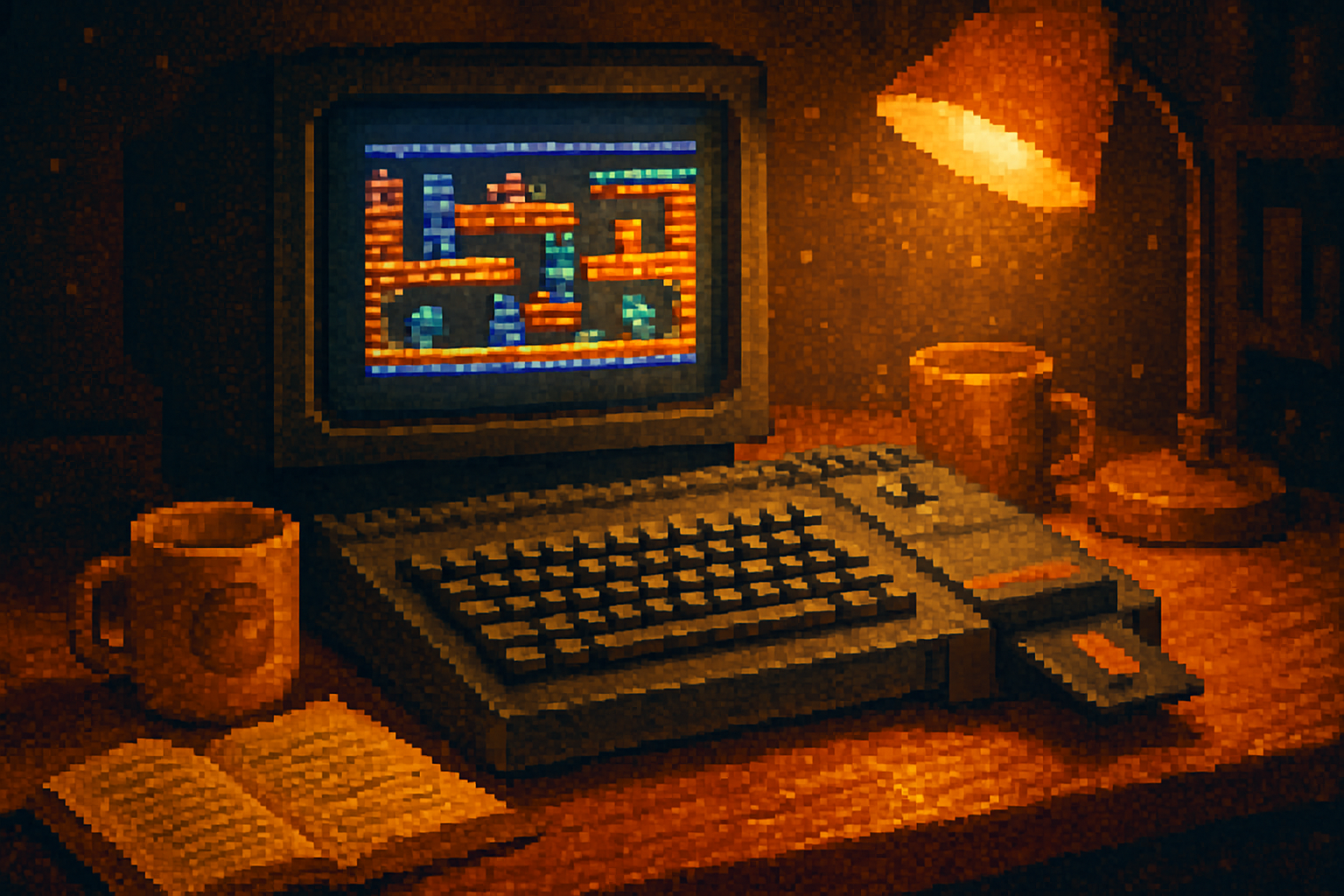
It began with a dust-covered beige box in the corner of my parents’ attic - a compact unit with a chunky keyboard, a built-in cassette deck and a monitor that glowed with flat, earnest colours. It didn’t look like a revolution. It looked like a perfectly reasonable domestic appliance. Which, to the people who bought it in 1984, is exactly what it was supposed to be.
The Amstrad CPC occupies that awkward middle ground in the popular memory of 8-bit microcomputers: too practical for romantic myths about bedroom coders, too late and too British to be treated as a global game-changer. Yet beneath its unflashy surface the CPC introduced a set of choices - design tradeoffs - that shaped how millions actually used a computer in the 1980s.
The hook: why the CPC matters beyond nostalgia
The CPC wasn’t first, fastest, or the most fashionable. It did something else: it packaged computing as an appliance. That sounds modest. It isn’t. Saying “computers as appliances” is like saying Rutherford discovered the atom with a flashlight - small language for a big reframe.
Put simply: where other manufacturers built raw components that looked like toys or hobbyist kits, Amstrad sold a tidy, integrated package that minimized friction for mainstream users. A monitor, a keyboard, and an integrated storage option - cassette or disc - came as one purchase. It reduced barriers. That decision deserves scrutiny.
Quick technical sketch (so we know what we’re talking about)
- CPU - Zilog Z80A at ~4 MHz.
- RAM - models ranged from 64 KB (CPC464 effectively) to 128 KB (CPC6128).
- Graphics modes - three distinct modes (Mode 0: 160×200/16 colours; Mode 1: 320×200/4 colours; Mode 2: 640×200/2 colours) that forced developers to make artistic trade-offs.
- Sound - General Instrument AY-3-8912 chip (three-channel PSG).
- ROM - bundled Locomotive BASIC, praised for being fast and feature-complete.
(For a compact technical reference, see the Amstrad CPC entry on Wikipedia and the enthusiast resources at CPCWiki.)
What the CPC did right
1) Integration: selling an entire workflow, not just a board
The CPC’s “unitize everything” approach - keyboard, storage, monitor in a single retail box - removed many of the second-guessing costs that killed adoption in the early home-computer market. You didn’t need to pair the machine with a dodgy TV or wrestle with RF modulators. That made it friendlier to parents, schools and small businesses.
Analogy: the CPC was the coffee machine that came with pods. You might sneer at the pods later, but there’s no arguing about the convenience.
2) A surprisingly competent BASIC and development environment
Locomotive BASIC, built into the CPC ROMs, was respected for being faster and more capable than many contemporaries’ BASICs. It offered structured programming constructs and quicker access to the machine’s hardware, so hobbyists and small developers could write useful, performant software without buying cross-compilers.
Concrete result: more accessible programming for kids and clubs, fewer trips to arcane manuals.
3) A strong European presence where it counted
Amstrad sold strongly in the UK, France and parts of mainland Europe - often through local partnerships (notably Schneider in France). In markets where Sinclair and Commodore warred, Amstrad carved a pragmatic niche: a full package at an affordable price. That mattered for educational uptake and for the development of a local industry of software houses targeting the platform.
4) Robust hardware choices and longevity
The CPC was built like a small appliance. The keyboard, the monitor and the case were sturdier than the fragile toys sold by some competitors. Many CPCs survive today and are still used by retro enthusiasts; longevity is a small, stubborn kind of success.
What the CPC got wrong (or why it was misunderstood)
1) Market timing and geography
The CPC arrived after the ZX Spectrum and was never going to dislodge the Commodore 64 in global markets. Its strengths were, therefore, largely regional. This made it easy for Anglo-centric histories to treat it as a footnote: “important in Britain and France, irrelevant in the wider narrative.” That impression stuck.
2) The conservative architecture
The CPC chose proven components (Z80 CPU, AY sound chip) rather than experimental chips. That conservative engineering produced predictability and solid software ports, but it deprived the machine of the single standout feature that historians love to point to - there was no killer differentiator like the Commodore’s custom VIC-II/SID chips.
The CPC’s graphics modes were competent, but their tradeoffs (between resolution and palette) meant developers had to worry about representation in ways that sometimes produced less spectacular ports compared to systems with different tradeoffs.
3) Software ecosystem and third-party relationships
Because Amstrad focused on hardware integration and mainstream retail, its relationships with software publishers were often transactional and promotional rather than curatorial. The CPC had great games and strong ports, but it never built the mythic, cross-platform software library that the Commodore or Spectrum could brag about. In a culture that romanticizes iconic titles and studios, that’s reputationally fatal.
The controversies: is the CPC an underrated hero or an overpraised also-ran?
This is where history gets moralized. There are two competing, emotionally charged positions:
- The CPC was a people’s computer - modest, useful, and quietly transformative in how it brought computing into the living room and classroom.
- The CPC was derivative and opportunistic - a late entrant that repackaged existing components without the daring engineering or cultural impact needed to claim major historical status.
Both positions contain truth. What’s less true is the knee-jerk dismissal that confuses cultural glamour for importance. The CPC didn’t win the software wars, but it changed user expectations - that a computer could be a tidy consumer appliance.
Concrete legacies (beyond museum displays)
- Education - its presence in schools in parts of Europe seeded a generation familiar with BASIC and simple hardware hacking.
- Retail model - it proved packaging and integrated systems could expand markets; that lesson mattered to later PC manufacturers and to consumer-electronics thinking.
- Community and preservation - an unusually strong retro scene preserved the platform, producing emulators, hardware clones and active refurbishing communities - a proof-of-life the machine never received in mainstream histories.
A few sharp comparisons (not because numbers settle everything, but because they illuminate choices)
- Commodore 64 - the C64 won hearts with superior sound/graphics hardware and a global games library. It felt like a creative tool. The CPC felt like a dependable household instrument.
- ZX Spectrum - cheaper, punchier in the bedroom-developer myth. The Spectrum cultivated subcultural legend; the CPC cultivated adoption by ordinary households.
Both rivalries left the CPC awkwardly placed: too sensible for countercultural legend, too limited for global dominance.
Why the debate still matters
History tends to celebrate dramatic breakthroughs and stylish rebels. But the slow, structural changes - the decisions that make a technology usable by non-nerds - matter more for the world that actually gets built. When historians prize bravado over usability, they forget the unnoticed labor of adoption.
If you care about how computing became ubiquitous, you should care about the CPC. It is the machine that smoothed the edges of adoption.
Final verdict (a contrarian but humble one)
The Amstrad CPC was not a revolution in electronic engineering. It was a clever reconfiguration of existing parts into a form that ordinary people could - and did - use. Its legacy is in habits, not headlines: kids taught by Locomotive BASIC; parents who bought a single-box solution and let learning happen; local software micro-industries whose memory survives in emulation and fanzines.
That may sound modest, but most technological change is modest. The CPC’s true crime - from the perspective of cultural fame - was to be too practical for romantic storytelling. That neglect is not a historical truth, only a storytelling choice. If we broaden what we call “important,” the Amstrad CPC graduates from footnote to exemplar: an object lesson in how good design for ordinary people can be quietly consequential.
Further reading and resources
- Amstrad CPC - Wikipedia: https://en.wikipedia.org/wiki/Amstrad_CPC
- CPCWiki (enthusiast resource and technical documentation): https://www.cpcwiki.eu/