· culture · 6 min read
Faxing Forward: Why the Old-School Tech Is Making a Comeback
Once dismissed as relics of a bygone office era, fax machines are quietly proliferating again - especially where legal weight, regulatory comfort, and air-gapped reliability still matter. This piece explains why, where, and how the fax persists, and how organizations can use it responsibly in 2025.
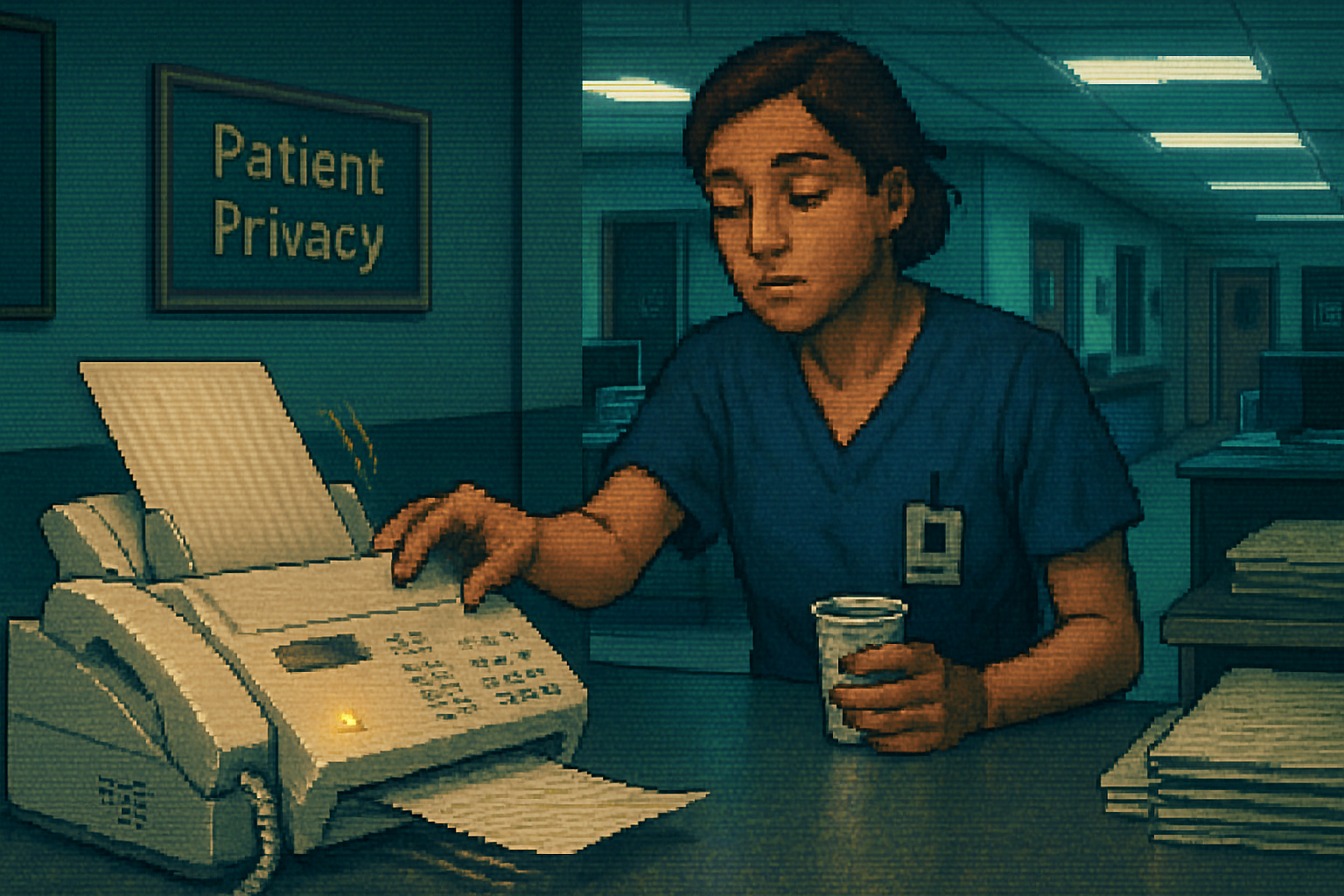
A hospital night-shift nurse pads down a corridor, coffee in one hand and a sheaf of lab results in the other. She drops the stack into a humming box in the nurses’ station. The machine spits out an indecipherably faint confirmation page; nobody reads it. They don’t need to. The results arrive in the chart. The patient gets treated. Nobody tweets about it.
That scene - mundane, stubborn, and embarrassingly analogue - is why the fax machine is not yet dead. In many industries the fax survives because it solves specific, stubborn problems that shiny new tech often ignores: legal admissibility, predictable transmission over analog lines, simple cross-vendor interoperability, and a bureaucratic taste for paper trails.
The claim: fax isn’t retro because people are nostalgic - it’s practical
Call it professional contrariness, but there are hard reasons businesses still fax. This isn’t an aesthetic choice. It’s a risk management decision, grounded in law, habit, and the messy reality of large organizations.
Where the fax remains common
- Healthcare (hospitals, clinics, labs)
- Legal and courts
- Government offices and public health agencies
- Some financial services and insurance processing
- Sectors and countries with slow digital transformation (notably parts of Japan and older municipal offices)
If you’ve ever wondered why doctor’s offices still ask you to “please fax” something, now you know: it’s not always laziness. It’s about certainty.
Why fax keeps being useful - six blunt reasons
Legal and evidentiary comfort
Paper with a dated transmission header still carries intuitive legal weight in many contexts. Signatures, cover sheets, timestamps - people trust the physical artifacts. For litigators and compliance officers, an identifiable transmission path can be reassuring.
Regulatory inertia and compliance corridors
Regulations like HIPAA don’t demand faxing, but they allow it under long-established practices and guidance when proper safeguards are applied. Institutions that built compliance around faxing often see conversion to wholly new workflows as a regulatory risk (and a project-management headache) rather than an obvious win. See guidance from the U.S. Department of Health and Human Services for context on permitted uses of fax under HIPAA: https://www.hhs.gov/hipaa/for-professionals/faq/2078/are-covered-entities-permitted-to-use-fax/index.html.
Predictability and survivability
Analog phone-line faxing is, in a perverse way, resilient. It can work when email servers are down, when internet links are flaky, or during abrupt IT failures. In crisis situations - think small hospitals with limited IT budgets, or municipal offices during outages - a working fax can be the lowest-common-denominator lifeline.
Interoperability across vendors and generations
A fax sent from a 1998 multifunction device arrives the other side as a standardized image. That’s an enormous compatibility advantage in sectors where one vendor’s EHR or records system refuses to play nice with another’s API.
The myth of security (and part truth)
Faxing uses phone lines; a line-level attack is quieter and often harder to execute remotely than an opportunistic phishing email. That reality has translated into the belief that faxing is inherently secure. That belief is a half-truth - it depends on the machine and workflows.
Low cost and low training overhead
Everybody knows how to use a fax. That matters in clinics and government counters where high staff turnover meets relentless paperwork.
But let’s be honest: faxing is not a panacea
If you treat the fax as a magical solution, you’ll be sorry. It has real and specific failure modes:
- Poor audit trails compared to modern secure messaging and document-management systems. Cover sheets and printed logs are easy to forge or misplace.
- Many modern multifunction printers store copies on disk. Left unprotected, those devices create data-at-rest risks.
- Fax over IP (FoIP) can introduce the very network vulnerabilities people think faxing avoids.
- Transmission quality is often poor - low-res scans, skewed pages, and illegible confirmations are common.
Remember: “it went by fax” is not the same as “it went securely.”
Evidence of a comeback - a few visible signals
- During public-health crises and other disruptions, agencies doubled down on fax for rapid, cross-organization document exchange. (See reporting on fax use in public health and government responses.)
- Private sector vendors now sell encrypted electronic fax services that combine the legal affordances of fax with modern transport-layer protections.
- Countries and bureaucracies with strong paper cultures - Japan being the canonical example - kept faxes as a default for official forms and notifications, which slowed full digital transition and kept demand steady.
For a readable look at why some countries cling to fax machines, see this exploration from the BBC on Japan’s relationship with faxing: https://www.bbc.com/worklife/article/20200604-why-japan-is-still-fond-of-fax.
How organizations should think about fax today: pragmatic modernization
If your org still uses fax - or is getting pressured to reintroduce it - don’t pretend it’s a relic. Treat it as one tool in a risk toolbox. Here are practical steps IT leaders, compliance officers, and operations managers should consider.
1) Inventory and classify
- Catalog every fax device and e-fax gateway. Note what data types flow through each one and why.
- Map fax workflows to business processes and legal requirements.
2) Decide: keep, replace, or wrap
- Keep - If a process truly needs paper artifacts or has no good digital equivalent, keep a tightly controlled fax workflow.
- Replace - Where a secure digital alternative exists (signed PDFs with audit trails, HL7/FHIR for clinical data exchange), plan a migration.
- Wrap - Where you must keep fax for the short term, wrap it with controls - encrypted e-fax services, logging, and automatic purge policies.
3) Harden devices and services
- Disable local storage on multifunction printers where possible. If storage is needed, encrypt and set strict retention.
- Use secure e-fax gateways that provide TLS, server-side encryption, and comprehensive logging.
- Segment networked printers on a separate VLAN with strict firewall rules.
4) Improve procedural controls
- Use cover sheets that include confidentiality notices and a minimal metadata set (recipient, sender, time, case number).
- Train staff to verify recipient numbers, to confirm successful transmissions, and to digitally archive received faxes into the official records system.
- Establish incident response steps for misdirected faxes or suspected disclosure.
5) Audit and measure
- Log every transmission, retention event, and purge. Make logs auditable and tied into compliance reporting.
- Periodically review whether fax flows can be replaced with modern interfaces (APIs, secure portals, EHR integrations).
Concrete recommendations for three audiences
- CIOs and IT leaders - Treat fax as a legacy interface that deserves a modernization roadmap, not a boycott. Invest in secure e-fax gateways, network segmentation, and device management.
- Compliance officers and legal counsels - Require documented business justification for continued fax use. Insist on auditable logging and regular risk reviews.
- Operations managers and clinicians - If a fax is the fastest way to save time and patients, use it - but scan it into the official digital record immediately and destroy the physical copy per policy.
The future: coexistence, not extinction
The fax’s renaissance isn’t a triumph of nostalgia; it’s a rebellion of practicality. Digital transformation advocates are right that modern secure messaging, APIs, and integrated record systems are the long-term solution. But transformation is costly, slow, and risky when lives or legal obligations hang in the balance.
So expect coexistence for years to come. The goal shouldn’t be to exterminate the fax with ideological zeal but to reduce its footprint, to insert secure wrappers around necessary faxes, and to migrate processes where clear digital alternatives exist.
And to the technologists who sneer at fax machines as the work of Luddites: remember that in a blackout, a chirping analog modem can feel like a miracle.
Further reading
- U.S. Department of Health and Human Services - HIPAA FAQs (on permitted transmissions): https://www.hhs.gov/hipaa/for-professionals/faq/2078/are-covered-entities-permitted-to-use-fax/index.html
- BBC - Why Japan still loves fax (on cultural and bureaucratic persistence): https://www.bbc.com/worklife/article/20200604-why-japan-is-still-fond-of-fax