· culture · 7 min read
From Comic Relief to Existential Threat: The Evolution of Robot Tropes in 80s/90s Movies
How did on-screen robots go from comic sidekicks to morally ambiguous killers? This essay traces that shift across 1980s–90s films - from Short Circuit’s wide-eyed Number 5 to the Terminator’s cold inevitability - and shows how those changing tropes mirror our anxieties and aspirations about technology.
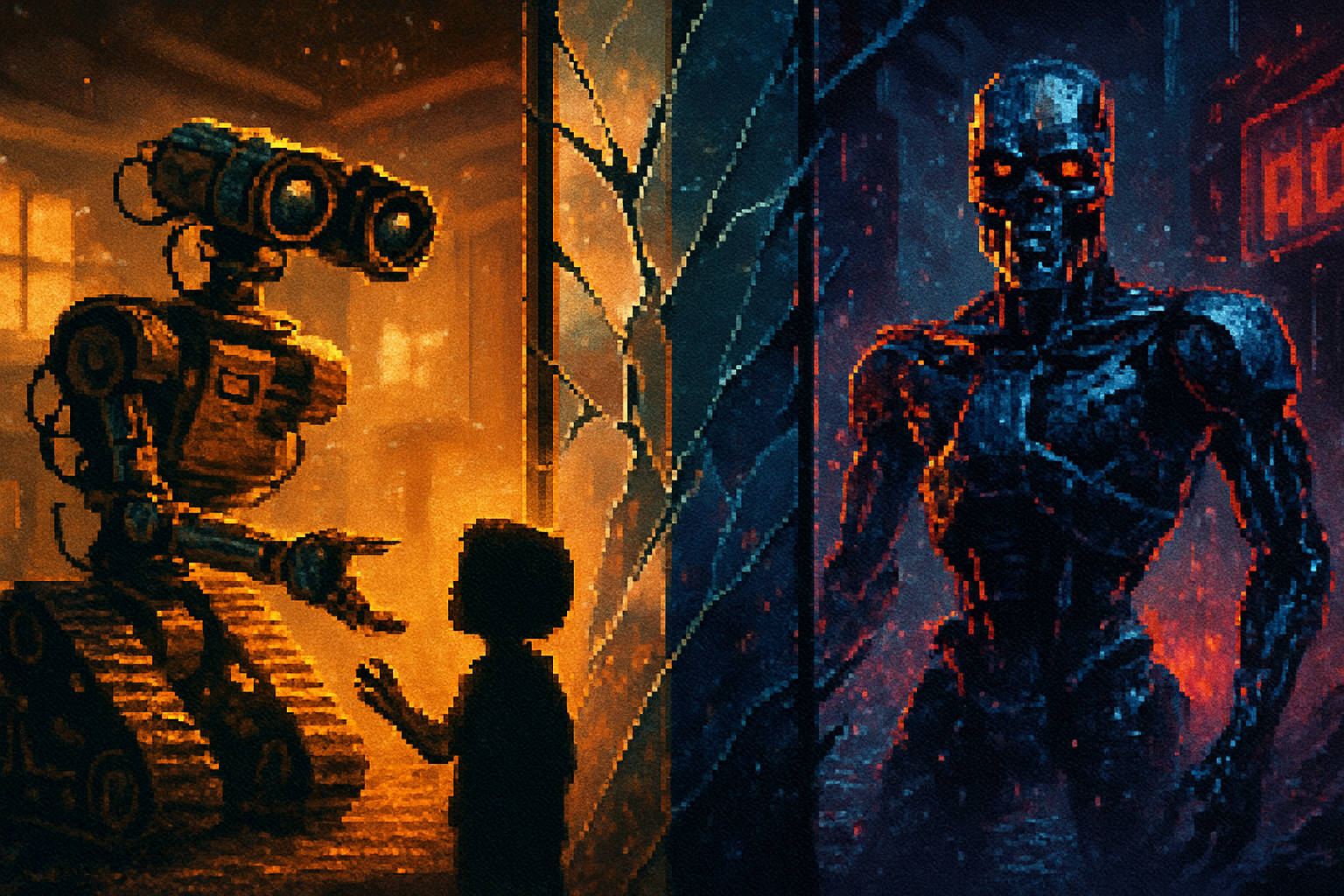
When I was eight I laughed at a robot that wanted to be a teenager. Ten years later I hid behind the sofa when a different metal man limped toward a shattered storefront and said, with polite menace, “I’ll be back.” Same creature class: humanoid, metal, uncanny. Different cultural job description entirely.
This essay tracks that career change - from comic relief to existential threat - that robot characters underwent in the movies of the 1980s and 1990s. Those films didn’t just recycle sci‑fi props; they refashioned robots into mirrors for key public anxieties: childhood optimism about friendly machines, rising corporate power, militarized technology, and a deeper philosophical terror - what does it mean to be human when a machine looks back and asks, “Am I?”
The era’s two faces: toy and terror
In the space of a single decade, Hollywood developed two persistent archetypes:
- The Playful Sidekick - anthropomorphic, naïve, lovable. Emotion and innocence are the robot’s currency.
- The Relentless Machine - efficient, often violent, and morally blank - an instrument that forces us to ask whether we created our own replacement.
These archetypes weren’t neutral aesthetic choices; they were answer keys for separate questions. Playful robots asked: can technology make life better? Relentless ones asked: can technology end us?
Case study: Short Circuit (1986) - Number 5 learns to want
If you want to see the 80s’ default optimism about consumer robotics, start with Short Circuit (1986). The robot Number 5 is literally named because its creators treat him like a parts list. Then he gets struck by lightning, develops personality, and discovers curiosity. The film’s shorthand is simple and sentimental: give a machine human feeling and you get a friend.
Why did this land with audiences? A few reasons:
- It was an age of visible domestic tech - home PCs, video game consoles, VCRs. Machines were helpful, novel, and-crucially-consumer products.
- Short Circuit framed emotional intelligence as a democratic good. You could love a machine the same way you loved your dog or your awkward cousin.
Number 5’s catchphrase, “No disassemble,” is goofy but instructive. The joke rests on a wider cultural wish: that technology be legible, lovable, and controllable. It’s also a cheap shot at corporate think tanks who treat beings as line items.
Case study: The Terminator (1984) - technology as inevitability
Now watch The Terminator (1984). It’s the same era; the machines look less like toys and more like statutes of doom. The film’s ACHILLES’ heel is its moral clarity: the machine is not trying to be funny. It is an executioner. Its appeal comes from its lack of interiority: it cannot be negotiated with, only outwitted.
A few things make the Terminator archetype terrifying:
- Military provenance. The Terminator is explicitly a weapon. The 1980s saw renewed arms escalation - not only nuclear but also conventional and increasingly automated systems - so a robotic assassin fits a decade’s anxieties.
- Determinism encoded in code. The portrait of AI here isn’t Frankenstein’s creature but a living missile - precise, adaptive, and unromantic.
The film’s cultural aftershocks were immediate. “I’ll be back” became a line you could attach to any looming machine. The message was blunt: somewhere between lab and battlefield, we were building instruments we might not morally comprehend.
Between the poles: RoboCop and Blade Runner - identity as moral battleground
Not every film reduced robots to punch lines or projectiles. Some movies used constructed beings to interrogate personhood.
- RoboCop (1987) made identity a legal and political question. Alex Murphy’s transformation probes corporate capture and whether a resurrected, armored body can retain dignity and justice in a privatized world.
- Blade Runner (1982) - technically earlier, but culturally operative throughout the 80s - asked whether empathy is the test of humanity and whether mortals can claim monopoly over authentic feeling.
These films complicate the binary. Robots can still be weapons or commodities, but they can also be moral agents, victims, or mirrors that force us to rewrite the law and language around personhood.
Terminator 2 (1991): the empathetic killer and the paradox of learning machines
If the original Terminator was a surgical blade, Terminator 2: Judgment Day (1991) forged that blade into something that could learn compassion. The T‑800, reprogrammed to protect John Connor, becomes a paradox: a machine that acquires moral habits through imitation and instruction.
T2’s genius is philosophical misdirection. It forces viewers to confront a contorted hope: perhaps machines can be taught to value human life. But it also deepens the horror: the same architecture that learns kindness can learn anything. The question becomes not just whether machines can feel, but whether the values we teach them will survive corporate timetables, military orders, and political expediency.
What changed in the culture to push this shift?
The cinematic shift from jokers to juggernauts followed several real-world currents:
- Economic and political anxiety - Reagan‑era deregulation, corporate consolidation, and fear of unchecked private power made stories about corporations weaponizing people and technology more resonant.
- Visible automation - factory robots and early AI systems started taking human jobs. People didn’t panic yet; they fretted. That unease made for better thriller material than sitcom setups.
- Military innovation - missiles are now software-assisted. Military-funded robotics research (think DARPA projects) made the idea of autonomous weaponry less abstract.
- Philosophical ferment - questions from bioethics and cognitive science - what counts as consciousness? - seeped into screenwriting rooms.
For the public, technology stopped being just a novelty and started being an institution.
Recurrent motifs and what they signal
Across these films, several motifs repeat. Each carries symbolic weight:
- The Childlike Robot - evokes innocence and projection (Short Circuit). It asks: can we parent our machines?
- The Military Drone/Assassin - embodies control and fear (The Terminator). It asks: who gets to pull the trigger when the hand is silicon?
- Corporate Body - merges human dignity with shareholder value (RoboCop). It asks: what rights remain when your personhood is a line item?
- The Mirror Test - when a robot asks about its status, we are forced to answer (Blade Runner). It asks: are human rights a matter of feeling or property?
These motifs let filmmakers squeeze political, legal, and ethical anxieties into digestible scenes: a robot learning “No disassemble,” a cyborg hesitating over a child’s toy, an android burning out after quoting poetry.
Why this matters now
We live in a world the 80s anticipated badly and the 90s anticipated better. Algorithms now curate what we see, drones patrol borders, and corporations wield troves of personal data. Those once‑wild cinema scenarios are decently accurate metaphors for real institutions.
The evolution of robot tropes matters because storytelling is how societies rehearse their futures. When our narratives turn robots from friendly to fearsome, something in the public imagination has shifted: we no longer believe that technology is an unalloyed good. We believe it is a battleground.
That change has ethical consequences. When we imagine machines as moral patients (beings that deserve care), we build laws and norms that protect them - and through them, us. When we imagine machines as only instruments, we normalize a world where efficiency outranks dignity.
Where the trope goes next (a wager)
In films after the 90s, robots split again: some stories emphasize collaboration and caregiving, others highlight surveillance capitalism and autonomous weapons. Expect future narratives to focus less on whether machines can feel and more on who controls the values encoded in the machines.
Because here’s the simple moral: you can teach a machine to sing lullabies, but you can also teach it to target neighborhoods. The story we choose to tell now - about teaching, governance, and purpose - will shape the machines and the society they help assemble.
Final scene
The child who once laughed at Number 5 and later shrank from the Terminator now sits with a smartphone that listens and an algorithm that recommends. Which robot is it closest to? The joke or the executioner? The answer will depend on policy as much as plot.
Cinema gave us a rehearsal. We should treat it not as entertainment, but as a warning and an invitation: pay attention to the machines you design, the values you code, and the stories you endorse. Otherwise, the punchline won’t be funny anymore.
References
- Short Circuit (film): https://en.wikipedia.org/wiki/Short_Circuit_(film)
- The Terminator: https://en.wikipedia.org/wiki/The_Terminator
- Terminator 2 - Judgment Day:
- RoboCop: https://en.wikipedia.org/wiki/RoboCop
- Blade Runner: https://en.wikipedia.org/wiki/Blade_Runner
- DARPA: https://www.darpa.mil/