· retrogaming · 7 min read
The Controversy of Jaguar Emulation: Legal Gray Areas
Atari Jaguar emulation sits at the crossroads of cultural preservation and copyright law. This article untangles the legal threads - ROM distribution, BIOS/firmware, reverse engineering, DMCA exemptions - and offers pragmatic ethical guidance for both users and developers.
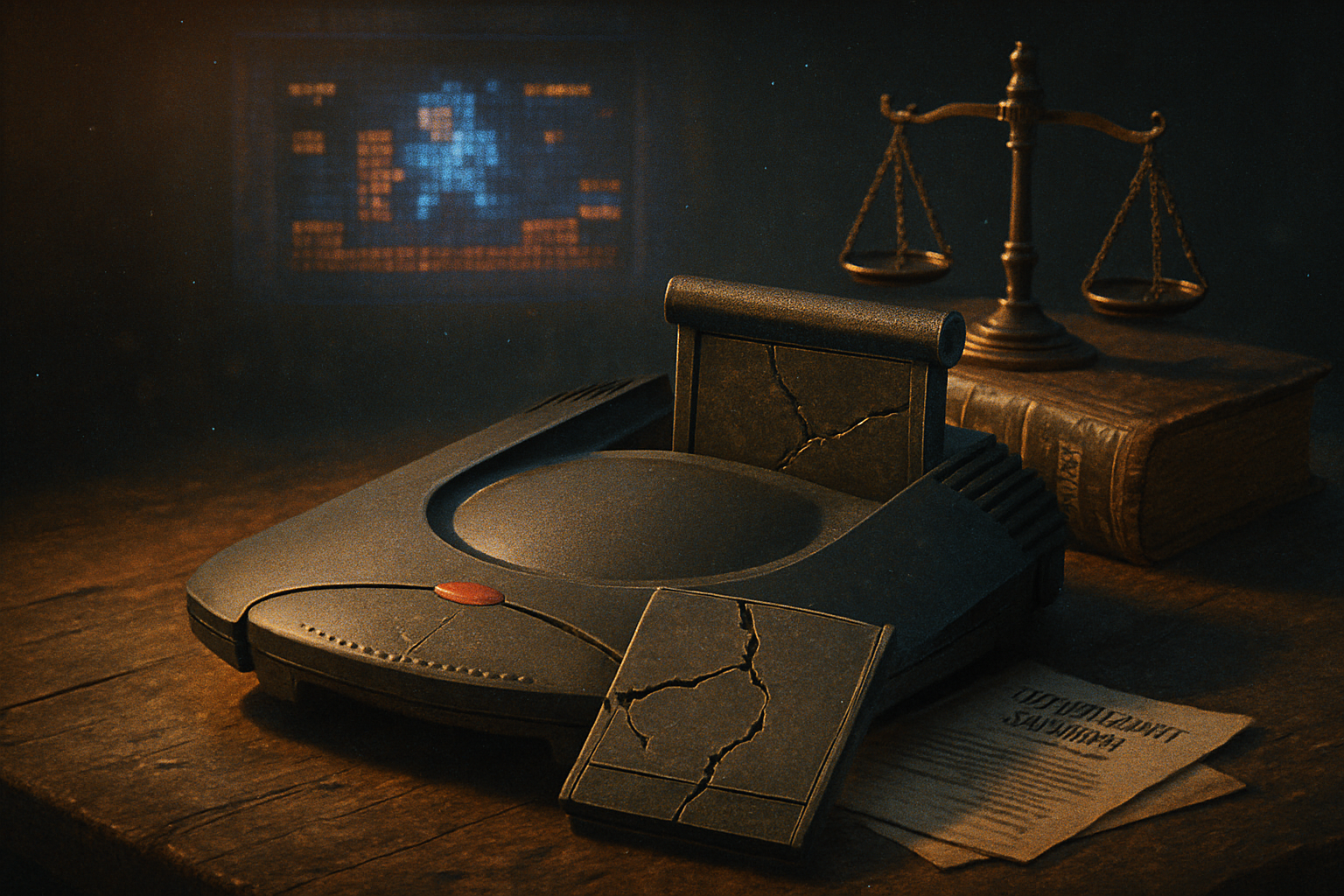
It began with a cramped photograph: a dusty Atari Jaguar, a single plastic cartridge, and a teenager’s trembling hands. He’d downloaded a ROM, fired up an emulator, and - for five glorious minutes - had the entire 1990s in his lap. Then the guilt set in.
That moment - exhilaration followed by a moral aftertaste - encapsulates the Jaguar emulation debate. The console itself was a failure by sales, but a laboratory for weird, brilliant games and odd hardware choices. Its scarcity makes it a poster child for the emulation community’s deepest conflicts: preservation versus piracy, curiosity versus copyright, and the messy middle where the law is as much a political instrument as a legal code.
A quick primer: What is the Atari Jaguar and why does it matter?
The Atari Jaguar launched in 1993 and flopped commercially, but it matters culturally. It was one of the last attempts by Atari to reclaim relevance in consoles, and it left behind a handful of games that are historically interesting and, in some cases, unavailable through modern rereleases. For a compact history and catalog, see the Atari Jaguar page on Wikipedia: Atari Jaguar.
Two forces drive interest in Jaguar emulation:
- Rarity - physical cartridges and working hardware are scarce and often expensive.
- Cultural value - some games are unique artifacts of design and technology that historians and fans want to study.
These are noble reasons. They collide awkwardly with the blunt instrument that is copyright law.
The legal scaffolding: copyright, the DMCA, and a couple of helpful court cases
At its simplest, copying or distributing a copyrighted work without permission is illegal in most jurisdictions. In the U.S., copyright law protects software and audiovisual works, and consoles’ ROMs are typically copyrighted.
Key legal sources to understand:
- Copyright basics: Cornell Legal Information Institute - Copyright
- DMCA and the 1201 rulemaking (important for circumvention and preservation exemptions): Library of Congress - Section 1201
- Emulation and legal analysis from activist and legal groups: Electronic Frontier Foundation - Emulation and ROMs
Two court decisions are especially relevant to emulation developers and defenders of reverse engineering:
Sega v. Accolade (9th Cir. 1992) - the court allowed reverse engineering for compatibility, a precedent that protects some kinds of intermediate copying when done to achieve interoperability. See the case summary:
Sony v. Connectix (9th Cir. 2000) - the court found that intermediate copies of BIOS during reverse engineering could be fair use because the purpose was to create a noninfringing product (an emulator). See summary:
Those cases are not blanket permissions. They provide legal breathing room for carefully performed, good-faith reverse engineering aimed at interoperability. They do not bless wholesale copying and distribution of copyrighted ROMs.
ROM sharing: the bluntest violation (and easiest to understand)
Distributing Jaguar ROMs that contain copyrighted game code or proprietary assets is prima facie infringement. “But it’s abandonware” is a comforting myth - legally meaningless. Abandonware has no legal status; rights remain with the copyright holder unless explicitly relinquished.
Why ROM sharing is risky:
- The copyright holder retains exclusive reproduction and distribution rights.
- Downloading and hosting ROMs exposes individuals and sites to takedowns and potential civil liability.
- Even if enforcement is uneven, illegality doesn’t evaporate with rarity or nostalgia.
If a game has been officially reissued (via digital storefronts, retro compilations, or licensed ports), the legal and ethical case for piracy evaporates. Support the rights holders when they’re offering the work.
BIOS, firmware, microcode: the proprietary grease in the engine
Many consoles have BIOS or firmware blobs that are proprietary. Distributing those files is usually infringement. The law treats firmware like any other copyrighted code; copying and sharing it without permission is risky.
Emulator projects often avoid legal trouble by:
- Not including proprietary BIOS/firmware in distributions.
- Implementing clean-room reimplementations - one team documents behavior, another reimplements without access to the original code (a practice that reduces risk of copying but must be done carefully).
Clean-room reimplementation and FPGA projects (which reproduce hardware behavior) can be safer legally if no copyrighted code or microcode is copied. But the safety margin depends on how the reimplementation was done and what it used as source material.
Reverse engineering: a defensible path, but with caveats
The judicial trend in the U.S. favors reverse engineering for compatibility, provided the process is done properly and the end product doesn’t simply replicate copyrighted code. Sega v. Accolade and Connectix give developers a roadmap: document behavior, justify the need for interoperability, and avoid copying protected code.
Good practices for emulator developers:
- Use clean-room techniques when reimplementing proprietary components.
- Avoid bundling copyrighted ROMs or firmware with emulator distributions.
- Keep meticulous documentation of development processes and sources.
- If possible, obtain licenses for any proprietary code used.
Even when following these steps, risk isn’t zero. Litigation is expensive, and rights holders occasionally litigate to assert control or send deterrent signals.
DMCA circumvention and preservation: recent pragmatic exceptions
The DMCA’s anti-circumvention provisions make it illegal to bypass technological protection measures, which complicates preservation of old games and hardware. The good news: the Library of Congress periodically grants exemptions for specific preservation activities and for reverse engineering necessary for interoperability.
Recent rulemakings have created carve-outs for libraries, museums, and preservationists under limited conditions. See the Library of Congress 1201 rulemaking portal for details: Library of Congress - Section 1201 Rulemaking.
These exemptions are narrow and technical - they help bona fide preservationists and researchers but don’t give carte blanche to download and distribute ROM libraries.
Abandonware and preservation - ethics more than law
Here we leave pure legality and enter the realm of ethics. Many emulation advocates argue that preserving software - especially orphaned works - is a cultural imperative. They are right in spirit. The counterargument: rights holders deserve control and compensation.
Pragmatic ethical framework for preservationists:
- Prioritize noncommercial preservation carried out by institutions (libraries, museums, universities) where possible.
- When working with orphaned or rare titles, exhaust attempts to contact rights holders before public distribution.
- Use access controls (on-site viewing, restricted archives) rather than public dumps when a license is not available.
- Push for policy change - advocate for statutory solutions that recognize the cultural value of at-risk software.
Groups like the EFF have documented this fight and tracked DMCA exemptions that help preservation work: EFF on video game preservation and DMCA exemptions.
Commercial rereleases, licensing, and the rights economy
One practical way to reduce piracy is availability. When rights holders reissue old games legally (on platforms like GOG, Steam, or through official mini-systems), the moral and legal question becomes simple: buy the legal re-release.
But licensing is messy. Rights to a game can be split across developers, publishers, and even third-party IP owners (music licenses, actor likenesses). That fragmentation often makes re-release expensive or impossible, leaving fans in limbo.
Practical advice: what users and developers can do today
For users:
- Don’t download or share ROMs or BIOS files you don’t have explicit permission to use.
- Buy legal re-releases where available.
- Support preservation institutions and projects that operate transparently and legally.
For emulator developers and hobbyists:
- Ship no proprietary ROMs or firmware. Not even one.
- Favor clean-room reimplementation and document your process.
- Consider requiring users to supply their own legally obtained dumps for formats that require proprietary blobs.
- If you plan to distribute a BIOS or game, secure a license first.
- Stay informed about DMCA exemptions that might legitimately cover your preservation or research activity.
The gray at the center
Legal doctrine gives some protections to reverse engineering and interoperability, but it does not legalize the wholesale copying and distribution of copyrighted games. Preservationists and emulator developers can operate with reduced risk if they follow clean processes, avoid distributing copyrighted assets, and make a principled case for cultural value when applicable.
Ethically, nostalgia and scarcity don’t override the rights of creators - but they do create a strong public policy argument for statutory remedies that allow libraries and museums to preserve at-risk games. If you’re interested in the intersection of law, technology, and cultural heritage, this is one of the small, knotty problems that will define digital stewardship in the 21st century.
Further reading
- Library of Congress - Section 1201 rulemaking: https://www.copyright.gov/1201/
- Electronic Frontier Foundation - Emulation and ROMs: https://www.eff.org/issues/emulation
- Sega v. Accolade summary: https://en.wikipedia.org/wiki/Sega_Enterprises_Ltd._v._Accolade,_Inc.
- Sony v. Connectix summary: https://en.wikipedia.org/wiki/Sony_Computer_Entertainment_America_v._Connectix_Corporation
- Fair Use Overview - Stanford University: https://fairuse.stanford.edu/