· culture · 6 min read
Breaking the Internet: What Fax Machines Can Teach Us About Digital Privacy
A lighthearted, slightly sardonic look at how the humble fax machine-its point-to-point analog transmissions, ephemeral paper, and bureaucratic rituals-accidentally enforced a kind of privacy that many modern internet systems lack, and what practical lessons we can borrow for today's digital hygiene.
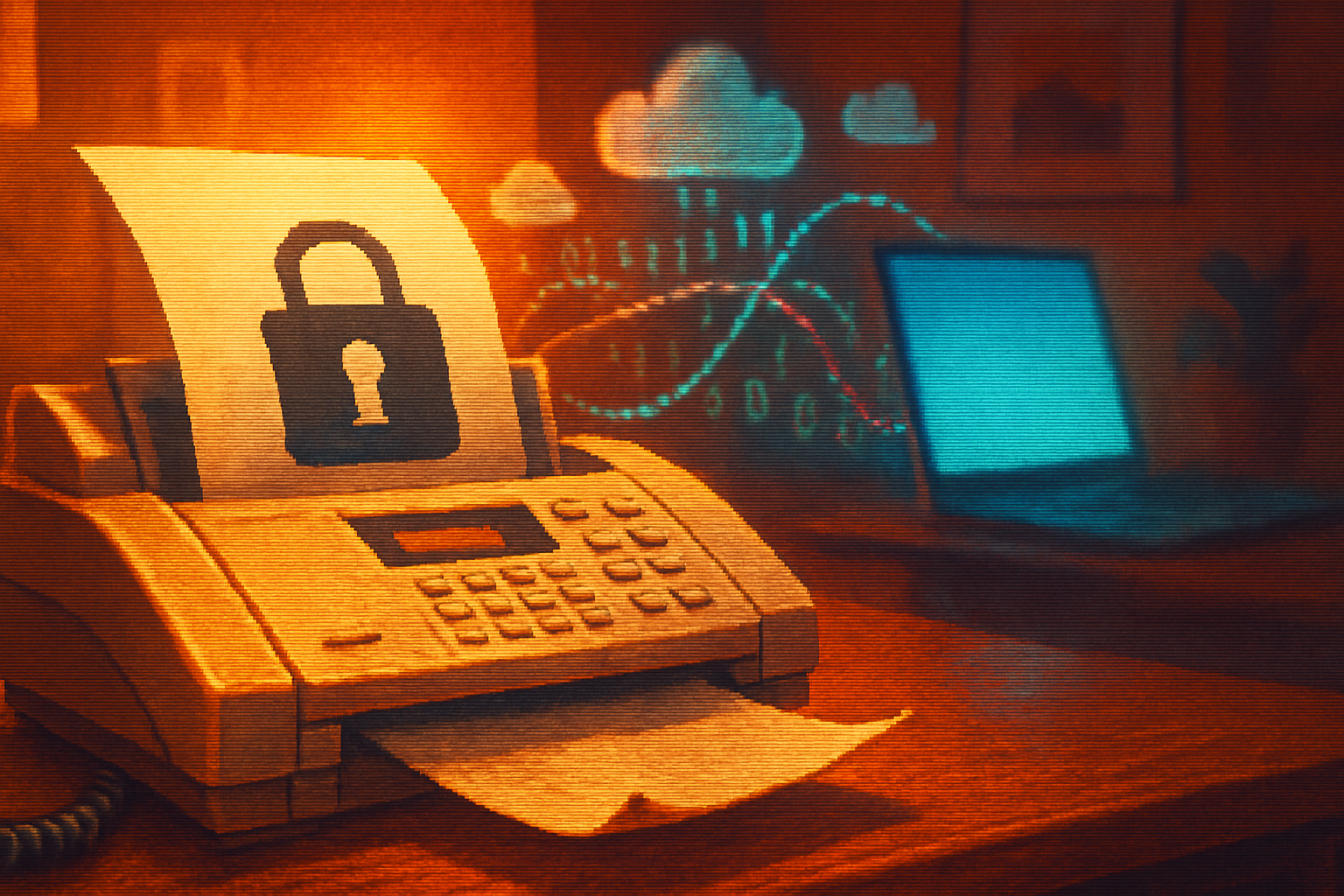
It started with a beep, a hiss, and a strip of hot paper.
I was twenty-something and standing in the fluorescent hinterlands of a small firm’s office watching a senior partner feed twelve legal pages into a battered desktop fax. He didn’t click “send” and walk away. He watched the green light bite down. He waited for the clatter, for the single-sheet chime, and when the faint smell of toner and ozone announced success, he slid the warm stack into a manila envelope and whispered, half to himself, “Done.”
That whisper was the privacy.
The odd intimacy of an analog machine
Fax machines are quaint relics-nostalgic beeps, paper jams, that small mechanical dignity. But they also embody privacy patterns we fetishize today: point-to-point transmission, ephemeral physical copies, and a ritualized human check. None of that required a privacy policy or a Terms of Service full of legalese. It was built into the technology and the workflow.
Before we romanticize too far, let’s be clear. Fax is not a cryptographic fortress. It never was. Analog signals travel across copper wires; a determined interceptor can tap a line. Misrouted faxes land in the wrong tray. Machines print unredacted headers and logs. Still, compared with the sprawling, copy-happy, server-laden modern internet, faxing enforced a few practical privacy constraints worth studying.
What exactly was the fax advantage?
Think less “invincible” and more “accidentally less leaky.” The fax era bundled a set of features that reduced the attack surface:
Point-to-point channel - Traditional faxing used the plain old telephone service (POTS), sending analog signals directly from one device to another without passing through cloud storage or third-party servers. To intercept content you generally had to tap the physical line or compromise one of the endpoints. See:
Fewer persistent copies - The canonical output of a fax was a single printed sheet. No automatic, searchable server archive unless someone scanned and uploaded it later. Fewer copies mean fewer places for attackers to look.
Human-in-the-loop checks - Someone had to physically feed the pages, watch the transmission, and collect the output. That ritual slowed thoughtless mass distribution and introduced friction that, oddly, protected privacy.
Simplicity of metadata - The signaling and headers were primitive compared with today’s global metadata soup. Yes, a fax prints the sender’s number and a timestamp, but it lacked the multi-hop, global breadcrumb trail email and web traffic leave behind.
Cultural protocols - Offices developed norms-don’t leave faxes on the tray, confirm numbers aloud, shred misprints. Culture can behave like a primitive access control.
The myth: analog = secure
Let’s not be sentimental. Analogy is not security. A few caveats:
Wiretapping is real. Anyone with physical access to the copper or the right radio gear can intercept analog signals. The FBI and law enforcement historically leveraged phone taps; private actors could too. See: Telephone tapping.
Fax headers leak identity. The transmitted cover page often includes sender ID, timestamps, pages - metadata that can be sensitive.
Misdeliveries happen. A misdialed number or an unattended fax tray can mean sensitive documents end up in an office where twelve strangers serve themselves coffee.
Digitized faxes live forever. Once someone scans or stores a fax, the privacy benefits evaporate. The paper was only a temporary barrier.
So no, we shouldn’t wish for a return to rotary dials. But the fax’s accidental privacy teaches precautionary lessons.
Why we lost the fax-like protections (and why it matters)
The internet solved massive coordination and convenience problems. Email, cloud drives, collaboration apps-all of them dramatically increased productivity. They also multiplied copies, widened access surfaces, and turned privacy into an engineering problem that many products are reluctant to solve.
Routing across many intermediaries. Email and web traffic hop across mail relays, content delivery networks, and cloud providers-each a place where data can be logged or compromised.
Default persistence. Most modern services assume you want storage, backups, and searchability. That’s useful. It’s also a liability when you don’t.
Rich metadata. Modern protocols emit far more metadata than a fax ever did - IP addresses, device fingerprints, location tags, headers that map conversations across services. See:
Business models that monetize access. Many services exist to collect, analyze, and sell data. The incentive to aggregate and retain is built into the economics.
The Snowden revelations remind us how powerful metadata can be in surveillance-the pattern of connections often betrays more than a single message’s content. See: Edward Snowden.
Translating fax-era lessons into modern privacy practice
You can’t unplug the internet. But you can borrow the practical constraints that made old-fashioned faxing quieter. Treat the fax’s virtues as heuristics for modern design and personal practice.
Minimize copies - Only create the backups you need. If a document must be ephemeral, use tools designed for ephemerality (and understand their limits).
Prefer direct channels - End-to-end encryption approximates the point-to-point spirit. Use E2E messaging and encrypted email where possible.
Reduce blast radius - Limit recipients and access. Apply the principle of least privilege to documents and folders.
Add human checkpoints - Implement workflows that require explicit confirmations before sending sensitive items-especially automated distributions.
Manage metadata - Where possible, strip unnecessary metadata, and use services that minimize logging. Remember: metadata often reveals the map, not just the address.
Physical hygiene still matters - Secure printers and shared devices. Shred sensitive misprints. Don’t leave confidential output in a public tray.
Audit and rotate secrets - Replace permanent credentials with short-lived tokens. Assume compromise and make recovery manageable.
Choose threat models honestly - Different documents require different defenses. The birthday invitation doesn’t warrant the same controls as payroll records.
Quick do-this / don’t-do-that
- Do - Use end-to-end encrypted messaging for small-scale confidential exchange.
- Don’t - Email unencrypted attachments to long distribution lists.
- Do - Limit cloud access to named individuals and set auto-expiry links.
- Don’t - Leave sensitive PDFs in shared folders with default permissions.
- Do - Physically secure printers and dispose of printed sensitive documents.
- Don’t - Assume deleting in an app removes all copies.
When nostalgia misleads
It’s tempting to tell a simple story: the fax machine, humble guardian; the cloud, ravenous beast. The real story is messier. The fax offered some privacy through friction and simplicity, not through rigorous protection. The internet offers powerful tools-if you design systems and habits to respect privacy.
The useful moral isn’t to bring back thermal paper or to swear off Dropbox. It’s to borrow the fax’s discipline: build fewer accidental copies, slow down automated churn, prefer direct channels, and treat metadata with the suspicion it earns.
Parting image
Imagine two offices. In the first, a junior associate slaps a document into a fax, watches it go, and tucks the warm output into an envelope. There’s a small grace in that act: attention, finality, and a physical boundary. In the second, a coworker hits “share,” types three words in a chat, and the document radiates outward-stored, copied, indexed.
We miss the first not because its tech was better, but because it forced us to pay attention. Privacy, ultimately, is as much a habit as it is an algorithm.
If you want better protection than nostalgia offers, treat your tools like the fax machine did: minimize copies, design for directness, and make a small ritual of discretion.
References
- “Fax” - https://en.wikipedia.org/wiki/Fax
- “Plain old telephone service” - https://en.wikipedia.org/wiki/Plain_old_telephone_service
- “Telephone tapping” - https://en.wikipedia.org/wiki/Telephone_tapping
- “Metadata (communication)” - https://en.wikipedia.org/wiki/Metadata_(communication)
- “Edward Snowden” - https://en.wikipedia.org/wiki/Edward_Snowden