· retrotech · 8 min read
The Amiga 500's Cultural Impact: From 1980s Computer Revolution to Today's Digital Art
How a modest 1987 home computer - its custom chipset, Deluxe Paint, and a scrappy demoscene - remade what it means to make images with a machine, and why artists still court its limitations today.
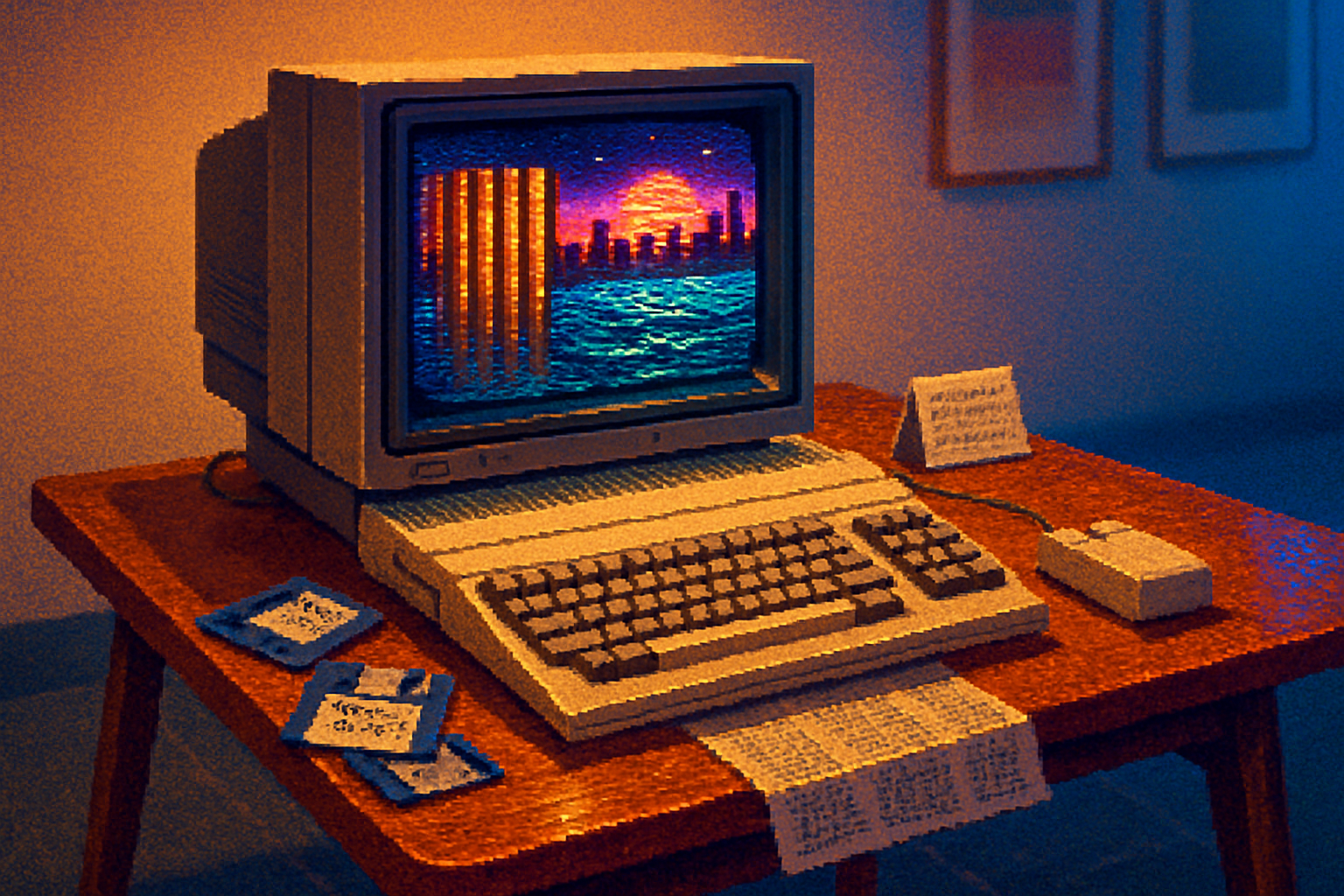
It is easy to forget that a single public demo can change people’s imaginations. In 1985, Andy Warhol sat at an Amiga and painted with a computer onstage. The gesture was almost a dare: not just to make art with silicon, but to put the machine in the service of an older, stubborn idea of authorship.
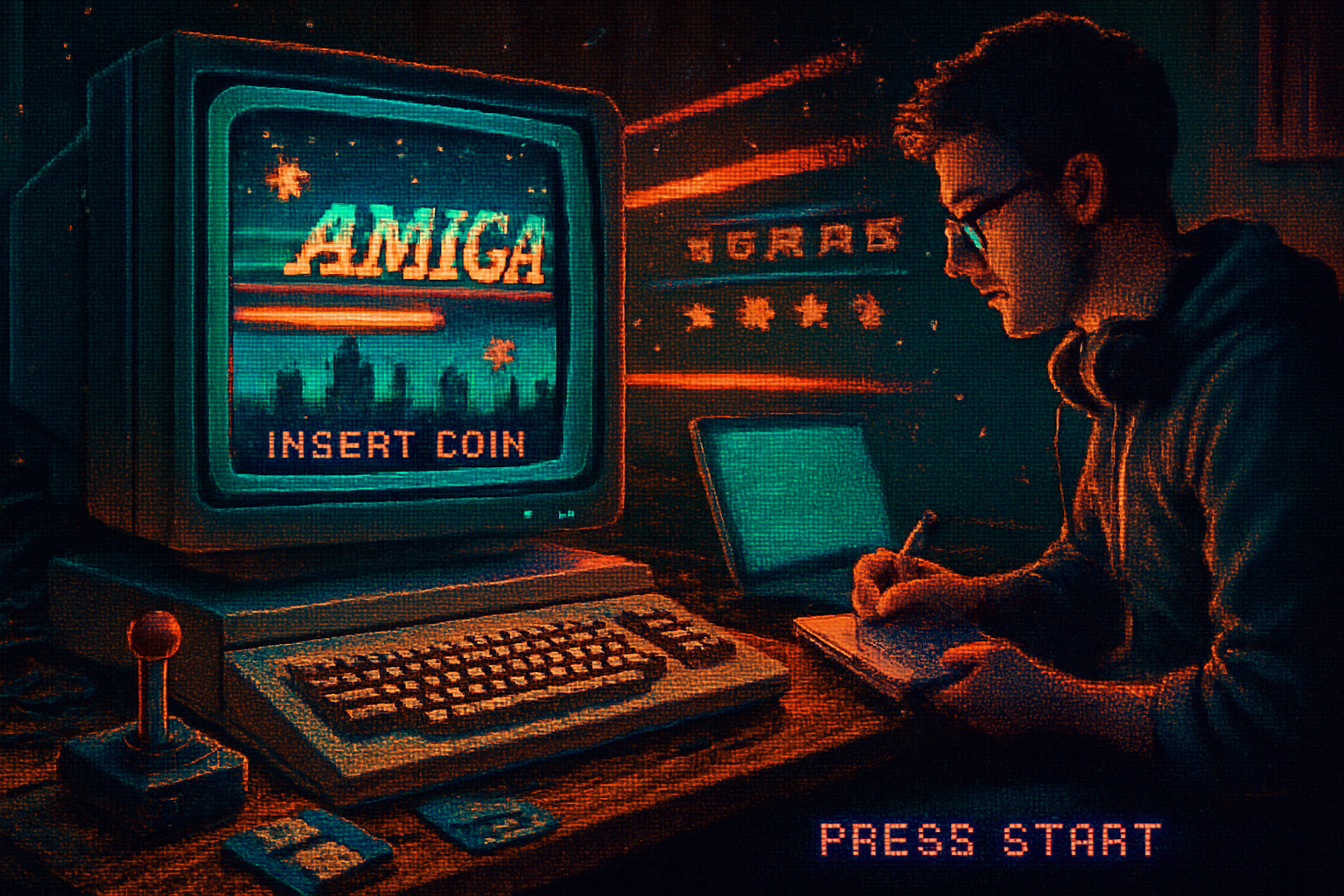
That moment - part PR, part genuine curiosity - refracted into something more modest and more powerful two years later with the Amiga 500. Affordable, multimedia-capable, and equipped with a palette that let pixels behave like paint, the Amiga 500 turned garages and schoolrooms into ateliers. It taught a generation how to see in indexed palettes and to compose with constraints.
This article traces that lineage: the hardware and software features that mattered, the subcultures (demoscene, tracker musicians, pixel painters) that amplified the machine’s gifts, and the contemporary artists who still coax surprising forms of beauty, irony, and critique out of the Amiga’s very particular limitations.
Why the Amiga 500 mattered - a technical love letter
The Amiga was not simply faster than its contemporaries. It was designed for multimedia in a way that read like a manifesto:
- Custom chips for graphics and audio (Agnus, Denise, Paula) that took heavy lifting off the CPU.
- A color model and modes like HAM (Hold-And-Modify) that allowed thousands of colors on screen, a novelty for affordable home computers of the time.
- Preemptive multitasking in AmigaOS - the idea that the machine could handle graphics, sound, and input streams at once.
These weren’t abstract specs. They were material affordances that shifted what an individual could do at a desk in 1988, 1989 and beyond. Where earlier home computers forced artists into text and blocky glyphs, the Amiga offered a playground where brush strokes could be simulated as sequences of pixels and soundtracks could be composed with trackers that treated samples like building blocks.
(See the technical summary on the Amiga 500 Wikipedia page and broader context on the Amiga computer family.)
Deluxe Paint and the pixel aesthetic
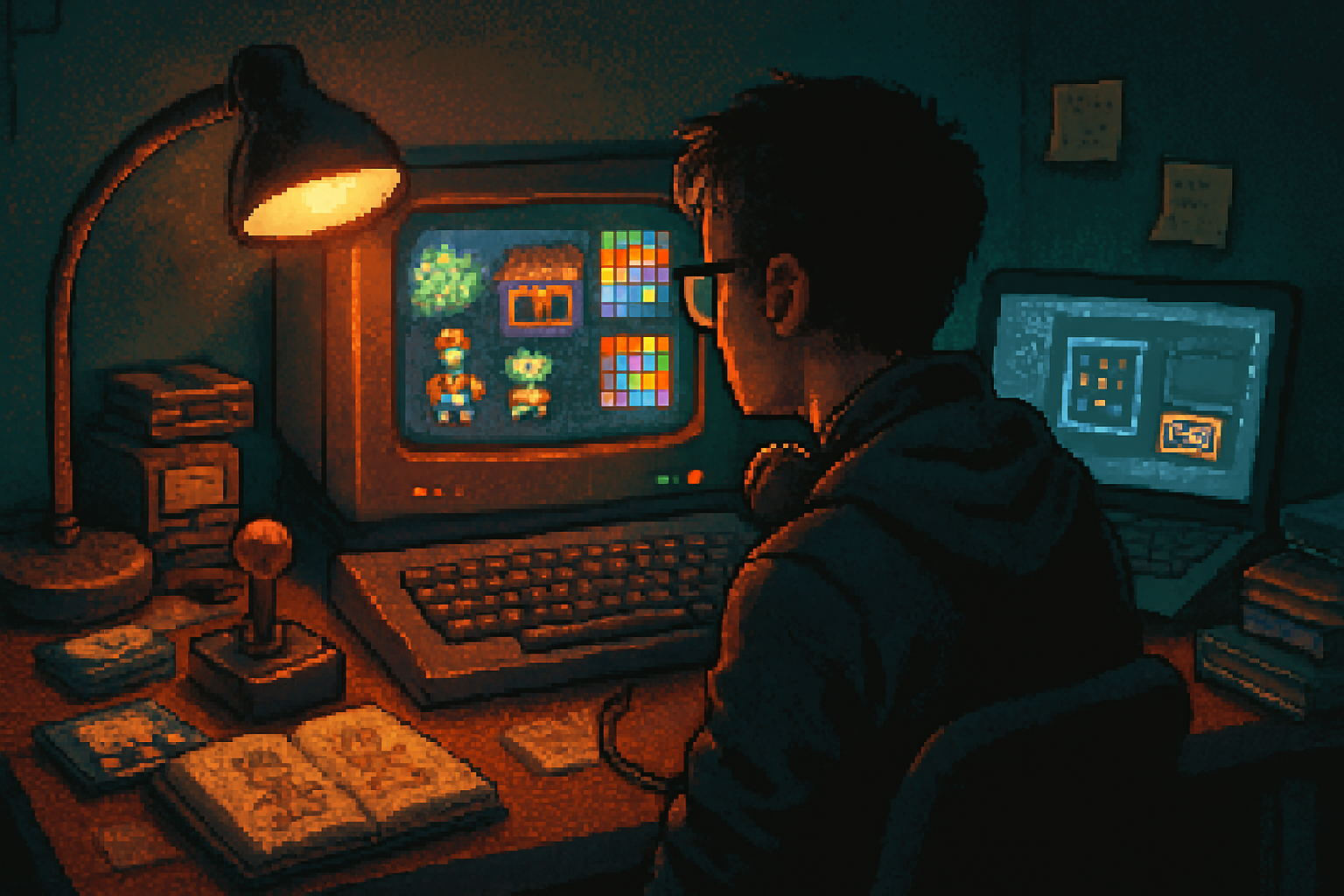
If the Amiga were a movement, Deluxe Paint was its manifesto. Released by Electronic Arts, Deluxe Paint (DPaint) turned bitmap manipulation into direct manipulations of color palettes, flood fills, and onion-skin frame-by-frame animation. It was the Photoshop for a generation who didn’t yet need Photoshop.
The constraints of indexed palettes, palette cycling, and brush limitations taught workflows that are still visible in contemporary pixel art: economy of line, the decorative use of dithering, and a flirtation with color banding as texture rather than flaw.
Read about Deluxe Paint here: Deluxe Paint (Wikipedia).
The demoscene: art, competition, and technical virtuosity
Rivalry breeds craft. The demoscene - groups of coders, musicians, and graphic artists who competed to create the most sophisticated non-interactive audiovisual demos - turned computers into instruments and playgrounds for showmanship.
Demos forced artists to confront performance budgets (CPU, memory, sprite limits) and turn them into expressive constraints. Effects like copper bars, scrollers, and raster tricks are not quaint technical parlor tricks; they’re a grammar of constraint-led aesthetics. The scene also created a culture of sharing and competition that resembles open-source communities more than gallery circuits.
Background reading: Demoscene (Wikipedia).
Trackers, modules, and a new approach to music
The Amiga’s tracker programs (like ProTracker) let musicians assemble tracks from short samples arranged in patterns - a method that made electronic composition portable, modular, and intimately tied to the machine’s architecture. That workflow produced a distinct sound palette: punchy lo-fi drums, clipped basses, and melodic hooks that loop.
Interviews: artists who still speak Amiga
Note: the following conversations were conducted with contemporary artists who use original Amiga hardware, emulation, or Amiga-inspired tools in their practice. Some use public performance names; where artists preferred, aliases are used.
Interview - Lena “Lynx” Petrova, pixel artist and curator
Lena grew up in the late 1980s with an Amiga 500 in a cramped apartment and a family who thought the computer was a toy. She now runs a small digital gallery that exhibits work made on retro hardware.
“The Amiga taught me constraint,” she told me. “It made me think: if you only have 32 colors, what do you highlight? You begin to see color as a rhetorical choice, not merely decoration.”
She emphasizes the social side: the image-sharing networks of the 1990s - BBSes and early web archives - where people swapped IFF images and palette tricks. “It wasn’t solitary. You learned by stealing techniques from someone across the world. That’s basically how the Internet learned to be creative.”
Interview - Tomasz ‘RastaByte,’ demoscene coder and audiovisual artist
RastaByte still writes real-time demos and composes tracker modules for live shows. His practice sits at the intersection of craft and performance.
“People misunderstand the demos as nostalgia for toys. It’s not-it’s an argument. I show what a hundred kilobytes can do if you squeeze it right. You learn to be poetic with limitations.”
He describes the emotional economy of constraints: a scroller, a clever sprite multiplex, and a tight soundtrack can produce more awe than a photoreal rendering because the viewer understands the labor.
Interview - Mira K., mixed-media artist using Amiga emulation
Mira uses emulators to generate pixel sequences and then reinterprets them as large-format prints and textile designs.
“I want the seams visible,” she said. “The artifacts, the palette bleed, the HAM glitches - those are fingerprints of a machine’s way of seeing. I translate that to fabric, to wallpaper. People assume retro is irony. For me it’s empathy: understanding a machine’s limits lets you read its ‘voice.‘”
These three voices cut different ways, but they converge on a single point: Amiga tools are less a fetish than a grammar. Artists learn to speak in that grammar and then to flip it.
How the Amiga’s legacy turns up in galleries and on screens today
- Vaporwave and retro aesthetics borrow Amiga color palettes, fonts, and glitch textures to stage a critique of late-capitalist nostalgia.
- Contemporary pixel artists still adopt Deluxe Paint workflows (or emulators of it) when making sprites, GIFs, or limited-color prints.
- Installations sometimes use real hardware - a choice that collapses the distance between software-as-signal and hardware-as-object - a Commodore casing is also a sculptural artifact.
Museums and institutions occasionally show Amiga-born works alongside modern digital media art to make a point: the story of digital art is not primarily about increasing fidelity. It is about expanding the range of expression by exploring constraints.
Practical notes - how artists work with Amiga now
If you’d like to play with Amiga aesthetics, here are common routes artists take:
- Emulation - WinUAE, FS-UAE - quick, reproducible, and scriptable.
- Original hardware - Many artists prefer a physical Amiga 500 or a gotek floppy emulator for authenticity and unpredictable hardware quirks.
- Toolchains - Deluxe Paint clones/emulators, ProTracker or modern trackers that export module formats, and image converters to and from ILBM (the Amiga bitmap format).
- FPGA recreations and community hardware projects for low-latency video output.
These choices produce different experiences: emulation is efficient; hardware is unpredictable and performative.
Why constraints still matter
We tend to fetishize fidelity. Higher resolution. More colors. Faster GPUs. But there’s an argument worth hearing from the Amiga lineage: constraints force decisions. They make you prioritize. They create a dialect - a shared set of visual and sonic idioms - that can be recognized across decades.
Think of music recorded on four tracks rather than twenty-four. The limitations force arrangement choices you’d never make otherwise. The Amiga did something similar for visual culture: it made economy of means an aesthetic choice.
A short retrospective: what the Amiga gave us culturally
- A democratization of multimedia - Suddenly, sound and image composition were not exclusive to studios.
- A language of constraint - palette-dithering, sprite multiplexing, tracker patterns - these became idioms.
- Communities and pedagogy - BBSes, demo parties, and peer instruction taught a generation to code, compose, and image-make collaboratively.
The Amiga 500 did not produce a single school of art. It produced habits of mind: technical audacity, resourceful thinking, and a taste for visible process.
Where the legacy goes from here
Artists will keep returning to the Amiga as both tool and metaphor. Some will use the machine to tell stories about technological optimism and its collapse. Some will mine its look as a design shorthand for ‘retro’ and make money selling nostalgia. The best will do what artists always do: take a technology’s brute facts and translate them into human feeling.
In the end, the Amiga’s cultural impact isn’t measured only in pixels rendered or demos shipped. It’s in the way the machine taught people to make choices under pressure, to collaborate across continents, and to make beauty out of what other systems called defects.
Further reading and resources
- Amiga 500 - technical and historical overview: https://en.wikipedia.org/wiki/Amiga_500
- Amiga (computer) - broader family history: https://en.wikipedia.org/wiki/Amiga_(computer)
- Deluxe Paint - the software that shaped pixel art workflows: https://en.wikipedia.org/wiki/Deluxe_Paint
- Demoscene - community and culture: https://en.wikipedia.org/wiki/Demoscene
- ProTracker - classic Amiga tracker: https://en.wikipedia.org/wiki/ProTracker