· culture · 7 min read
From Ruler to Smartphone: The Evolution of Calculation Tools
How did a wooden ruler, a clacking pocket calculator and the glowing rectangle in your pocket form a single lineage? An analytical, often wry look at how calculation tools evolved, what calculators taught us, how they seeded the smartphone age-and what we quietly lost when everything went app.
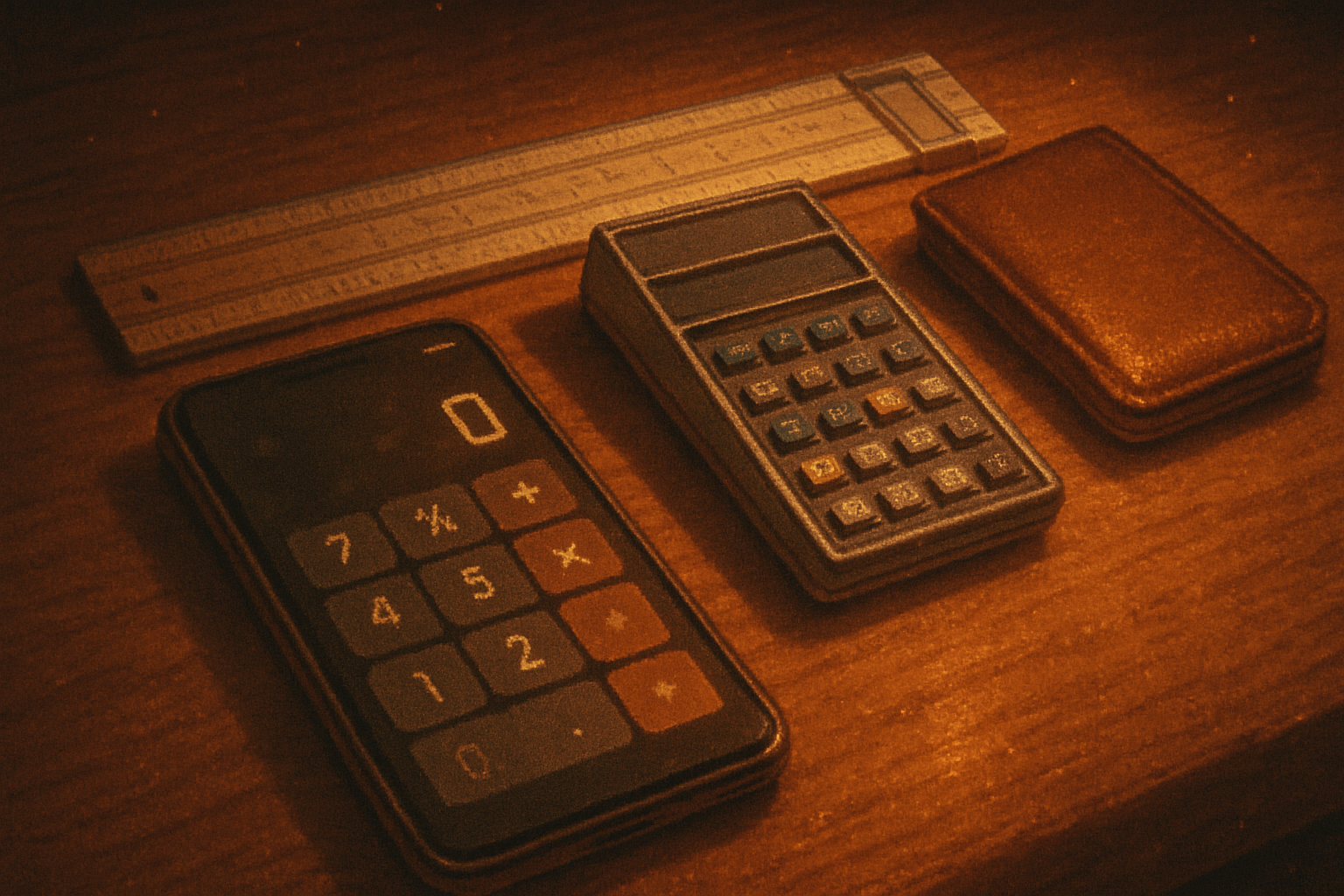
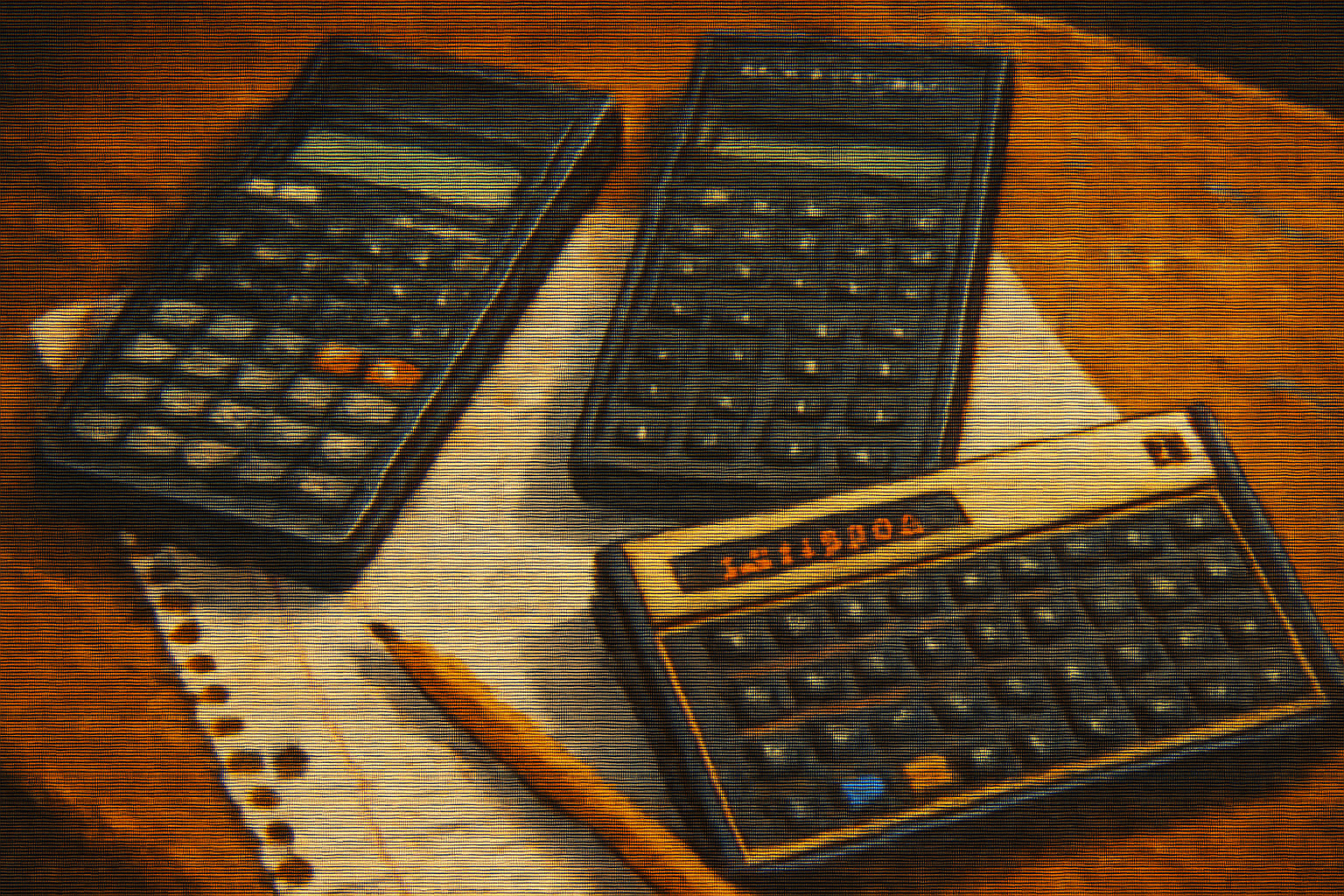
I can still hear it: the small, ferocious click of an HP-12C as my neighbor-an actuary with the calm of a man who had outlived several paradigms-ran cash-flow calculations in under ten keypresses. The keys were tiny, the leather case smelled faintly of old coffee, and the machine was unforgiving. It demanded you learn its language. It rewarded memory and procedure.
We are nostalgic for that sound because it marks a moment when calculation was a craft. Today the craft has migrated into a glass rectangle that also orders dinner and broadcasts your mood to the planet. That migration was not inevitable. It was built, step by step, on a chain of tools: the graduated stick, the slide rule, the LED-clacking calculators of the 1970s, and a century of engineering assumptions about what a calculation tool should be.
This essay traces that chain. It asks: how did pocket calculators pave the way for smartphones? Which features made the leap, which got repurposed, and which quietly died? And, finally, what did we lose when our calculators became just another app?
A short genealogy: ruler → slide rule → pocket calculator → smartphone
- The ruler - civilization’s earliest direct computational aid. Not arithmetic, but measurement and simple proportional reasoning. The idea of externalizing a part of thought with an object begins here.
- The slide rule - born of Napier’s logarithms and perfected over the 17th–18th centuries, it turned multiplication and division into addition and subtraction of lengths. The slide rule is calculation as craft-fast, analog, continuous, and unforgiving of sloppy framing. Read its concise history at the
- The pocket calculator - silicon, cheap displays, and integrated circuits compressed complex operations into a handful of buttons. The HP-35 (1972) is often called the first true pocket scientific calculator; it collapsed months of training into a portable, deterministic device. See Hewlett-Packard’s historical notes on the HP-35 and the evolution of handheld calculators at the
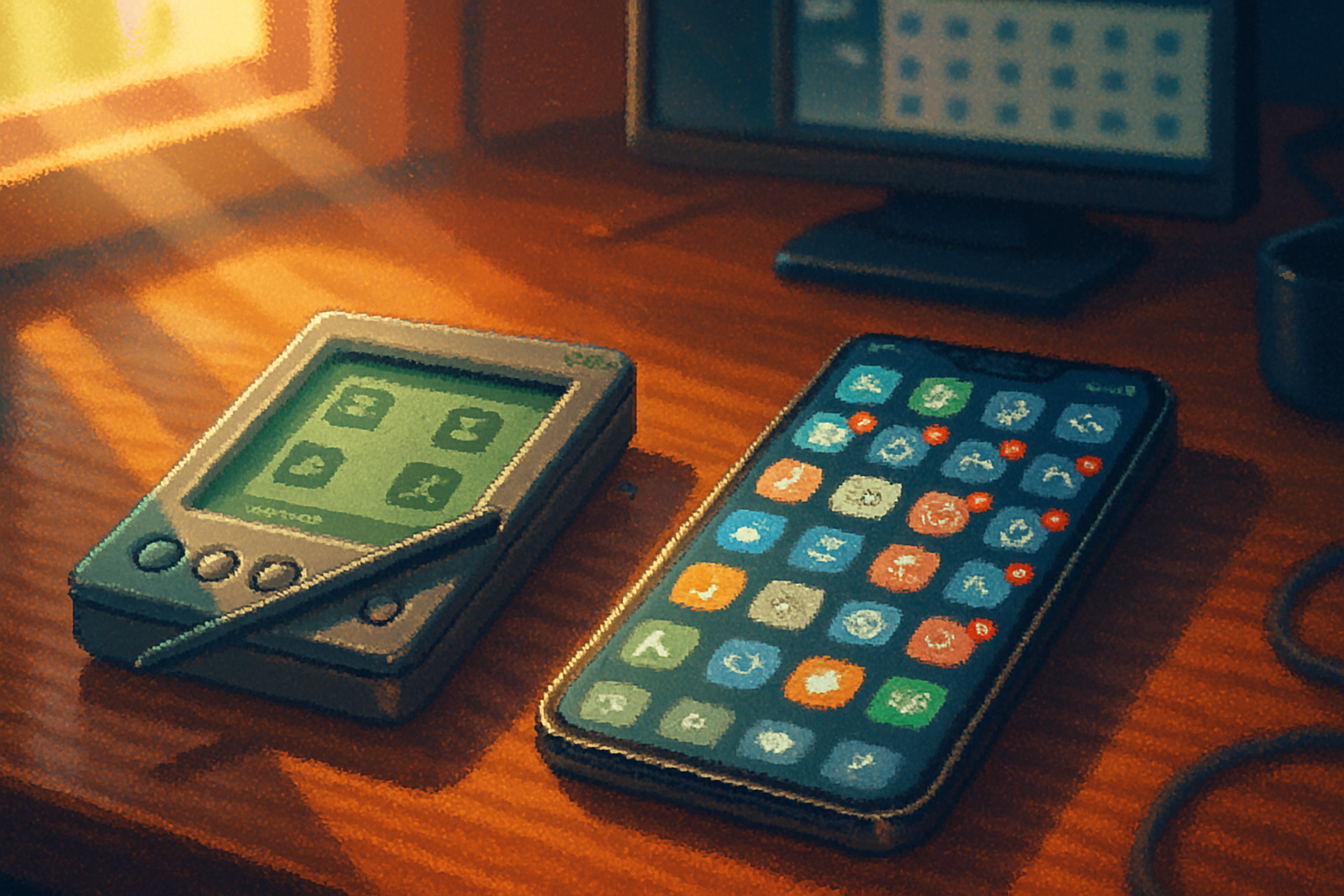
- The smartphone - a general-purpose computing platform with a capacitive touchscreen, ubiquitous connectivity, sensors, and an app economy. The iPhone (2007) pivoted phones into platforms; the calculator became one of many apps. Apple’s announcement and the subsequent ecosystem shift are chronicled in numerous retrospectives, including
Each transition changed the relationship between user and calculation: from tactile craft to algorithmic black box to ambient, networked utility.
What pocket calculators pioneered (and why that mattered)
Portability and standardization
Calculators compressed a lot of mechanical and cognitive work into a predictable, portable box. You could take a consistent computational grammar anywhere-lecture halls, construction sites, airplane cockpits.
Encoded procedures and discoverable interfaces
Devices like the HP-41 or the TI-59 didn’t just compute; they embodied procedural thinking: register management, RPN (reverse Polish notation), programmability. They trained users to think in concise, repeatable steps.
Reliability and determinism
A calculator gave one right answer (within numeric limitations). That made it a tool for verification in science and finance. It allowed specialization: you could outsource many mental loads to a deterministic device.
Democratization of complex operations
Integrals, trig tables, logarithms-once the province of slide rules and logarithm books-were suddenly available to anyone with pocket change. That widened access to STEM work and to everyday numeracy.
These innovations created mental habits-procedural thinking, careful framing of problems, and a muscle memory for numeric work-that would shape early computing culture.
Which calculator features survived the leap to smartphones?
- Portability - obviously. The calculator became an app, accessible without another object.
- Ubiquity - calculators on phones are always with you, integrated into search, widgets, and assistants.
- More functions - computational power exploded. Numerical limits that once required specialized instruments became trivial.
- Standardized UI patterns - digits, operators, memory keys-translated to touchable icons and gestures.
But survival was selective. The features preserved were those that fit into the smartphone’s multiuse ideology: small, generalized, network-aware, and visually oriented.
What was lost - and why it matters
Losses come in three flavors: sensory, cognitive, and social.
Sensory loss - tactility and feedback
The physical piano of calculator keys trained your fingers and attention. Haptic and mechanical feedback anchored procedural memory. Touchscreens are smoother. They can vibrate, but they rarely replicate the precise click that told you, “this step is done.” Small sensory cues become mnemonic anchors. Without them, we rely more on external confirmation.
Cognitive loss - procedural fluency and mental calculation skills
Calculators forced you to learn a grammar. To get a complex result you needed to build it out of atomic steps. That discipline trained thinking habits-planning, chunking, error-checking. When the tool becomes a black-box function (“Hey Siri, what’s 17% of 1,250?”), the user is less likely to learn the intermediate reasoning.
There is evidence that when external resources are reliably available, people offload memory and skill. The “Google effect” shows we are likelier to forget information we expect to be accessible online (Sparrow, Liu & Wegner, Science, 2011). Calculators and phones extend that effect to numeracy.
Social loss - apprenticeship and craft
Using an HP-35 or a slide rule in a classroom was visible practice. You learned from watching someone’s fingers, from shared rituals. The silent, invisible calculator app reduces opportunities for mentorship and public demonstration of competence.
Repairability and lifespan
Classic calculators were often kept for decades-mechanically simple, easy to conserve. Modern phones age fast; calculators as durable single-purpose devices are rare. We lost the idea of a tool designed to outlast fashion.
Attention and context switching
The smartphone erases the clarity of purpose. A calculator on a phone competes with notifications, feeds, and context switches. Calculation used to be an activity. On phones, it is a background function you call up between looking at your messages and doomscrolling.
A nuanced trade-off: gains that justify losses (sometimes)
Let’s be fair: many losses are offset by enormous gains.
- Accessibility. A phone’s calculator is instantly available to billions. Complex functions are only a download away.
- Integration. Results can be pasted into spreadsheets, shared, backed up, and checked by cloud services. That changes workflows for the better in many contexts.
- Education tools. Apps can visualize, animate steps, and provide interactive learning-something a pocket calculator could never do.
These are not small wins. But they come with behavioral side effects. When tools become too helpful, they change what we feel compelled to learn.
The civic dimension: who benefits when calculation vanishes into the cloud?
There’s a political economy to computational design. Dedicated, durable calculators supported decentralized competence: anyone could learn and keep the device. The smartphone consolidates power: you rely on platforms for updates, for app availability, for the integrity of results.
Consider algorithmic opacity. Many modern calculation tools incorporate numerical methods and heuristics that are invisible to users. Should a tax calculator on a platform be open about its assumptions? When we move computation into proprietary systems, we outsource not only memory but critical scrutiny.
Practical takeaways: how to preserve what mattered
If you like the convenience of smartphones but miss the discipline of older tools, you can intentionally recreate valuable constraints:
- Use a dedicated pocket calculator for exams, fieldwork, or tasks where discipline helps. Treat the phone as secondary.
- Practice mental arithmetic routines-daily micro-exercises build fluency.
- Teach procedures, not just outcomes. When instructing, show the steps and the mistakes, and use devices that make the process visible.
- Choose durable tools for environments where longevity and repairability matter.
Conclusion: neither elegy nor triumphalism-just a map
Technology rarely replaces functions cleanly. It recombines them, strips some away, and grafts new ones on. The slide rule taught us the pleasure of analog craft. The calculator popularized procedural mathematics. The smartphone merged calculation with connectivity, convenience, and opacity.
We should celebrate the practical miracles-the ability to do complex computation in our pockets-and mourn the subtle losses: the craft, the tactility, the public apprenticeship, the reflexive bit of mental geometry we no longer exercise.
The question going forward is not whether we will use