· retrotech · 6 min read
Battle of the Browsers: What Internet Explorer Teaches Us About Loyalty in Tech
Internet Explorer was once the default, the comfortable choice, and - for many corporate users - the only choice. Its slow decline holds lessons about habit, lock-in, and the difference between coerced loyalty and earned loyalty in today’s fast-moving tech landscape.
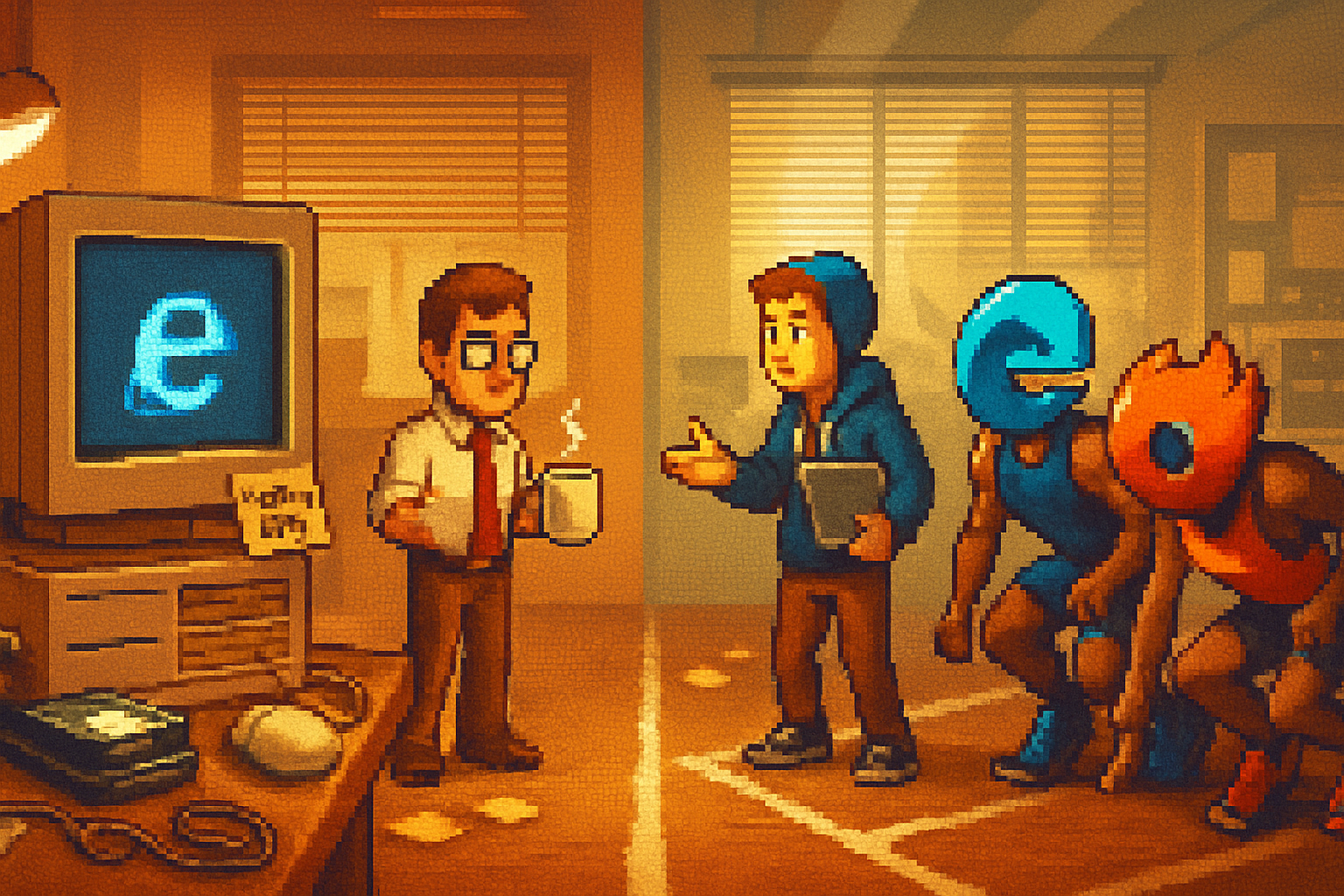
A few years ago I watched a mid-level accountant named Jerry refuse to touch anything but the blue “e” on his desktop. The company had a bespoke expense system built for Internet Explorer. That system worked. It was familiar. It was Jerry’s comfort blanket. When IT announced a migration to a modern browser, Jerry’s reply was not technical: “Why change? It works.”
Jerry’s resistance is the spine of this story. It explains how Internet Explorer - not the sleekest, most secure, or most popular browser today, but once the unquestioned default - dominated for years. More importantly, it reveals something every product person should know: what people call “loyalty” in tech is often something else entirely.
The rise, the dominance, and the slow unmaking
Internet Explorer (IE) arrived in the mid-1990s and, thanks to being bundled with Windows, became the browser for hundreds of millions. For a long while, market share meant default share: if Windows put IE in front of you, many people used it because it was there.
That default advantage began to crumble when alternatives provided clear reasons to switch. Google Chrome launched in 2008 and, by focusing on speed, a minimalist interface, rapid updates, and an ecosystem (syncing, extensions), it offered something people felt was worth the effort of switching. Today Chrome is the dominant browser by a large margin - the trajectory is visible in browser market statistics such as StatCounter’s global browser market share.
Microsoft eventually accepted the truth and retired Internet Explorer for most Windows versions, announcing the shift to Microsoft Edge and an end to IE’s support timeline in official communications (see Microsoft’s blog post on the decision: “The future of Internet Explorer on Windows 10 is in Microsoft Edge”). For enterprise environments that needed compatibility, Microsoft added an IE compatibility mode inside Edge rather than keeping two full browsers forever (IE mode in Microsoft Edge documentation).
IE’s fall isn’t just a nostalgia tale about an old app. It’s a primer on what “loyalty” actually is - and how brittle it can be.
What IE teaches us about loyalty (the inconvenient truths)
Default is not devotion. Many IE users weren’t actively choosing a browser; they were using the path of least resistance. Defaults paper over effort. But they don’t buy affection.
Habit masquerades as preference. People repeat behaviors that require little cognitive effort. The longer the habit, the more it feels like identity. Jerry didn’t say “I love IE”; he said “I don’t want to learn something else.”
Lock-in is sticky - and ethically grey. Enterprise software often creates real switching costs - retraining users, rewriting apps, validating security. Those costs feel like loyalty to organizations; to users they’re often plain coercion.
Value beats inertia - eventually. Chrome and later browsers gave users tangible improvements - speed, extensions, synchronization across devices. Once the perceived benefit outweighed the switch cost, users switched en masse.
Tech loyalty is context-dependent. Consumers who own iPhones can be fiercely loyal to Apple’s ecosystem because of deep integration. But loyalty evaporates when an easier or better alternative appears and migration costs are low.
Why people stay - and why they leave
Think of user loyalty as a tug-of-war between two forces: friction (the effort or cost to change) and benefit (the new value you get). If friction is high and benefit is low, users stay by inertia. If benefit overtakes friction, they leave.
Sources of friction
- Technical lock-in - legacy web apps that only run in a specific engine.
- Skills and habit - users comfortable with a UI or workflow.
- Organizational policy - IT standards and compliance requirements.
- Data and context loss fears - “Will my bookmarks, extensions, saved passwords survive?”
Sources of benefit
- Performance - faster, more reliable experiences.
- Convenience - syncing, single sign-on, cross-device continuity.
- Innovation - new features that solve real pain points.
- Social proof and ecosystems - everyone else is on the other platform.
The modern countertrend: loyalty in a high-churn world
Today’s tech ecosystem nudges users to swap platforms more frequently than in the desktop-era. App stores make distribution trivial. Cloud accounts move data between services. Social platforms offer instant network effects that can both lock you in and make you move quickly if the social graph shifts.
In short: switching costs are lower in many cases. Loyalty must be earned continually; it can’t be coerced by defaults or legacy dependencies.
Lessons for builders, product managers, and leaders
If you want real loyalty - durable and voluntary - design for it. Here are concrete steps:
Build value, not chains. Make your product worth keeping, not impossible to leave.
Reduce perceived risk in migration. Offer import tools, thorough docs, step-by-step migration wizards, and visible reassurance about data fidelity.
Communicate early and often about sunsets. Surprise drives mistrust. Microsoft’s public timeline for IE’s retirement was the right move; many companies aren’t nearly as generous.
Treat defaults responsibly. Being the default is a privilege and a moral responsibility. Defaults should promote user welfare, not vendor lock-in.
Invest in compatibility layers where needed - but don’t rely on them forever. Microsoft’s IE mode in Edge was a pragmatic way to let enterprises migrate on their schedule. It’s a transitional strategy, not a permanent excuse.
Measure loyalty as behavior plus sentiment. Track churn, but also track why people leave and what they miss when they go.
Design for portability. Make it easy for customers to take their data elsewhere. Portability is a credibility generator - companies that let people go, and do it gracefully, earn trust.
The ethical angle: when loyalty is forced, it isn’t loyalty
There is a moral distinction between a service that people keep because they love it and one they must keep because moving is too costly. The latter is more extractive than loyal. Companies should ask themselves: are we building products that people choose, or products they cannot easily escape?
This matters beyond ethics. Extractive lock-in creates fragility. It invites regulatory attention. It creates brittle ecosystems that collapse when a better option appears - and those collapses are messy.
Parting thought
Jerry eventually moved to a new browser when the company made the change unavoidable. He grumbled for a week, then forgot about it. That’s the point. Real product success is when your users stop thinking about the tool and start thinking about what they do with it.
Internet Explorer lived long because it was the default. It died because defaults aren’t a substitute for delivering clear, continuing value. If you want true loyalty in tech, earn it daily. Make people choose you for reasons that last, not because changing would be a pain.
References
- Microsoft - “The future of Internet Explorer on Windows 10 is in Microsoft Edge” -
- Microsoft Docs - IE mode in Microsoft Edge -
- StatCounter - Browser Market Share -