· culture · 7 min read
Gadgets of Tomorrow: Tech Innovations Inspired by Time Travel Stories
A tour through inventions that were once pure time-travel fantasy - from hoverboards and self-lacing sneakers to ‘pre-crime’ algorithms, AR time windows, and medical stasis. We trace the fiction-to-factory arc, show the real-world applications, and ask what it means when stories start to write hardware.
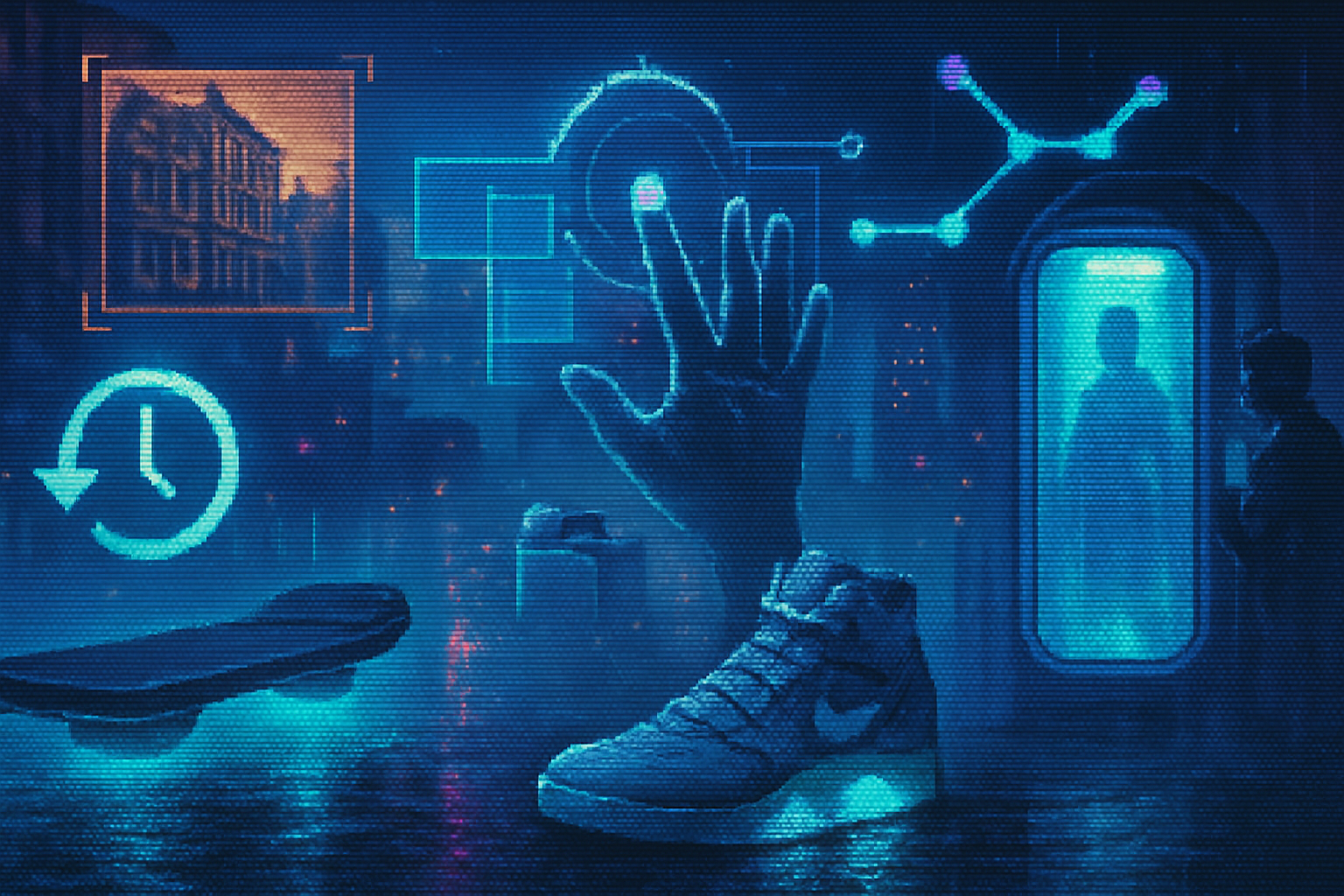
A boy in 1985 looks up at the DeLorean, heart in throat. He imagines a future in which shoes tighten themselves, boards levitate above the pavement, and the city rearranges itself based on what will happen tomorrow. That boy is every product designer, engineer, and policy wonk who ever read science fiction and mistook prophecy for a to-do list.
Stories about traveling through - or meddling with - time do more than thrill. They give form to anxieties, lay out moral thought experiments, and hand engineers a set of vivid design prompts: what would you make if you could visit the future, borrow its conveniences and bring them home?
Below: a guided museum of modern gadgets and systems that wear their time-travel lineage on their sleeves. Each entry pairs the fiction that shaped it, the real-world tech that answered the siren song, and the practical (sometimes disturbing) uses we’ve found for it.
1) Hoverboards and Self-Lacing Shoes - Back to the Future’s consumer heaven
Back to the Future II promised a slick, self-adjusting lifestyle: a skateboard that hovered above the street, shoes that laced themselves, and enough gadgetry to make a mall security guard faint. Hollywood called; engineers obliged.
- What fiction gave us - The franchise’s hoverboard and auto-lacing trainers became icons - shorthand for a future that’s playful and lightweight.
- What reality built - Several companies have produced prototypes and limited-run products. Lexus demonstrated a working magnetic levitation “hoverboard” prototype in 2015 that relies on superconductors and liquid nitrogen cooling [
- Real-world use - Beyond cosplay, self-lacing tech addresses accessibility (auto-fit prosthetics, shoes for limited-mobility users). Hoverboard tech-magnetic levitation and advanced bearings-filters into industrial transport and low-friction material handling rather than children’s play.
Takeaway: Not every prop becomes a consumer product; many become engineering constraints refined into industrial tools.
2) “Pre-crime” and Predictive Analytics - Minority Report’s moral throb
Steven Spielberg’s gleaming interrogation of preemptive justice left a single, sharp imprint on technologists: a hunger to predict and prevent events before they happen.
- What fiction gave us - Pre-crime - arrest based on predicted intent - complete with gesture-driven interfaces and panoramic surveillance.
- What reality built - Gesture-based UIs inspired by the movie’s visuals influenced research labs and companies exploring natural interactions (Oblong/John Underkoffler’s work on spatial computing being an explicit descendant) [
- Real-world use and risks - Predictive analytics help allocate resources (firefighters, ambulances, maintenance crews). But when used for policing, such systems can replicate biased histories and entrench over-policing in marginalized communities - the ethical paradox Minority Report dramatizes in a very human register.
Takeaway: The appeal of averting harm is irresistible; the temptation to do so without safeguards is where fiction becomes a nightmare.
3) Time Travel as Backup - Apple’s Time Machine & version control
If you could travel in time to fix a mistake, why not give users a way to do the digital equivalent? Time-travel metaphors migrated neatly into software tools.
- What fiction gave us - The elegant idea that you could step sideways in time and correct course.
- What reality built - Apple’s Time Machine provides versions and snapshots of a Mac’s filesystem so users can “go back” to a previous state [
- Real-world use - These are the most practical time machines we have: they prevent catastrophe, save careers, and make experimentation safe.
Takeaway: The only time travel most of us will ever master is the one that recovers deleted work.
4) Suspended animation, torpor and medical stasis - frozen scenes of fiction turned clinical research
Time travel stories often use suspended animation to bridge long distances or pause a body until a better cure exists. Scientists are treating the idea less like magic and more like medicine.
- What fiction gave us - Stasis pods, cryosleep, and narrative permission to postpone difficult outcomes.
- What reality built - Research into induced torpor and therapeutic hypothermia aims to slow metabolism for trauma care and long-duration spaceflight. NASA and other agencies study hibernation-like states to reduce resource needs on deep-space missions [
- Real-world use - Induced hypothermia is already a tool in emergency medicine (reducing metabolic rate after cardiac arrest). Therapies that nail down safe, reversible torpor could revolutionize trauma care, organ transport, and even space travel.
Takeaway: The stasis fantasy has become a field of incremental but profoundly useful interventions.
5) Time windows: AR, historical overlays and ‘visiting’ the past
If time travel can’t physically move you, it can move your perception. Augmented reality lets us peer back into the same place at a different date.
- What fiction gave us - Time portals and devices that overlay different eras onto a present scene.
- What reality built - Google Earth Timelapse stitches satellite imagery across decades so you can watch cities grow [
- Real-world use - Tourism, education, and urban planning. These tools make history visceral and help planners visualize past land use when assessing restoration or development.
Takeaway: You can’t physically change the past, but you can scaffold empathy for it.
6) Immutable ledgers and the ‘no-tampering’ fantasy - blockchain as anti-time-travel
Many time-travel stories hinge on the possibility of changing history. For engineers worried about malfeasance, the solution is stubborn: make records that do not admit tampering.
- What fiction gave us - The dread and drama of a reality re-written.
- What reality built - Blockchain and distributed ledgers are designed to make transactions and records effectively immutable, so retroactive rewriting is prohibitively difficult. They’re a technical countermeasure to the problem time-travel stories make vivid.
- Real-world use - Supply chain provenance, voting experiments, tamper-resistant records for finance and law. The technology trades flexibility for auditability.
Takeaway: If you can’t zap the past, you can at least guard the ledger about it.
Ethics, design lessons and what the future borrows from fiction
Fiction doesn’t merely predict gadgets. It sculpts desire, surfaces trade-offs, and forces us to ask: who benefits from traveling (or claiming to travel) through time?
- Stories give engineers moral prompts. Minority Report made us ask whether preventing harm justifies preemptive action; H.G. Wells asked who owns the future.
- Designers often skip the ethics chapter. The seduction of a brilliant solution (predictive policing, say) is to overlook structural bias baked into data.
- Useful technology pairs imagination with governance. If a tool can predict accidents, we must ask who is accountable for false positives and what due process looks like.
What to watch next - five trends worth betting on
- Practical torpor and organ vitrification - moving from lab demos to clinical protocols.
- More sophisticated “time-window” AR for places and events - tourism will be an early adopter.
- Gesture and spatial UIs migrating into collaborative workspaces (not glass-clad surveillance hubs).
- Broader adoption of immutable audit trails for public records, with real legal and logistical wrinkles.
- Responsible predictive systems combined with transparent redress mechanisms - or else a surge of public pushback.
Final reckoning: What time-travel stories give us
Time-travel narratives do what good thought experiments do: they compress consequences into a single image. They let us live through the ethical and social shocks of a technology before anyone writes the spec.
Sometimes, engineers translate the image into hardware. Sometimes, they salvage an idea and rebuild it as something else entirely (a hoverboard becomes a magnetic bearing for factories; pre-crime becomes logistics forecasting). The most interesting inventions aren’t those that exactly reproduce the prop, but those that inherit the story’s moral question.
If you want tomorrow’s gadgets, read a good time-travel story today. It will save you money on regrets.
References
- Lexus creates real-life hoverboard (press release): https://news.lexus.co.uk/2015/08/06/lexus-creates-real-life-hoverboard/
- Nike Adapt / self-lacing coverage: https://www.theverge.com/2019/2/6/18214618/nike-adapt-bb-self-lacing-shoes-release
- Oblong / John Underkoffler (spatial computing & Minority Report lineage): https://oblong.com/
- Predictive policing and its controversies: https://www.nytimes.com/2016/07/10/us/police-use-predictive-policing-software.html
- Apple Time Machine support: https://support.apple.com/en-us/HT201250
- Git - version control and “time travel” for code: https://git-scm.com/book/en/v2/Getting-Started-About-Version-Control
- Google Earth Timelapse: https://earthengine.google.com/timelapse/
- TimeLooper (AR/VR historical experiences): https://timelooper.co/
- NASA on hibernation/torpor research for spaceflight: https://www.nasa.gov/feature/what-is-hibernation-and-how-could-it-help-human-spaceflight