· retrotech · 7 min read
8-Bit Revolution: The Impact of VIC-20 on Modern Game Design
How a $300 plastic keyboard and 5KB of RAM forced elegant design, seeded an ethic of accessibility, and still whispers in the ears of modern indies. From PICO-8 jams to Celeste's origins, the VIC-20's constraints shape today's aesthetics, UX, and development practices.
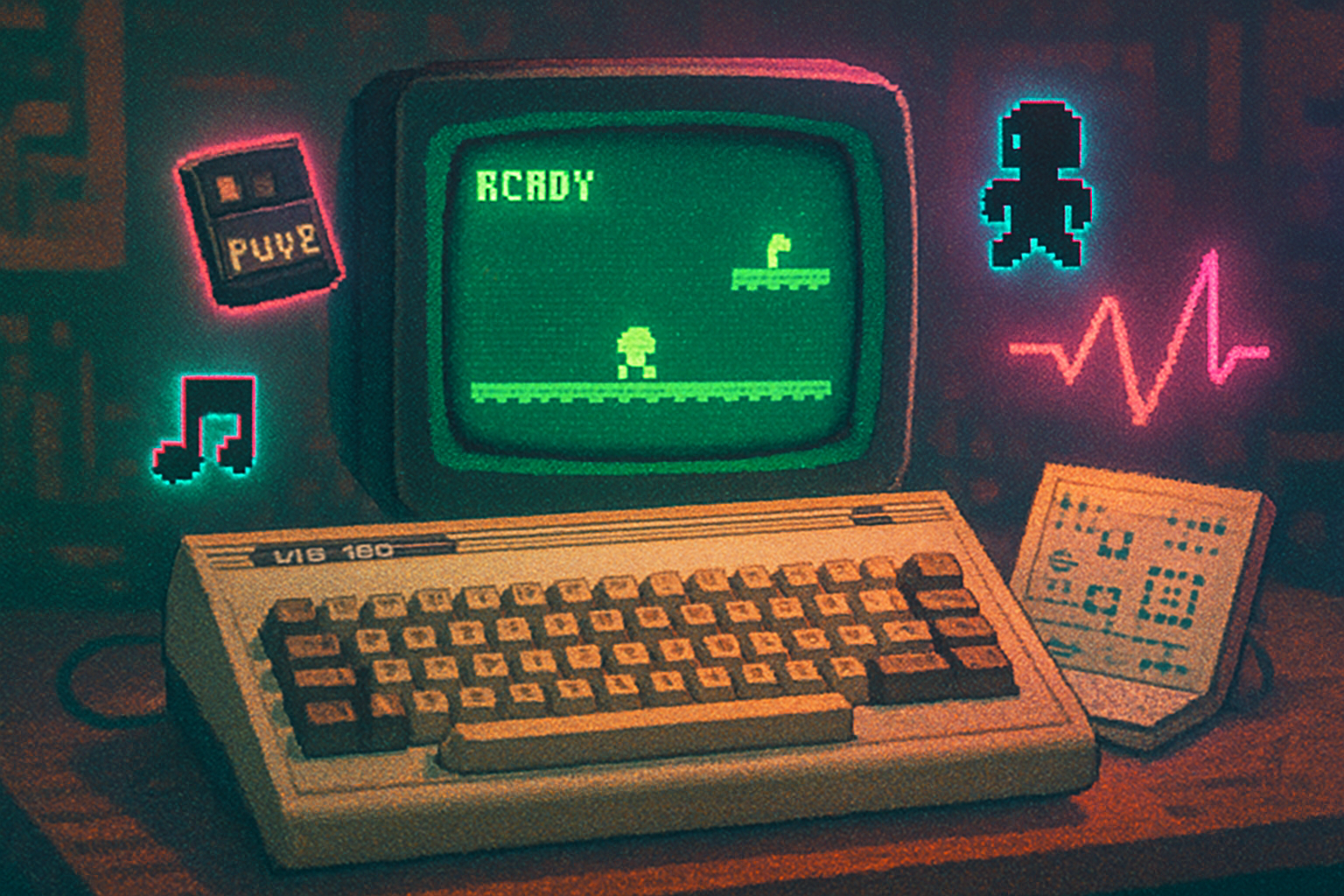
The first time I saw a VIC-20 boot, it felt like watching someone whisper a secret into a universe that hadn’t learned how to shout back yet. A black screen. BASIC ready. A blinking cursor like a throat clearing: READY.
That blinking cursor mattered. You either typed, waited, and learned - or you turned the plug back in. The machine did not want you to be passive. It insisted you be precise, creative, and economical.
This essay is about that insistence: how the humble Commodore VIC-20 - a mass-market, low-cost 8‑bit home computer released in 1980 - still shapes the aesthetics, interfaces, and cultural habits of modern game design. The VIC didn’t merely force developers to make do with less; it taught design how to be ruthless and humane at once.
Why the VIC-20 matters (more than nostalgia would like to admit)
The VIC-20 was not the most powerful machine. It sold on being affordable, cheap to manufacture, and friendly to beginners. That combination created a set of design constraints that became recipes for good design in general:
- Severe memory and graphical limits (typically 5KB of RAM inbase) forced minimalism and clarity. You only had so many bytes to say something with.
- A keyboard-first interface and an accessible BASIC interpreter made programming visible and immediate to users.
- A thriving community traded programs in magazines, on cassette, or by swapping tapes - the machine encouraged tinkering and sharing.
Read the technical details here: Commodore VIC-20 - Wikipedia. For the language that made it all breathable, see Commodore BASIC - Wikipedia.
These structural facts are boring on paper, but they became a practical ethos in people building, playing, and teaching games.
Design philosophies born from scarcity (and why they still matter)
If the VIC-20 taught one lesson, it is: constraints are a design tool, not a punishment. From that flows several durable principles:
- Embrace the economy of expression - fewer pixels, clearer silhouette. Low-res forces iconic character design. When you have a single block to convey a sword, you design the sword that reads instantly.
- Immediate feedback loop - type it, run it, see it. The edit–run–modify cycle made learning fast and failure cheap.
- Make the machine teach you - a visible, editable program fosters literacy. Players become creators.
- Design for discoverability - no complex menus; affordances must be obvious because there’s no room for hand-holding.
- Shareability and remix - the cassette, magazine listings, and early BBS culture normalized user modification and distribution.
Modern indie games and tools adopt these in spirit if not in literal hardware.
From VIC-20 to PICO-8: fantasy consoles as cultural descendants
If you trace a line from the VIC-20 to today, you hit the fantasy-console movement. Tools like PICO-8 intentionally recreate the constraints of old hardware (limited color palettes, low resolutions, tiny cartridge-size limits). They are explicit homages - spiritual successors that compress the creative rules into a friendly package.
The result: rapid prototyping, tiny jams, and a community that prizes constraint-driven craft. PICO-8 games are not just nostalgic artifacts; they teach a design discipline mirroring the VIC-20’s lessons: clarity of intent, elegant systems that fit small budgets, and an emphasis on shareable source.
Case study: Celeste Classic (the PICO-8 origin story)
Before Celeste became a multi-platform hit in 2018, its ancestor was a 32‑screen, PICO-8-made prototype called Celeste Classic. Maddy Thorson and Noel Berry proved that a tight, punishing mechanics-first platformer could be conceived in a constrained environment and then expanded.
Polygon covers Celeste’s roots and the surprising robustness of a tiny prototype: How Celeste grew from a 32-screen PICO-8 game to an acclaimed platformer.
Lessons:
- Constraints force mechanical purity. The core hook (precise movement and forgiveness via short levels/checkpoints) was distilled in a tiny sandbox before being elaborated.
- A minimal prototype proves systems quickly; expansion is less risky when the nucleus works.
This is classic VIC logic: make the core tight, then surround it with polish.
Case study: Downwell and the elegance of a single mechanic
Ojiro Fumoto’s Downwell (2015) is not an 8‑bit port, but it channels the same constraint-driven mindset: one dominant mechanic (gunboots), a narrow color palette, and strict level design that emphasizes skill. The visual and mechanical minimalism feel like design filtered through a retro lens - an ethos the VIC-20 cultivated out of necessity.
Indies like this remind us that constraints produce identity. When you can name the single interesting thing a game does, every other design decision should illuminate that thing rather than compete with it.
UI lessons borrowed from early home computers
The VIC-20 era promoted interfaces that: show the machine’s state, make actions reversible or instantly visible, and prefer text when pixels would confuse. Several modern trends echo this:
- Interface-as-mechanic - games that use windows, terminals, or command-line-like controls turn the UI into gameplay (e.g., interactive fiction, ’90s-hacker simulators, or titles like Her Story whose interface
- Minimal HUDs - because early systems couldn’t clutter the screen with overlays, modern designers often strip HUDs to improve readability and immersion.
- Teach by doing - short, integrated tutorials that expose systems like early BASIC listings exposed code.
The VIC’s blinking prompt is a brutal UX teacher: it demands action but can be forgiving. Modern designers copy that rhythm: minimal friction to try something; immediate, legible feedback.
Chiptune and the aesthetics of limitation
The sonic side of 8‑bit hardware created chiptune conventions that persist in indie soundtracks. Simple waveforms, catchy loops, and economical composition make melodies memorable. See the broader movement: Chiptune - Wikipedia.
Those sounds are not just nostalgia - they’re efficient audio design. A clear, hummable lead and a tight rhythmic loop are readable at a glance (or a millisecond) and never compete with gameplay.
Community, distribution, and the politics of accessibility
The VIC-20’s place in living rooms normalized games-as-code. Magazines published program listings; users typed and modified them. That culture birthed an ethics: software should be readable and remixable.
Today that manifests as:
- Community-driven jams (e.g., JS13KGames - 13KB web game jams that celebrate size limits),
- Accessible authoring tools (PICO-8, TIC-80, GB Studio),
- Indie physical releases and homebrew scenes that mimic cassette-and-cartridge exchange.
These practices are not quaint. They democratize creation, lower cost barriers, and make design iterative and social.
Where modern design betrays the VIC-20 - and why that’s sometimes fine
Not everything old is better. The VIC-20’s interfaces could be cryptic; its memory limits could force brutal compromises. Modern designers benefit from salvaging the ethic without slavishly copying the mechanic. Use constraints to sharpen focus, not as an excuse for cramped thinking.
Practical balance:
- Keep the discipline of economy, but use modern affordances (tooltips, accessibility options) to reduce unnecessary friction.
- Prefer clarity over strict retro authenticity when accessibility or comprehension is at stake.
A short, mordant design checklist - what the VIC would tell you if it could blink an LED
- Can the core mechanic be explained in one sentence? If not, simplify.
- Does every pixel or byte support that mechanic? Remove cruft.
- Is the feedback immediate and visible? Fix latency.
- Is the UI legible without a manual? If not, make it so.
- Are you fostering remixability and learnability? Publish a readable prototype.
Be brutal. Constraints are generosity in disguise.
Closing: constraints as a creative dialect
The VIC-20 did something modern design schools still forget: it made constraints conversational. A blinking cursor isn’t a barrier; it’s the system saying, “Try me.” That posture - an invitation to poke, to break, to learn - is the real legacy.
If you play a clean indie platformer, admire a terse pixel sprite, or jam in a 13KB contest, you are hearing the VIC’s echo. The games industry has grown fluent in abundance; every so often it needs a dialect of scarcity to remember what clarity feels like.
If you want to design better games, give yourself a VIC-20’s worth of constraints, and watch how your ideas get sharpened rather than stamped out.
References
- Commodore VIC-20 - Wikipedia: https://en.wikipedia.org/wiki/Commodore_VIC-20
- Commodore BASIC - Wikipedia: https://en.wikipedia.org/wiki/Commodore_BASIC
- PICO-8 (fantasy console): https://www.lexaloffle.com/pico-8.php
- How Celeste grew from a 32‑screen PICO-8 game - Polygon: https://www.polygon.com/2018/1/16/16897210/celeste-maddy-thorson-interview
- Chiptune - Wikipedia: https://en.wikipedia.org/wiki/Chiptune
- JS13KGames - 13KB web game jam: https://js13kgames.com/